Facts
The appellant was convicted by the Special Sessions Judge and the High Court of Telangana for the murder of Shiva Shankar under Sections 302 and 323 of the IPC, and Sections 3(2)(v) and 3(1)(x) of the SC/ST Act.
Source reference: p. 2The prosecution alleged that on May 12, 2013, the appellant attacked the deceased with a stone due to a grudge regarding the deceased eloping with the appellant's sister three months prior.
Source reference: p. 3The prosecution relied on the testimony of the deceased’s mother (PW1) and a friend (PW3), claiming PW3 informed PW1 of the attack.
Source reference: p. 4, 7PW3 turned hostile, denying he ever informed PW1.
Source reference: p. 10Independent witnesses (PW4 and PW5) denied that a village Panchayat ever took place regarding the elopement.
Source reference: p. 11The appellant challenged the concurrent findings based on discrepancies in medical evidence and the unreliability of "interested" witnesses.
Source reference: p. 17-19Issues
1. Whether the ocular evidence provided by a related/interested witness (PW1) is sufficient for conviction when contradicted by hostile witnesses and surrounding circumstances?
Source reference: p. 17 / para. 7.42. Whether the testimony of a hostile witness can be utilized by the court for the purpose of acquitting the accused?
Source reference: p. 24 / para. 93. Whether the conviction is sustainable given significant, unexplained discrepancies in the medical (Postmortem) reports and the timeline of death?
Source reference: p. 14 / para. 5.2.2Law Applied
The Court primarily applied Section 302 (Murder) and Section 323 of the IPC, alongside Sections 3(1)(x) and 3(2)(v) of the SC/ST Act.
Source reference: p. 2Regarding evidence, the Court relied on Masalti v. State of U.P. and Bhaskarrao v. State of Maharashtra, which mandate cautious weighing of "interested" witnesses’ testimony to avoid distorted truth.
Source reference: p. 20, 21For medical evidence, it cited Ghulam Hassan Beigh v. Mohammad Maqbool Magrey, establishing that a postmortem report is not substantive evidence and must be corroborated by the doctor’s testimony.
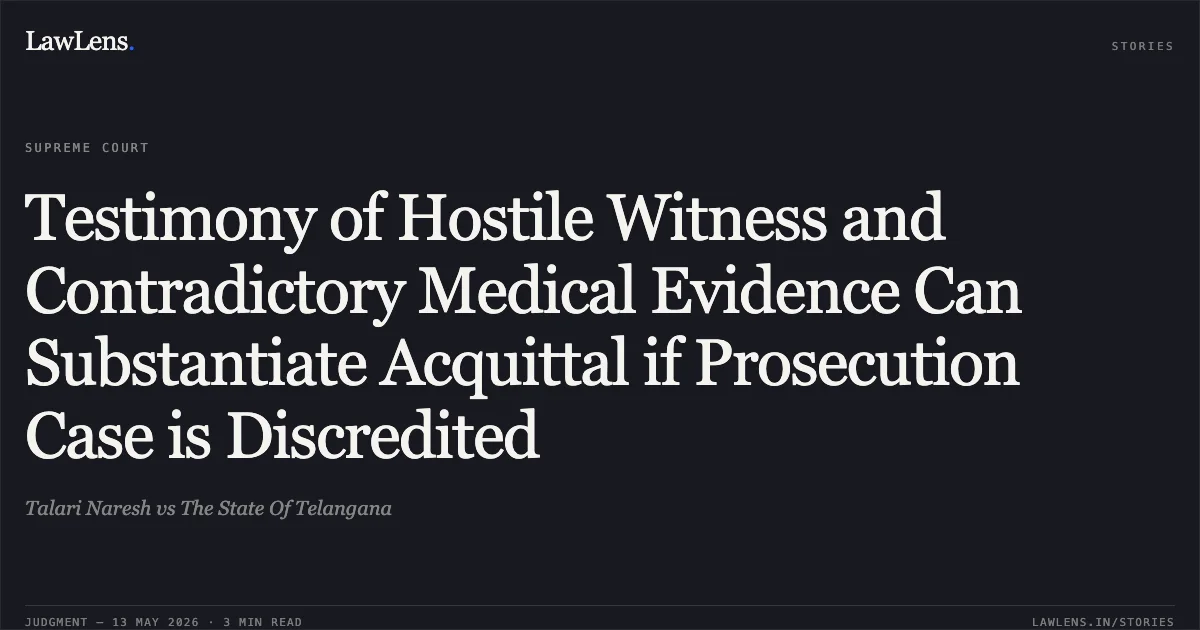
Source reference: p. 15Relying on Khujji @ Surendra Tiwari v. State of M.P. and Himanshu alias Chintu v. State (NCT of Delhi), the Court held that while hostile testimony can support a conviction if corroborated, it can also be used to discredit the prosecution's case.
Source reference: p. 22-24Reasoning
The court noted that the "genesis" of the crime—the village Panchayat—was debunked by the hostile testimonies of PW4 and PW5.
Source reference: para. 7.3The "eyewitness" link between PW1 and PW3 was severed when PW3 denied informing PW1 about the incident, leaving PW1’s testimony as an uncorroborated "interested" witness account.
Source reference: para. 7.2, 8.2The Court emphasized that since the incident occurred on a busy public road, the failure to examine independent witnesses created significant doubt.
Source reference: para. 7.1Regarding medical evidence, the Court identified "irreconcilable" discrepancies: the Inquest Report (Ex. P7) and Postmortem Report (Ex. P8) showed different dates and times for the autopsy, which the medical officer (PW7) failed to explain adequately.
Source reference: para. 5.2.2, 5.2.3Consequently, the Court held that the testimony of hostile witnesses provided credible grounds to discredit the prosecution’s narrative.
Source reference: para. 9Holding
The Supreme Court allowed the appeal and set aside the judgments of the High Court and Trial Court.
The Court held that the prosecution failed to prove the occurrence of the incident, the motive, or the medical veracity of the injuries beyond a reasonable doubt.
Source reference: para. 10The Court ruled that the testimony of a hostile witness could be properly employed to acquit an accused if it inspires credibility when read with other evidence.
Source reference: para. 9The appellant was acquitted of all charges under the IPC and the SC/ST Act and ordered to be set at liberty forthwith.
Source reference: para. 10.4Acts & Sections Cited
5 provisions across 3 statutes referred to in this judgment. Each provision opens on LawLens.
Indian Penal Code, 18603
Scheduled Castes and the Scheduled Tribes (Prevention of Atrocities) Act, 19891
Code of Criminal Procedure, 19731
Original Court PDF
Talari NareshvsThe State Of Telangana
Click to open original judgment
Original judgment, available to read, download and summarize on LawLens.in