Facts
The petitioners, a legally wedded couple for over 17 years, were unable to conceive naturally and underwent multiple unsuccessful IVF procedures
Source reference: para. 5On July 18, 2015, the petitioners successfully preserved three embryos
Source reference: para. 7However, following the enforcement of the Surrogacy (Regulation) Act, 2021, on January 25, 2022, they were barred from proceeding with surrogacy because Petitioner No. 1 (the wife) exceeded the upper age limit of 50 years prescribed under the Act
Source reference: para. 6The petitioners approached the High Court seeking a waiver of this age limitation to exercise their reproductive rights
Source reference: para. 4Issues
1. Whether the age restrictions imposed by Section 4(iii)(v)(c)(I) of the Surrogacy (Regulation) Act, 2021, apply retrospectively to "intending couples" who had already frozen embryos prior to the Act’s commencement
Source reference: para. 8, 102. Whether the rigid application of age limits under the Surrogacy Act infringes upon the fundamental right to reproductive autonomy under Article 21 of the Constitution of India
Source reference: para. 9Law Applied
Section 4(iii)(v)(c)(I) of the Surrogacy (Regulation) Act, 2021, which sets the eligibility age for males at 26–55 years and females at 23–50 years
Source reference: para. 6Supreme Court precedents in Vijaya Kumari S & another v. Union of India (2025) and Arun Muthuvel v. Union of India (2024), which established that the creation and freezing of embryos constitute the "crystallization" of the surrogacy process, and therefore, new age barriers cannot be applied retrospectively to frustrate the constitutional right to parenthood under Article 21 of the Constitution
Source reference: para. 8, 9Reasoning
The court reasoned that the surrogacy process for the petitioners "commenced" when they extracted gametes and froze embryos in 2015, long before the 2021 Act came into force
Source reference: para. 7, 8Following the logic in Vijaya Kumari, the court noted that since the petitioners had taken bona fide steps and manifested their intention to achieve parenthood when no age restriction existed, the subsequent statutory age bar could not be applied to them
Source reference: para. 8The court emphasized that reproductive autonomy is a facet of personal liberty under Article 21, and a rigid, retrospective application of the law would unjustly strip the petitioners of their only remaining path to biological parenthood
Source reference: para. 9, 10Holding
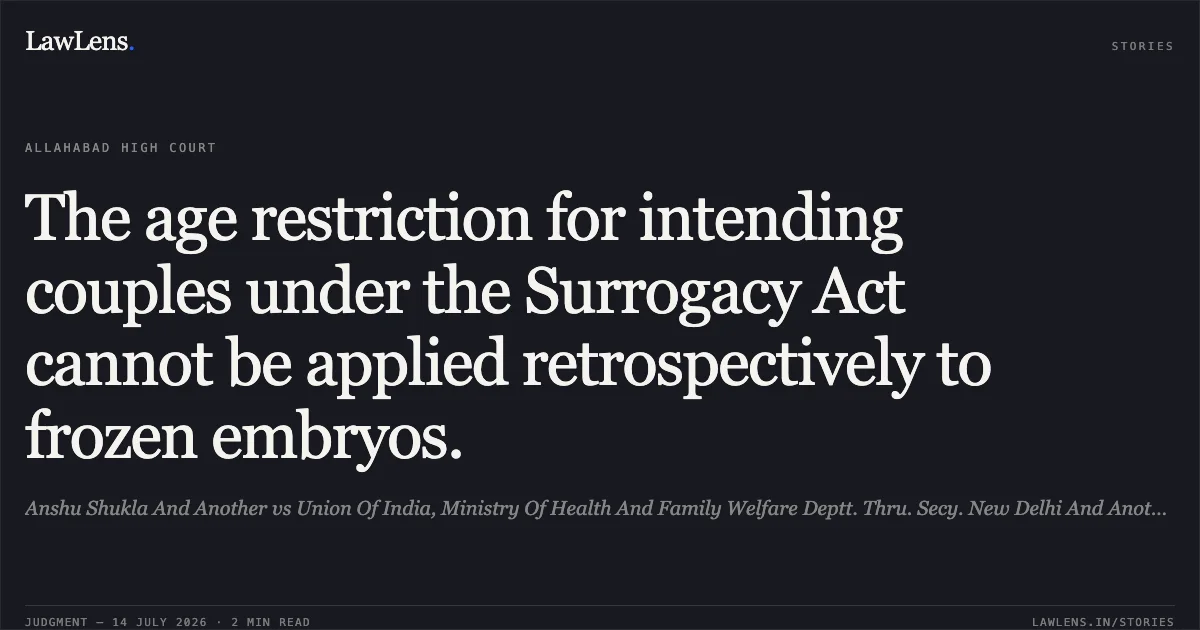
The Court held that back-dating age restrictions to couples who started the process prior to the Act is impermissible. It ruled that Section 4(iii)(v)(c)(I) of the Surrogacy Act is not applicable to the petitioners
The Court granted the petitioners permission to proceed with the surrogacy process and directed the Chief Medical Officer, Lucknow, to process their application under Section 35 of the Act within three weeks, passing a reasoned order in line with Supreme Court guidelines
Source reference: para. 11, 12Acts & Sections Cited
3 provisions across 1 statute referred to in this judgment. Each provision opens on LawLens.
Surrogacy (Regulation) Act, 20213
Original Court PDF
Anshu Shukla And AnothervsUnion Of India, Ministry Of Health And Family Welfare Deptt. Thru. Secy. New Delhi And Another
Click to open original judgment
Original judgment, available to read, download and summarize on LawLens.in