Facts
The National Highways Authority of India (NHAI) acquired lands belonging to the respondents for a four-lane project at Devagiri-Yellapur village
Source reference: p. 4, para 3Dissatisfied with the compensation awarded by the competent authority, the landowners initiated arbitration. The Arbitrator enhanced the compensation to ₹346 per sq. ft.
Source reference: p. 5, para 3NHAI challenged these awards under Section 34 of the Arbitration and Conciliation Act, 1996, before the Principal District and Sessions Judge, Haveri. On May 22, 2023, the Trial Court initially confirmed the Arbitrator’s awards
Source reference: p. 5, para 3However, the landowners subsequently filed Review Petitions, leading the Trial Court to modify the Arbitrator's award on January 30/31, 2024
Source reference: p. 5-6, paras 3, 5NHAI appealed these modifications under Section 37 of the Act.
Source reference: no citationIssues
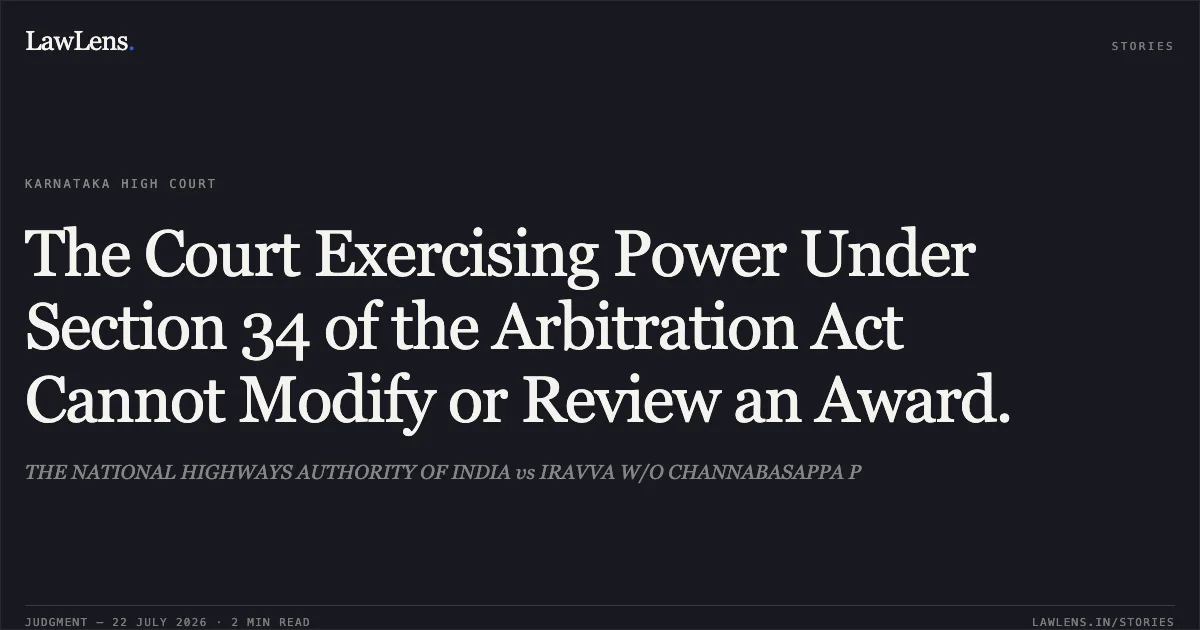
1. Whether a Court exercising jurisdiction under Section 34 of the Arbitration and Conciliation Act, 1996, has the power to modify or revise an arbitral award
Source reference: p. 6, para 52. Whether the Trial Court can review and modify its own judgment passed in a Section 34 petition to alter the compensation rate
Source reference: p. 14, para 14Law Applied
Section 34 of the Arbitration and Conciliation Act, 1996, which limits judicial interference to setting aside an award or remanding the matter, rather than modifying it on merits
Source reference: p. 7, para 6Supreme Court precedent in Project Director, NHAI v. M. Hakeem, which established that Section 34 does not empower courts to "modify, revise or vary" an award
Source reference: p. 7, para 6; p. 10, para 9Principles from Gayathri Balaswamy v. M/s ISG Novasoft Technologies Ltd., noting that Section 151 of the CPC cannot be used to circumvent Section 34’s limitations
Source reference: p. 13, para 13S.V. Samudram v. State of Karnataka, which characterized modification of an award as "crossing the Lakshman Rekha"
Source reference: p. 12, para 11Reasoning
The High Court observed that the Trial Court exceeded its statutory mandate by modifying the Arbitrator's award through a review petition
Source reference: p. 14, para 14Applying the M. Hakeem doctrine, the Court reasoned that the 1996 Act—unlike the 1940 Act—was designed to minimize judicial intervention; therefore, a judge cannot "put himself in the shoes of Parliament" to read a power of modification into Section 34 that was explicitly omitted
Source reference: p. 10-11, para 9The court noted that while clerical or typographical errors may be corrected, any substantive change to the compensation rate constitutes an impermissible modification
Source reference: p. 8, para 7Since the Trial Court moved beyond confirming or setting aside the award to actively altering the quantum of compensation, its judgment was found to be patently illegal and in violation of the fundamental policy of Indian law
Source reference: p. 9-10, para 8-10Holding
The District Court lacks the jurisdiction to modify an arbitral award under Section 34 and has no power to review its own judgment for the purpose of such modification
The High Court set aside the impugned revised judgments dated January 30/31, 2024, and remanded the matters back to the Trial Court for fresh consideration in accordance with the law
Source reference: p. 14-15, para 15Acts & Sections Cited
3 provisions across 2 statutes referred to in this judgment. Each provision opens on LawLens.
Arbitration and Conciliation Act, 19962
Code of Civil Procedure, 19081
Original Court PDF
THE NATIONAL HIGHWAYS AUTHORITY OF INDIAvsIRAVVA W/O CHANNABASAPPA P
Click to open original judgment
Original judgment, available to read, download and summarize on LawLens.in