Facts
The petitioner applied on 1 September 2026 for permission to hold a political rally on G.T. Road, Hooghly, on 11 September 2026 between 14:00 and 17:00 hours, with approximately 5,000 participants.
Source reference: para. 4The petitioner contended that other political organisations were regularly permitted to hold rallies on G.T. Road and that the proposed programme would keep one flank of the road open for vehicular and pedestrian movement.
Source reference: para. 4After the writ petition was filed on 7 September 2026, the Inspector-in-Charge, Serampore Police Station rejected the application on the same day.
Source reference: para. 2The police cited, inter alia, possible obstruction of access to Walsh Hospital, the location of a Fire Brigade establishment, and the presence of five schools along or near the proposed route.
Source reference: para. 7A local organisation, Rishra Shyamaprasad Seva Samity, opposed the proposed rally on the ground that G.T. Road was narrow and congested, particularly on working days.
Source reference: para. 6During the hearing, the petitioner proposed an alternative meeting at Mahesh Jagannath Dev’s Snanpiri Maidan, while the State suggested that the programme be held on Delhi Road.
Source reference: para. 10Issues
Whether the petitioner could be permitted to exercise the right to hold a political gathering under Article 19(1)(b) despite the police authorities’ refusal to permit the proposed rally on G.T. Road on grounds of public safety, traffic management, and access to essential institutions.
Source reference: paras. 4–9Whether the Court could regulate the venue, timing, duration, attendance, and manner of the proposed political programme so as to balance the petitioner’s democratic rights with the interests of local residents and public administration.
Source reference: paras. 8–12Law Applied
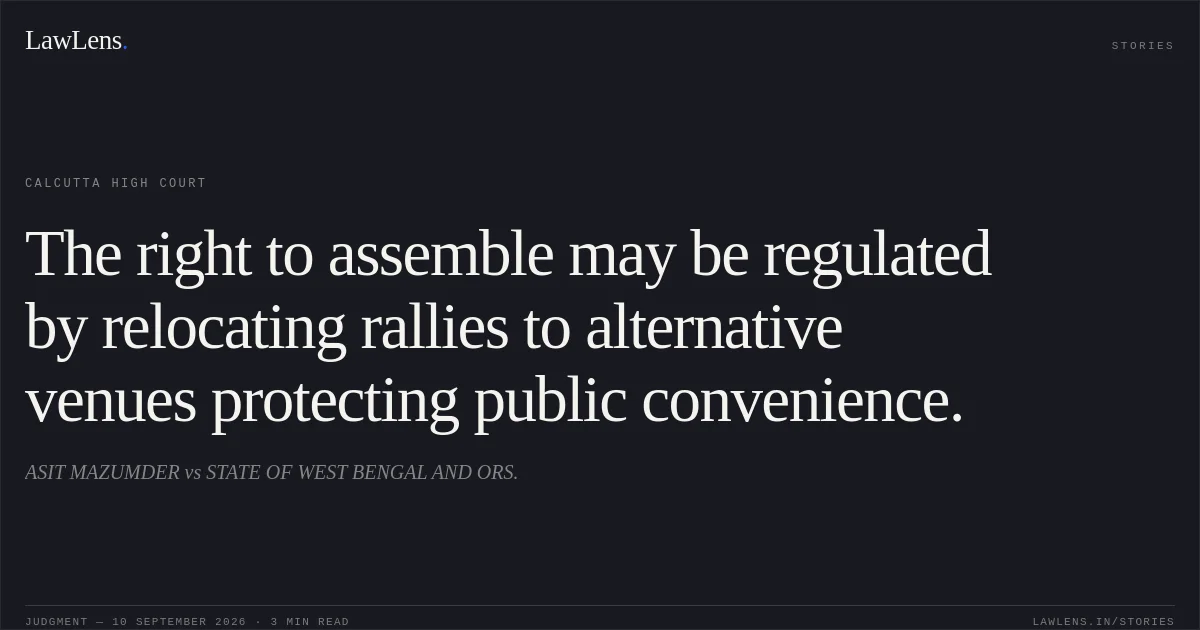
Article 19(1)(b) of the Constitution protects the right to assemble peaceably and without arms, but that right may be reasonably regulated in the interests of public order and the rights of others.
Source reference: no citationRelying on Himat Lal K. Shah v. Commissioner of Police, Ahmedabad & Anr., (1973) 1 SCC 227, particularly paragraph 42, the Court recognised that the right of assembly can be regulated so that all persons are able to enjoy their rights.
Source reference: para. 9The Court applied the principle that regulation should balance the exercise of democratic freedoms with traffic, public safety, access to hospitals and other essential establishments, and the maintenance of law and order.
Source reference: paras. 7–8Reasoning
The Court accepted that the proposed procession on G.T. Road could create practical difficulties because the road was narrow and the route potentially affected access to Walsh Hospital, a Fire Brigade establishment, and five schools.
Source reference: para. 7At the same time, it considered that an outright denial would insufficiently account for the petitioner’s constitutionally protected democratic right to assemble.
Source reference: no citationApplying the balancing principle in Himat Lal K. Shah, the Court found that shifting the programme from a procession or rally on G.T. Road to a confined meeting at Mahesh Jagannath Dev’s Snanpiri Maidan would substantially address the police authorities’ concerns while preserving the petitioner’s right to hold a political programme.
Source reference: paras. 8–11The Court therefore imposed conditions concerning the venue, time, number of participants, sound limits, non-inflammatory speech, police deployment, prohibition on blocking G.T. Road, volunteer responsibility, immediate vacation of the venue, and removal of the temporary stage and event equipment.
Source reference: para. 12Holding
The writ petition was disposed of by permitting the petitioner to hold a meeting, rather than a rally or procession, at Mahesh Jagannath Dev’s Snanpiri Maidan on 11 September 2026 between 13:00 and 15:00 hours, with a maximum of 2,000 participants.
The meeting was subject to conditions including compliance with sound limits, prohibition of inflammatory statements, maintenance of public order, no procession or obstruction on G.T. Road, immediate vacation of the venue, and dismantling of the temporary stage after the meeting.
Source reference: para. 12(ii)–(viii)The Inspector-in-Charge, Serampore Police Station, was directed to provide necessary protection and assistance to enable the meeting and the removal of equipment peacefully.
Source reference: para. 12(ix)The advocates were directed to communicate the substance of the order to the Inspector-in-Charge without awaiting the server copy.
Source reference: paras. 13–14Original Court PDF
ASIT MAZUMDERvsSTATE OF WEST BENGAL AND ORS.
Click to open original judgment
Original judgment, available to read, download and summarize on LawLens.in