Facts
The appellants, accused Nos. 1, 2 and 4, challenged the Sessions Court’s rejection of their application for anticipatory bail in a case arising from an alleged quarrel on 22 May 2026 in agricultural land.
Source reference: para. 1The complaint alleged that the complainant was abused by reference to her caste.
Source reference: paras. 1–2The case involved offences under Sections 3(1)(r), 3(1)(s), 3(1)(g) and 3(2)(v) of the Scheduled Castes and Scheduled Tribes (Prevention of Atrocities) Act, 1989, and Sections 115(2), 329(3), 351(3) and 352 read with Section 3(5) of the Bharatiya Nyaya Sanhita, 2023.
Source reference: paras. 1–2The investigation was complete and a charge-sheet had been filed against the appellants; non-bailable warrants had subsequently been issued.
Source reference: paras. 6–10Issues
1. Whether the appellants had shown sufficient grounds to set aside the rejection of anticipatory bail and obtain such relief.
Source reference: para. 142. Whether the allegations disclosed a prima facie offence under the SC/ST (POA) Act, thereby attracting the statutory bar to anticipatory bail under Sections 18 and 18A.
Source reference: paras. 16–19Law Applied
Sections 18 and 18A of the SC/ST (POA) Act bar anticipatory bail where a prima facie offence under the Act is disclosed; however, under Prathvi Raj Chauhan v. Union of India, (2020) 4 SCC 727, the bar does not apply where the complaint fails, on its face, to make out such a case.
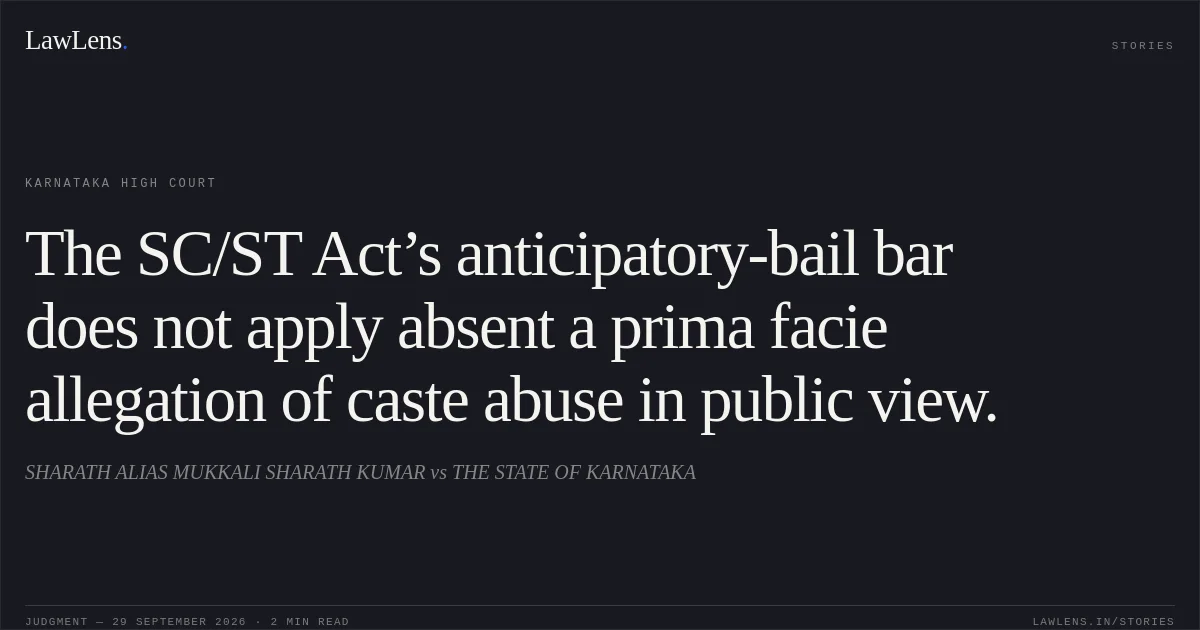
Source reference: para. 17For the alleged offences under Sections 3(1)(r) and 3(1)(s), the Court considered whether the alleged caste-based abuse occurred in a place “within public view”; the fact that an incident occurred on agricultural land does not, by itself, establish that the place was outside public view.
Source reference: paras. 18–19The Court also considered the completion of investigation, the filing of the charge-sheet and the nature of the BNS offences in assessing the bail application.
Source reference: paras. 20–22Reasoning
The Court found that the material before it did not sufficiently establish, prima facie, that the alleged caste-based abuse occurred in a place within public view, and therefore the statutory bar under Sections 18 and 18A was not attracted on the material then available.
Source reference: paras. 18–19, 23It did not treat the agricultural setting alone as conclusive, but assessed whether the public-view ingredient was shown in the circumstances of this case.
Source reference: paras. 18–19The investigation had concluded and the charge-sheet had been filed, reducing the apparent need for custodial interrogation; the alleged BNS offences were also not punishable with death or life imprisonment.
Source reference: paras. 20–21The later issuance of non-bailable warrants did not, by itself, prevent consideration of anticipatory bail.
Source reference: para. 22Holding
The Court answered the issue in the affirmative, allowed the appeal and set aside the Sessions Court’s order rejecting anticipatory bail.
It directed that, in the event of their arrest in connection with Crime No. 71/2026, the appellants be released on anticipatory bail, subject to conditions including execution of bonds, surrender before the Investigating Officer within 15 days of receiving a certified copy, cooperation with the investigation, non-interference with witnesses and appearance before the Trial Court.
Source reference: pp. 12–14The Court clarified that its observations were confined to the bail appeal and should not affect the trial on the merits.
Source reference: p. 14Acts & Sections Cited
8 provisions across 3 statutes referred to in this judgment. Each provision opens on LawLens.
Scheduled Castes and the Scheduled Tribes (Prevention of Atrocities) Act, 19892
Bharatiya Nyaya Sanhita, 20235
Code of Criminal Procedure, 19731
Original Court PDF
SHARATH ALIAS MUKKALI SHARATH KUMARvsTHE STATE OF KARNATAKA
Click to open original judgment
Original judgment, available to read, download and summarize on LawLens.in