Facts
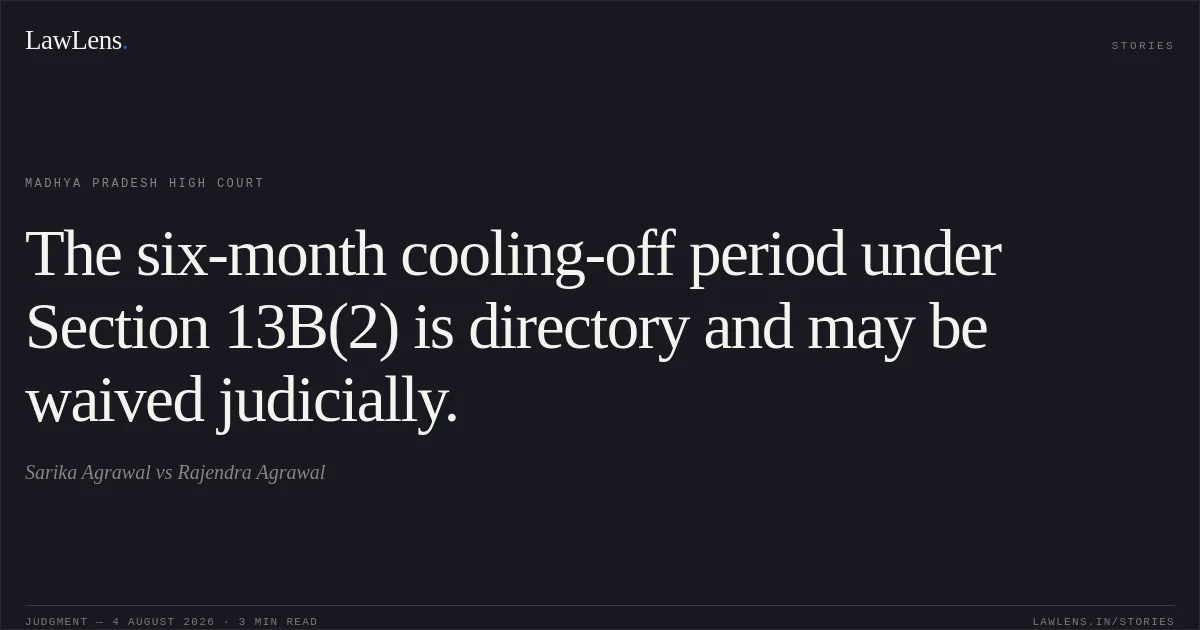
The petitioner challenged the order dated 29 June 2026 passed by the First Additional Principal Judge, Family Court, Indore, in HMA No. 1110/2026, concerning the parties’ application for waiver of the statutory cooling-off period in a petition for divorce by mutual consent.
Source reference: para. 2The petitioner relied on Section 13B of the Hindu Marriage Act, 1955, and on the Supreme Court’s decisions in Amardeep Singh v. Harveen Kaur and Amit Kumar v. Suman Beniwal, as well as a subsequent decision of the Delhi High Court in Shiksha Kumari v. Santosh Kumar.
Source reference: paras. 3–5The High Court found that the Family Court had decided the waiver application without considering the later legal position.
Source reference: para. 6Issues
Whether the six-month waiting period under Section 13B(2) of the Hindu Marriage Act, 1955, is mandatory or directory and may be waived by the court in appropriate circumstances.
Source reference: paras. 4–5Whether the Family Court’s order rejecting or otherwise deciding the waiver application was legally sustainable in light of the subsequent decisions in Amardeep Singh and Amit Kumar.
Source reference: para. 6Whether the matter should be remanded to the Family Court for fresh consideration of the waiver application.
Source reference: paras. 6–7Law Applied
Section 13B of the Hindu Marriage Act, 1955, permits dissolution of marriage by mutual consent where the parties have been living separately for the requisite period, have been unable to live together, and mutually agree to dissolve the marriage.
Source reference: para. 3Under Amardeep Singh v. Harveen Kaur, the six-month period under Section 13B(2) is directory, not mandatory, and may be waived where the court is satisfied that the statutory period would prolong the parties’ agony, reconciliation is unlikely, mediation or conciliation efforts have been undertaken, and the parties have genuinely settled issues such as alimony, custody and other disputes.
Source reference: para. 4Amit Kumar v. Suman Beniwal clarified that the factors identified in Amardeep Singh are illustrative and not exhaustive; where the relevant conditions are fulfilled, the court must exercise its discretion to waive the waiting period, and the parties’ prior period of separation should not be treated as an inflexible mandatory requirement.
Source reference: para. 5The court must interpret the provision in light of its object—preventing purposeless prolongation of a broken marriage while safeguarding against hasty decisions.
Source reference: para. 4Reasoning
The High Court held, prima facie, that the Family Court had applied the earlier understanding of the law while deciding the application for waiver and had failed to consider the later Supreme Court decisions governing Section 13B(2).
Source reference: para. 6Since the cooling-off period is directory and the waiver factors are not to be applied as rigid or exhaustive preconditions, the Family Court was required to reconsider the parties’ circumstances in accordance with the principles laid down in Amardeep Singh and clarified in Amit Kumar.
Source reference: paras. 4–6The High Court therefore did not itself determine whether waiver should ultimately be granted; instead, it restored the issue to the Family Court for a fresh and legally informed decision.
Source reference: para. 6Holding
The High Court allowed the petition to the extent that it quashed the impugned order dated 29 June 2026 and remanded the matter to the Family Court, Indore, for fresh consideration of the application seeking waiver of the statutory cooling-off period under Section 13B(2), in light of Amardeep Singh, Amit Kumar and the subsequent judgment referred to before the High Court.
The Family Court was directed to decide the application expeditiously, preferably within fifteen days from receipt of the certified copy of the order.
Source reference: para. 6The petition was accordingly disposed of, with a direction for issuance of the certified copy as per rules.
Source reference: para. 7Acts & Sections Cited
1 provisions across 1 statute referred to in this judgment. Linked provisions open on LawLens.
Hindu Marriage Act, 19551
Original Court PDF
Sarika AgrawalvsRajendra Agrawal
Click to open original judgment
Original judgment, available to read, download and summarize on LawLens.in