Facts
The Petitioner filed a complaint dated April 18, 2023, with the Director of Municipal Administration (DMA), seeking the removal of Respondent No. 1 (a Councillor of Sanguem Municipal Council) from office under Section 44 of the Goa Municipalities Act, 1968.
Source reference: para. 3The Petitioner alleged that Respondent No. 1 fraudulently obtained construction licenses, committed irregularities, and used a false caste certificate.
Source reference: para. 3The DMA dismissed the complaint on September 29, 2023, ruling that he lacked jurisdiction as Section 44 powers vest exclusively in the State Government.
Source reference: para. 4The Petitioner challenged this dismissal, arguing that a 1996 Gazette Notification appointing the DMA as an Ex-Officio Joint Secretary constituted a delegation of the Government’s powers.
Source reference: para. 5Issues
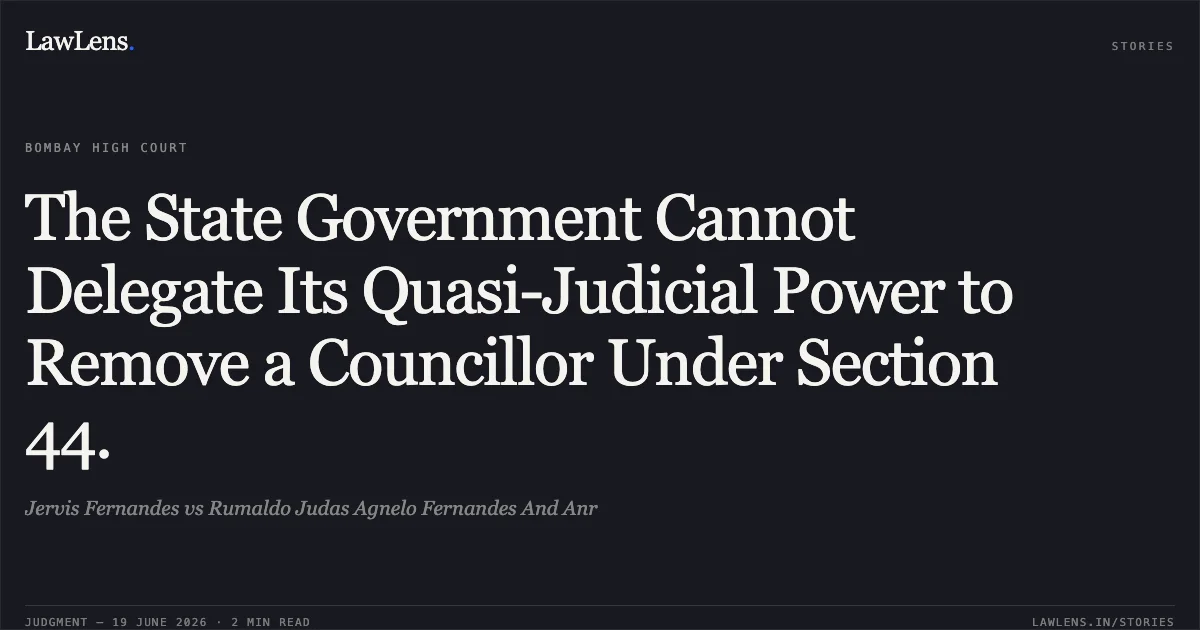
Whether the Director of Municipal Administration (DMA) is vested with powers, delegated or otherwise, under Section 44 of the Goa Municipalities Act, 1968, to remove a Councillor for misconduct.
Source reference: para. 2Law Applied
Section 44 of the Goa Municipalities Act, 1968, which empowers "The Government" to remove Councillors for misconduct or disgraceful conduct.
Source reference: para. 10Section 2(11) and Section 71 of the Act, which define and limit the powers of the "Director".
Source reference: para. 7Maxim Delegatus non potest delegare (a delegate cannot further delegate), holding that judicial or quasi-judicial powers cannot be delegated unless the statute expressly permits it.
Source reference: para. 13Bombay Municipal Corporation v. Dhondu Narayan Chowdhary, which established that judicial functions require express statutory authorization for delegation.
Source reference: para. 13(i)Savita Chaudhary v. State of Uttarakhand, which affirmed that powers affecting the status of elected representatives are quasi-judicial and cannot be delegated to subordinate officers.
Source reference: para. 13(iii)Reasoning
The Court observed that Section 44 carries serious consequences, including a five-year disqualification, making the power to remove an elected representative quasi-judicial in nature.
Source reference: para. 11Under the Act’s scheme, the "Director" and "Government" are distinct entities with separate defined powers.
Source reference: para. 7-8The Court found no provision in the Act authorizing the Government to delegate its Section 44 powers to the DMA.
Source reference: para. 8Regarding the 1996 Notification, the Court clarified that it was an executive arrangement for secretarial duties (signing communications with approval) and did not transfer substantive statutory or judicial authority to the DMA.
Source reference: para. 8, 12The Court distinguished the Petitioner’s reliance on Savio Norvin Menezes, noting that the administrative functions in the Goa Education Act are not comparable to the quasi-judicial removal process under the Municipalities Act.
Source reference: para. 9Having no express statutory permission to delegate, the Government remains the sole repository of power under Section 44.
Source reference: para. 14Holding
The Court answered the issue in the negative, holding that the DMA has no jurisdiction to adjudicate complaints under Section 44 of the Goa Municipalities Act.
The DMA’s order rejecting the complaint for lack of jurisdiction was upheld as legally sound. The Writ Petition was dismissed, and rule was discharged.
Source reference: para. 14-15Acts & Sections Cited
3 provisions across 1 statute referred to in this judgment. Each provision opens on LawLens.
UTTARAKHAND PANCHAYATI RAJ ACT, 20163
Original Court PDF
Jervis FernandesvsRumaldo Judas Agnelo Fernandes And Anr
Click to open original judgment
Original judgment, available to read, download and summarize on LawLens.in