Facts
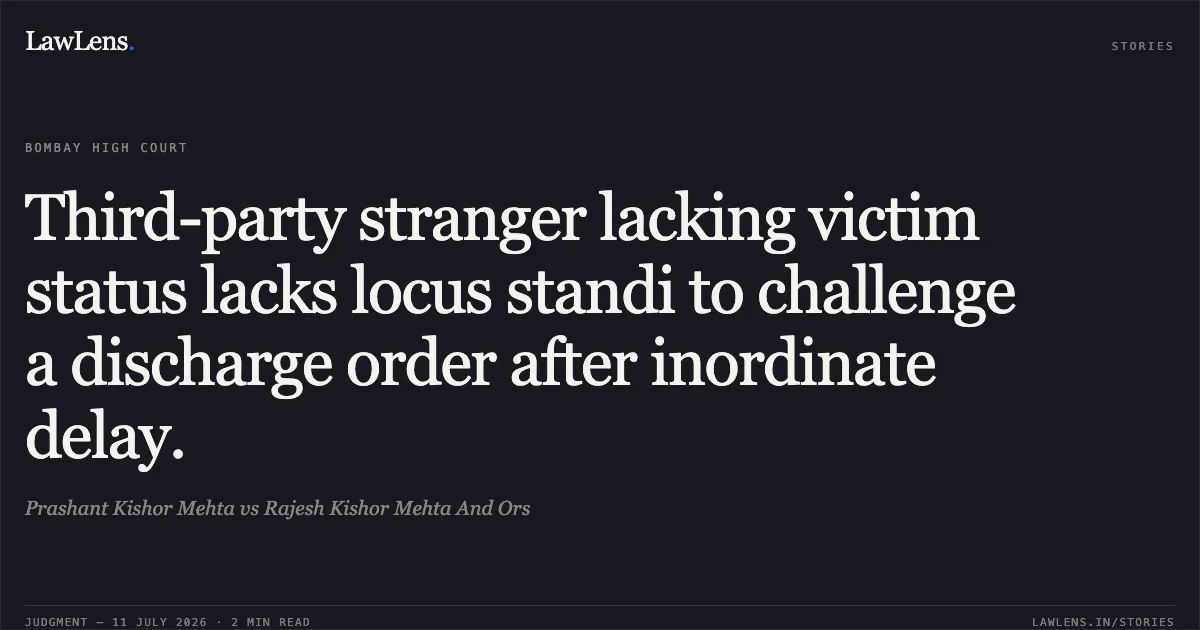
The Petitioner, Prashant Kishor Mehta, challenged an order dated August 8, 2018, passed by the Special Judge for CBI, which had discharged his brother, Respondent No. 1 (Rajesh Kishor Mehta), from a 2009 criminal case involving alleged bank fraud.
Source reference: para. 2-3The Petitioner was neither the complainant nor a party to the original proceedings or the revision application.
Source reference: para. 5, 9He filed this Writ Petition in 2026, nearly eight years after the impugned discharge order was passed, claiming he only recently gained knowledge of it.
Source reference: para. 4, 13Respondent No. 1 raised preliminary objections regarding the Petitioner's standing (locus) and the extreme delay in filing.
Source reference: para. 3Issues
1. Whether a third party/stranger who is neither a victim nor an aggrieved person has information the locus standi to challenge a discharge order under Article 227 of the Constitution or Section 482 CrPC
Source reference: para. 92. Whether the Petition is maintainable despite an inordinate delay of 7 years and 10 months
Source reference: para. 16Law Applied
the principle of locus standi in criminal jurisprudence, relying on Harsh Mandar v. Amit Anilchandra Shah, which holds that a total stranger cannot invoke inherent powers to challenge a revisable discharge order unless a legal right is invaded.
Source reference: para. 10the doctrine of laches and the principle interest reipublicae up sit finis litium (it is for the general welfare that a period be put to litigation), as seen in State of M.P. vs. Nandlal Jaiswal, Chennai Metropolitan Water Supply and Sewerage Board v. T.T. Murali Babu, and Londhe Prakash Bhagwan v. Dattatraya Eknath Mane, establishing that even where no limitation is prescribed, a petition must be filed within a reasonable time.
Source reference: para. 19-23Reasoning
The Court found that the Petitioner failed to demonstrate how he was a "victim" or "aggrieved person" under the law; he suffered no prejudice or impairment of legal rights by the discharge of Respondent No. 1.
Source reference: para. 9, 11The court noted that criminal law cannot be used by third parties to "wreak vengeance" or satisfy personal disputes.
Source reference: para. 10The Court rejected the Petitioner's explanation of "want of knowledge," noting that the case had been active since 2009 and involved his own father as a co-accused.
Source reference: para. 5, 12, 24The court reasoned that while Article 227 has no fixed limitation, the delay of nearly eight years was "inordinate" and "lethargic," and exercising discretion in such cases would cause "new injustices" and "uncertainty".
Source reference: para. 15-23Holding
The court held that the Petitioner lacked locus standi as a stranger to the proceedings and that the Petition was barred by inordinate delay and laches.
The Court dismissed the Petition.
Source reference: para. 27The court refused to condone the 7-year and 10-month gap, noting the CBI (the investigating agency) had not challenged the discharge and the Petitioner failed to show "sufficient cause" for the delay.
Source reference: para. 24-25Acts & Sections Cited
11 provisions across 4 statutes referred to in this judgment. Each provision opens on LawLens.
Code of Criminal Procedure, 19734
Bharatiya Nagarik Suraksha Sanhita, 20232
Indian Penal Code, 18604
Limitation Act, 19631
Original Court PDF
Prashant Kishor MehtavsRajesh Kishor Mehta And Ors
Click to open original judgment
Original judgment, available to read, download and summarize on LawLens.in