Facts
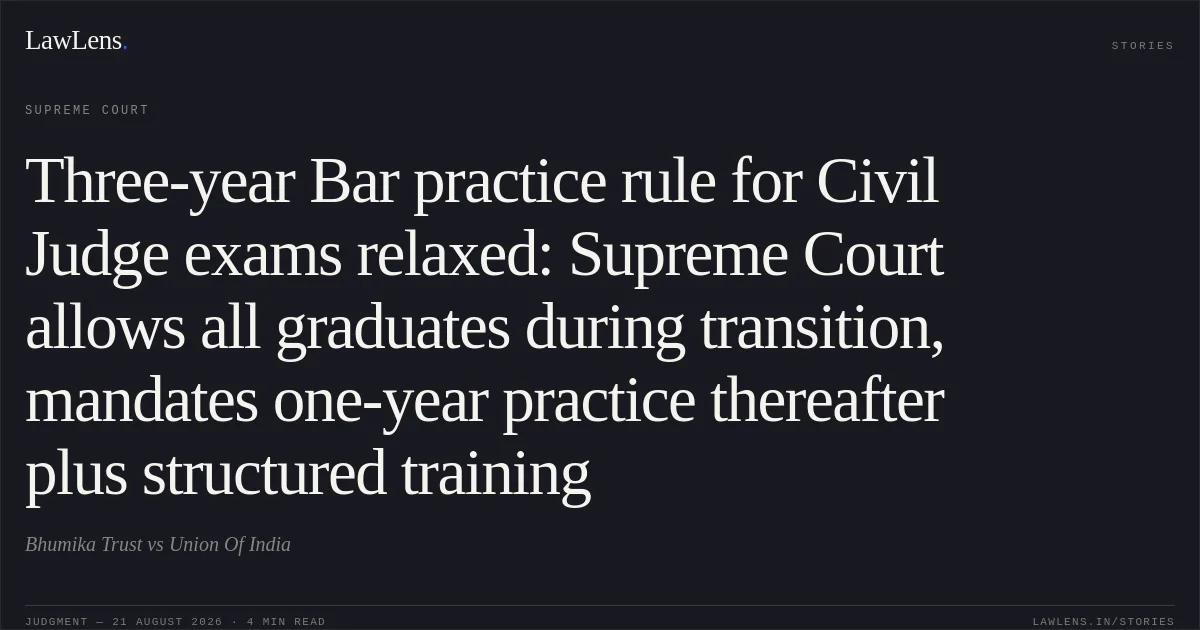
The proceedings concerned the eligibility requirement of three years’ practice at the Bar for recruitment to the post of Civil Judge (Junior Division).
Source reference: paras. 4–7In the Second All India Judges’ Association case (“Second AIJA Case”), the Supreme Court directed that three years’ legal practice be prescribed as an essential qualification.
Source reference: paras. 4–7Subsequently, relying on the Shetty Commission’s recommendations, the Court dispensed with the requirement in the Third AIJA Case, while recommending extended institutional training for fresh law graduates.
Source reference: paras. 8–14By judgment dated 20.05.2025, the Court restored the three-year practice requirement and directed amendments to the relevant service rules, while permitting experience as a Law Clerk to be counted towards the requirement.
Source reference: paras. 15–23Bhumika Trust, representing persons with disabilities, sought clarification or relaxation of the requirement, and review petitions were filed seeking recall or modification of the restored condition.
Source reference: paras. 24–30Applications were also filed seeking that time spent pursuing higher legal education be counted as practice.
Source reference: para. 58Issues
Whether prior exposure to the functioning of courts is necessary for appointment to the post of Civil Judge (Junior Division).
Source reference: paras. 43–47Whether such exposure must necessarily be acquired through three years of conventional practice at the Bar before a candidate is permitted to appear for the recruitment examination.
Source reference: paras. 44, 48–60Whether the three-year practice requirement restored by the judgment dated 20.05.2025 required review or modification in view of its impact on recent law graduates, women, economically weaker candidates and persons with disabilities.
Source reference: paras. 49–65Whether a structured combination of prior practice, institutional judicial training and supervised Law Clerkship could satisfy or partly satisfy the objectives underlying the practice requirement.
Source reference: paras. 67–72Whether the period spent pursuing higher legal education should be counted towards the prescribed practice requirement.
Source reference: para. 58Law Applied
Article 233(2), which requires seven years’ standing as an advocate or pleader for appointment as a District Judge, and Articles 217(2)(b) and 124(3)(b), which recognise substantial legal practice as a qualification for appointment to the High Court and Supreme Court.
Source reference: para. 6The Second AIJA Case held that practical experience at the Bar was necessary at the entry level of the judiciary to secure competent, independent and effective judicial officers.
Source reference: paras. 4–7The Third AIJA Case had previously accepted the Shetty Commission’s recommendation that the requirement could be dispensed with if accompanied by intensive judicial training.
Source reference: paras. 8–14The limited scope of review, declining to reconsider the fundamental proposition that court exposure is desirable, but permitting modification of the implementation mechanism to prevent unfairness and unintended exclusion.
Source reference: paras. 43–48, 60–64Structured judicial training and supervised Law Clerkship as relevant forms of practical exposure, though not identical to conventional Bar practice.
Source reference: paras. 67–71Reasoning
The majority affirmed that a prospective Civil Judge must possess familiarity with court procedure, courtroom decorum, litigants’ difficulties and the practical consequences of judicial orders.
Source reference: paras. 45–47It accepted the concerns recorded in the 2025 judgment that candidates entering directly from law school may lack practical understanding of court functioning and judicial responsibility.
Source reference: paras. 45–47However, it held that the mere passage of three years at the Bar does not uniformly ensure meaningful courtroom experience, since the quality of practice depends on the nature of the chamber, opportunities for appearances, mentoring and financial circumstances.
Source reference: para. 48The sudden restoration of the requirement also adversely affected candidates who had pursued legal education and prepared for judicial examinations under the earlier regime permitting fresh graduates to compete.
Source reference: paras. 49–53The Court therefore adopted a calibrated approach: it preserved the objective of practical exposure but permitted that objective to be achieved through a combination of limited prior practice and structured post-selection training.
Source reference: paras. 60–72The majority considered one year of institutional training followed by one year of supervised Law Clerkship capable of providing relevant exposure and of allowing senior judicial officers to assess the trainee before independent judicial functions were entrusted.
Source reference: paras. 67–72The applications seeking credit for higher legal education were rejected because academic study was not equivalent to familiarity with the functioning of courts.
Source reference: para. 58Justice Vinod Chandran disagreed, holding that the review jurisdiction could not be used to substitute the Court’s assessment for the considered decision of the earlier Bench and that practical legal experience remained indispensable.
Source reference: separate opinion, paras. 5–9Holding
By majority, the Court modified the 20.05.2025 judgment.
For recruitment notifications issued after that judgment and up to 31.03.2027, all law graduates were permitted to apply and were deemed to possess one year of practice without producing a separate practice certificate.
Source reference: para. 73(i)Selected candidates were to be appointed as Trainee Judicial Officers, undergo one year of intensive training at the State Judicial Academy, and thereafter complete one year of structured Law Clerkship—six months under the District Judiciary and six months under a sitting High Court Judge.
Source reference: para. 73(ii)–(v)They would receive prescribed trainee emoluments and would enter regular judicial service only upon a satisfactory, reasoned evaluation.
Source reference: para. 73(iii), (vi)–(vii)For notifications issued on or after 01.04.2027, candidates must possess at least one year of actual, duly certified practice, followed by the same one-year judicial training and one-year structured clerkship arrangement.
Source reference: para. 74The State Governments and High Courts were directed to amend the applicable service rules within three months, and the scheme was directed to remain in force for five years, after which its operation and efficacy would be reviewed.
Source reference: paras. 76, 79–80The applications seeking credit for higher legal education were dismissed, and the writ petition and review petitions were disposed of in the modified terms.
Source reference: paras. 81–84Justice Vinod Chandran would have dismissed the review petitions and left the 2025 judgment undisturbed.
Source reference: separate opinion, paras. 9–11Original Court PDF
Bhumika TrustvsUnion Of India
Click to open original judgment
Original judgment, available to read, download and summarize on LawLens.in