Facts
The petitioner, a registered trade mark agent, challenged the Trade Marks Registry’s practice of requiring applicants represented by agents to file a stamped power of attorney.
Source reference: para. 2He contended that Section 145 of the Trade Marks Act, 1999 and Rule 19 of the Trade Marks Rules, 2017 require only an authorisation in the prescribed form, not a stamped power of attorney.
Source reference: para. 4The respondents maintained that the authorisation permits the agent to act for the applicant, receive service and appear before the Registrar, and therefore must be stamped under the applicable State stamp law.
Source reference: para. 3, 5The petitioner sought declarations that a stamped power of attorney was not required; the writ petition was dismissed.
Source reference: para. 16Issues
Whether an authorisation filed by a trade mark agent under Section 145 of the Trade Marks Act, 1999 is liable to stamp duty.
Source reference: para. 1Whether that authorisation may be treated as a power of attorney for the purposes of the applicable Stamp Act.
Source reference: para. 1Law Applied
Section 145 of the Trade Marks Act, 1999 permits specified persons, including registered trade mark agents, to perform acts before the Registrar on another person’s behalf when duly authorised; Rule 19 of the Trade Marks Rules, 2017 prescribes Form TM-M and provides for service on the agent to be deemed service on the authorising person.
Source reference: para. 8–9Under Sections 2(j) and 2(p) of the Kerala Stamp Act, 1959, an “instrument” includes a document by which a right or liability is created, and a “power of attorney” includes an instrument empowering a person to act for and in the name of its executant.
Source reference: para. 12–13An instrument conferring authority to act for another is subject to stamp duty under the applicable Stamp Act unless it is chargeable with court fee; the Kerala court-fee legislation did not apply to documents filed before the Registrar, who is an officer appointed by the Central Government and not a court or tribunal.
Source reference: para. 7, 14The Court also relied on The Institute of Chartered Accountants of India v. Union of India [2002 SCC OnLine Ker 675], concerning stamp duty on authorisations before taxing authorities, and referred to Hindustan Steel Ltd. v. Dilip Construction Co. [(1969) 1 SCC 597] and Dr. Chiranji Lal v. Haridas [(2005) 10 SCC 746] on the revenue purpose of stamp-duty provisions.
Source reference: para. 11, 15Reasoning
The Court reasoned that the prescribed form of authorisation under Rule 19 did not determine whether stamp duty applied, because that question is governed by the Stamp Acts, not the Trade Marks Act or Rules.
Source reference: para. 11The authorisation gives the agent a right to act for the applicant, accept service and appear before the Registry; the agent’s acts may bind the principal or affect the principal’s rights.
Source reference: para. 10, 16It therefore constitutes an instrument with the essential characteristics of a power of attorney.
Source reference: para. 16Because the Registrar is not a court or tribunal, the court-fee treatment applicable to a vakalathnama did not exempt this authorisation from stamp duty.
Source reference: para. 7, 14–16Holding
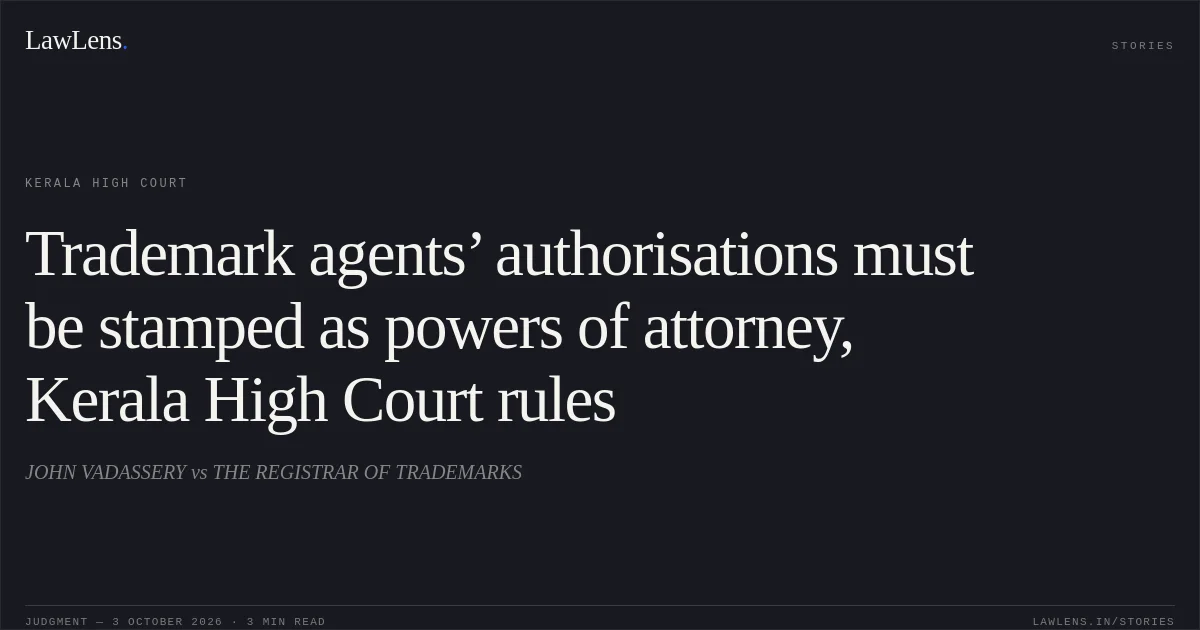
The Court held that an authorisation under Section 145 of the Trade Marks Act read with Rule 19 of the Trade Marks Rules is an instrument conferring authority to represent another and must be stamped under the relevant Stamp Act applicable where it is executed.
The requested declarations were refused, and the writ petition was dismissed.
Source reference: para. 16Acts & Sections Cited
2 provisions across 1 statute referred to in this judgment. Each provision opens on LawLens.
Trade Marks Act, 19992
Original Court PDF
JOHN VADASSERYvsTHE REGISTRAR OF TRADEMARKS
Click to open original judgment
Original judgment, available to read, download and summarize on LawLens.in