01Facts
Respondents 1 to 3 sued Late Sh. Sadhu Ram for specific performance of an Agreement to Sell dated 08.07.2006 in respect of a residential plot (Khasra No. 142/783, 1 bigha 1 biswa) and an industrial plot (Khasra No. 143/679) at Kanjhawala, Delhi.
¶ 2The suit (CS(OS) 1816/2006) was filed on 20.09.2006.
¶ 2On 21.09.2006 the Court restrained Sadhu Ram from parting with possession or creating any third-party interest in the suit property.
¶ 3, 14The Appellant claims that Sadhu Ram had earlier executed GPAs dated 17.07.2006 (in favour of his son Tej Pal) and 07.08.2006 (in favour of Abhishek Sharma), and that on 06.11.2012 he bought the residential plot from Abhishek Sharma through an unregistered Agreement to Sell, GPA and Will.
¶ 3, 4He was impleaded as Defendant No. 3 on 18.08.2017 and filed a written statement.
¶ 4The Trial Court decreed specific performance on 11.12.2024 subject to payment of Rs. 68,43,000 within three months, directed subsequent purchasers to join the LRs in executing the sale deed, and left them "at liberty" to recover amounts paid to Sadhu Ram or his LRs "through appropriate legal remedy".
¶ 5 · ¶ 34In execution proceedings (EP 90/2025), the Appellant filed an application under Order XXI Rule 101 CPC claiming Rs. 53,21,400 as a proportionate share of the decretal amount.
¶ 6The Executing Court dismissed the application on 14.11.2025, holding that the unregistered documents conferred no title and that any grievance lay against his transferor.
¶ 7, 12The Appellant challenged that order in this appeal.
¶ 102Issues
i.1. Whether the unregistered Agreement to Sell, GPA and Will dated 06.11.2012 conferred any right, title or interest in the residential plot sufficient to resist or obstruct execution of the decree dated 11.12.2024.
¶ 13, 14, 15, 27, 28ii.2. Whether the Appellant is entitled, under Order XXI Rule 101 CPC, to have a proportionate sum of Rs. 53,21,400 determined and paid out of the decretal sale consideration in execution proceedings.
¶ 13, 33, 34, 35, 36, 3703Law Applied
Section 52 of the Transfer of Property Act, 1882, embodies the doctrine of lis pendens: a transfer pendente lite is not void but remains subject to the outcome of the litigation, and binds transferees whether or not they had notice.
¶ 16Jayaram Mudaliar v. Ayyaswami explains the doctrine of lis pendens under Section 52 of the Transfer of Property Act, 1882.
¶ 17Where a transfer breaches an express restraint order, the Court may treat it as having not taken place for the proceedings, as held in Surjit Singh v. Harbans Singh, Vidur Impex v. Tosh Apartments, Sonu Bhati v. Archana Jain and Balwantbhai Somabhai Bhandari v. Hiralal Somabhai Contractor.
¶ 19, 20, 21, 22, 24Under Section 54 TPA, a contract of sale does not itself create an interest in immovable property, and sale requires a registered instrument. Suraj Lamp & Industries v. State of Haryana holds that Agreement to Sell, GPA and Will transactions do not transfer title, although they may be used for limited purposes such as Section 53A protection.
¶ 25, 26Section 53A TPA, read with Section 17(1A) of the Registration Act, 1908, requires a registered contract for part-performance protection.
¶ 28Order XXI Rule 101 CPC is confined to questions arising under Rules 97 and 99 within the framework of the decree and cannot be used to create independent monetary rights.
¶ 29, 30Order XXI Rule 102 and Tahir V. Isani v. Madan Waman Chodankar apply the lis pendens bar to transferees pendente lite where a decree for possession is sought.
¶ 31, 32An executing court cannot go behind the decree.
¶ 38Provisions in the judgment · 14 · Linked ones open on LawLens
Code of Civil Procedure, 1908 Section 96Section 151Section 21
Transfer of Property Act, 1882 Section 5Section 40Section 52Section 54Section 55
Specific Relief Act, 1963 Section 3
Indian Trust Act, 1882 Section 91
Powers-of Attorney Act, 1882 Section 2
Indian Succession Act, 1925 Section 69Section 70
Registration Act, 1908 Section 17
04Reasoning
The Appellant's claim could not be assessed in isolation. His chain of title traced to Sadhu Ram, who was expressly restrained from creating third-party interests by the order of 21.09.2006, and his purchase came in 2012, more than six years after the suit was filed.
¶ 14, 18, 19, 23Any transfer made in defiance of that order could not defeat the decree-holders' rights.
¶ 20, 21, 22, 23, 24Independently, the 2012 documents were unregistered and conveyed no ownership under Section 54 TPA and Suraj Lamp. Possession alone did not confer title, and the Appellant could not invoke Section 53A because his agreement was unregistered.
¶ 25, 26, 27, 28The Appellant was impleaded and participated in the suit, so he was bound by the decree's direction to join the sale deed.
¶ 42, 43The Court read the Trial Court's "liberty" clause as preserving a right of recovery, not as creating an executable money decree. No amount was quantified or directed to be paid to the Appellant. The consideration was paid to Abhishek Sharma, not to Sadhu Ram or his LRs, so the condition in the decree was not established. A proportionate calculation cannot be imported into execution proceedings under Order XXI Rule 101.
¶ 35, 36, 37, 38, 39, 4505Holding
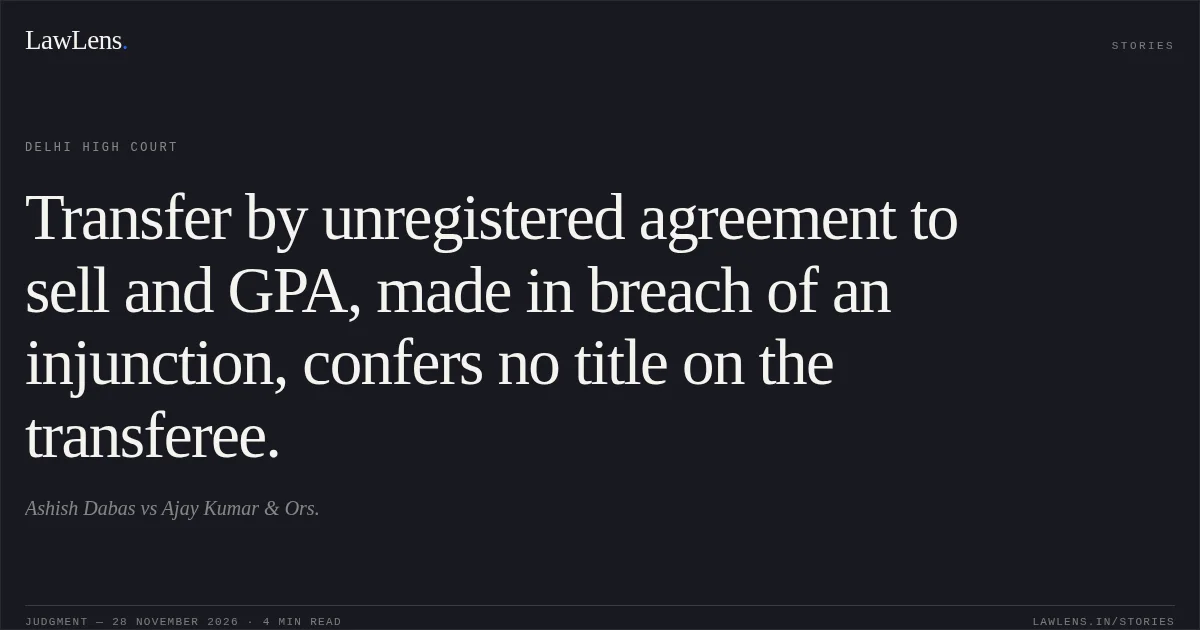
The Appellant's unregistered Agreement to Sell, GPA and Will dated 06.11.2012 conferred no title and could not resist execution of the decree dated 11.12.2024.
¶ 44, 45, 46His claim to a proportionate Rs. 53,21,400 is not an amount decreed under that decree and cannot be adjudicated in execution under Order XXI Rule 101.
¶ 44, 45, 46The appeal is dismissed and the Order dated 14.11.2025 is upheld. The dismissal does not preclude the Appellant from pursuing an independent remedy for recovery of the amount allegedly paid, if available in law. The Court expressed no opinion on the merits or maintainability of such proceedings.
¶ 47, 48Original Court PDF
Ashish DabasvsAjay Kumar & Ors.
Click to open original judgment
Original judgment, available to read, download and summarize on LawLens.in