01Facts
The original Respondent, Smt. Parveen Singh, sought eviction of the Petitioner-tenant under Section 14(1)(e) read with Section 25-B of the Delhi Rent Control Act, 1958 (DRC Act) from a shop measuring about 11 ft × 12 ft at WZ-30C, Virender Nagar, New Delhi, on the basis of a 2003 sale deed and a 2011 gift deed.
¶ 4Her pleaded bona fide requirements were: (i) expansion of a computer coaching institute run by her husband; (ii) an office for her LIC agency; and (iii) residential use for herself and her family.
¶ 4–5The Petitioner contested, alleging the institute was a sham, and the Rent Controller granted leave to defend.
¶ 6During trial, the Rent Controller allowed the Petitioner's application to bring on record the alleged shifting of the Respondent to the first floor and closure of the institute.
¶ 7By Judgment dated 18.04.2019, the Rent Controller allowed the eviction petition, finding the requirement bona fide.
¶ 8, 21The Petitioner filed the present revision under Section 25-B(8). During its pendency, the Respondent's husband died on 22.04.2021 and the Respondent died on 27.04.2021.
¶ 9Their daughter, Ms. Kashvi Singh, was brought on record as legal representative on 30.09.2024.
¶ 9The Petitioner filed applications to bring these deaths on record as extinguishing the bona fide requirement, and the legal representative opposed them.
¶ 9, 1402Issues
i.1. Whether the subsequent demise of the original Respondent and her husband, after an eviction order had been passed in her favour, extinguishes the bona fide requirement on which the eviction order was based, so as to warrant interference in revisional jurisdiction.
¶ 3, 22ii.2. Whether the subsequent events relied upon by the Petitioner are of such a nature and dimension as to completely eclipse the requirement originally pleaded and adjudicated.
¶ 23–24, 2803Law Applied
The Court's revisional jurisdiction under the proviso to Section 25-B(8) of the DRC Act is supervisory, not appellate, and is confined to illegality, material irregularity, or error apparent on the face of the record, citing Abid-Ul-Islam v. Inder Sain Dua, (2022) 6 SCC 30.
¶ 18–19The bona fide requirement is ordinarily tested as on the date of institution of the eviction petition. Subsequent events may be taken into account only where they are of such nature and dimension that the requirement is completely eclipsed, citing Gaya Prasad v. Pradeep Srivastava, (2001) 2 SCC 604 and Hasmat Rai v. Raghunath Prasad, (1981) 3 SCC 103.
¶ 23–24Where a decree or order is passed and the landlord dies later, his legal representatives succeed to the estate and may defend the benefit so accrued; the bona fide need is not lost merely because of death, citing Kamleshwar Prasad v. Pradumanju Agarwal, (1997) 4 SCC 413, Shakuntala Bai v. Narayan Das, (2004) 5 SCC 772, and Phool Rani v. Naubat Rai Ahluwalia, (1973) 1 SCC 688.
¶ 25–26The expression "own use" under Section 14(1)(e) is of wide import and includes the legitimate needs of the landlord's family, citing Mohd. Burhan v. Triloki Nath, 2026 SCC OnLine Del 25.
¶ 27, 35Cases such as V. Ramanathan and Gurinder Singh, involving exclusively personal requirements or cumulative diminution of need, are distinguishable.
¶ 29–30Provisions in the judgment · 1 · Linked ones open on LawLens
delhi rent control act, 1958 Section 14
04Reasoning
The impugned order was passed after a full trial, and reappreciation of the requirement was outside the scope of revisional jurisdiction.
¶ 20The deaths occurred more than two years after the 18.04.2019 judgment, so the Petitioner was seeking to unsettle an adjudicated right.
¶ 33The death events did not completely eclipse the requirement, because the residential requirement was family-based and not confined to the deceased, and the surviving daughter, Ms. Kashvi Singh, continues as a family member and legal representative.
¶ 34–36The three requirements were pleaded together and the Rent Controller found the need established on all of them; the loss of two personal limbs (the institute and the LIC office) did not extinguish the whole claim.
¶ 37The Court distinguished V. Ramanathan and Gurinder Singh on facts, as the former involved cumulative circumstances showing diminished need and the latter involved a claim founded solely on the personal requirement of the deceased.
¶ 29–30On the subsequent-event applications, the allegations of a tuition-centre tenancy and an unused shop were unsupported by cogent material (no rent agreement, and no proof of the other shop's suitability or availability), so they did not show complete eclipse.
¶ 39–4105Holding
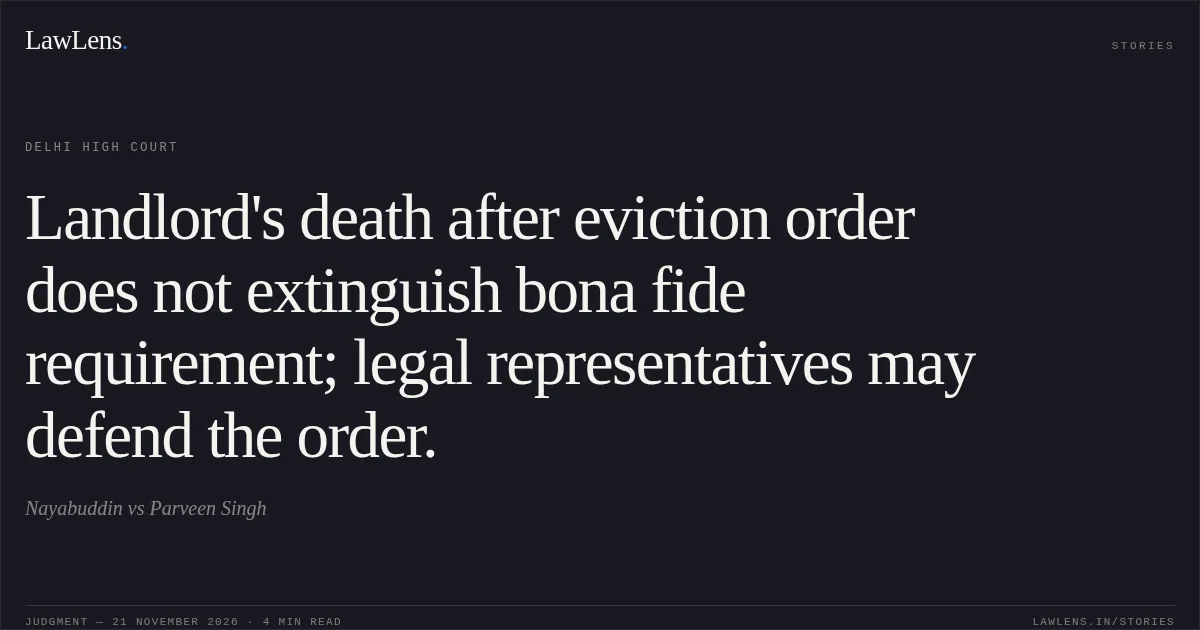
The Court answered both issues in the negative. The demise of the original Respondent and her husband, after the eviction order, does not by itself extinguish the bona fide requirement adjudicated in her favour, and the subsequent events do not completely eclipse the requirement.
¶ 38, 42The applications (CM APPL. 7006/2022 and CM APPL. 9241/2026) are allowed only to the extent of placing the pleaded subsequent events on record, without any effect on the impugned order.
¶ 43No illegality, material irregularity, or jurisdictional error was found, and the Revision Petition is dismissed. The eviction order dated 18.04.2019 passed by the learned Rent Controller is upheld.
¶ 44–45Original Court PDF
NayabuddinvsParveen Singh
Click to open original judgment
Original judgment, available to read, download and summarize on LawLens.in