Facts
The appellant, engaged in trading lubricants and motor vehicles, was registered under the service-tax law for specified construction-related services.
Source reference: para. 3It entered into an agreement with M/s. Bestech India Ltd. and other landowners to transfer development rights in land situated at Village Wazirpur, Gurgaon, in exchange for a specified share of the built-up area in the development project.
Source reference: para. 4The appellant subsequently sold its share of flats for ₹8,15,43,987 through the developer and treated the receipts as consideration for construction services, paying service tax after claiming 75% abatement under Notification No. 26/2012-ST.
Source reference: para. 4The appellant also availed CENVAT credit of ₹30,40,929 on administrative charges and construction services provided by the developer.
Source reference: para. 4Following verification of the appellant’s records, the Department alleged that the appellant had actually transferred development rights, which constituted a taxable service, and that the claimed abatement was unavailable.
Source reference: para. 5The Joint Commissioner confirmed service-tax demand of ₹1,06,66,772 under Section 73 of the Finance Act, 1994, imposed penalties under Sections 77 and 78, and ordered recovery of the CENVAT credit with an equivalent penalty under Rule 15 of the CENVAT Credit Rules, 2004.
Source reference: para. 1The Commissioner (Appeals) upheld that order, leading to the present appeal.
Source reference: para. 1Issues
Whether the transfer of development rights in land constituted a taxable service, including construction service, or was a transaction in immovable property outside the scope of service tax?
Source reference: paras. 7–9Whether the appellant was entitled to retain the CENVAT credit of ₹30,40,929 availed on administrative charges and construction services supplied by the developer?
Source reference: paras. 5, 10Whether the extended period of limitation and penalties under Sections 77 and 78 of the Finance Act, 1994 and Rule 15 of the CENVAT Credit Rules, 2004 were sustainable?
Source reference: paras. 1, 10, 12Law Applied
The Tribunal applied Section 3(26) of the General Clauses Act, 1897, under which “immovable property” includes land, benefits arising out of land, and things attached to the earth; consequently, development rights, FSI and TDR are treated as immovable property.
Source reference: para. 7It relied principally on Chheda Housing Development Corporation v. Bibijan Shaikh Farid, 2007 (2) TMI 664 (Bombay High Court), which held that FSI/TDR is a benefit arising from land and therefore immovable property.
Source reference: para. 7The Tribunal also followed Genius Probuild Pvt. Ltd. v. Commissioner of Central Excise and CGST, Jaipur, 2025 (9) TMI 1607 (CESTAT New Delhi), and Raipur Development Authority v. Commissioner of Customs, Central Excise and Service Tax, Raipur, 2025 (7) TMI 1542 (CESTAT New Delhi), holding that transfer of development rights is not a service.
Source reference: para. 8Under Rule 14 of the CENVAT Credit Rules, 2004, wrongly availed credit is recoverable, while Rule 15 provides for penalty in specified cases; however, the extended limitation period and penalty require conduct warranting such action.
Source reference: para. 10The Tribunal further referred to Section 11B of the Central Excise Act, 1944, as applicable to service tax, for any refund of service tax paid, including the doctrine that amounts passed on to others must be credited to the Consumer Welfare Fund.
Source reference: para. 11Reasoning
The Tribunal held that development rights constitute a benefit arising from land and are therefore immovable property under Section 3(26) of the General Clauses Act, following the binding reasoning in Chheda Housing Development.
Source reference: para. 7Since the appellant’s transaction involved transfer of such development rights to the developer, it was not a taxable service—whether construction service or any other service—and the service-tax demand under Section 73 was consequently unsustainable.
Source reference: para. 9The Tribunal nevertheless distinguished the tax demand from the CENVAT-credit issue: because the transfer of development rights was not an output service, the administrative charges and construction services obtained from the developer could not qualify as input services for the appellant, making the credit inadmissible under Rule 14.
Source reference: para. 10However, the appellant had genuinely treated the transaction as taxable construction service and had paid service tax on that basis; therefore, the Tribunal found no justification for invoking the extended limitation period or imposing the penalty under Rule 15.
Source reference: para. 10The same circumstances also warranted setting aside the penalties under Sections 77 and 78.
Source reference: para. 12Holding
The Tribunal partly allowed the appeal.
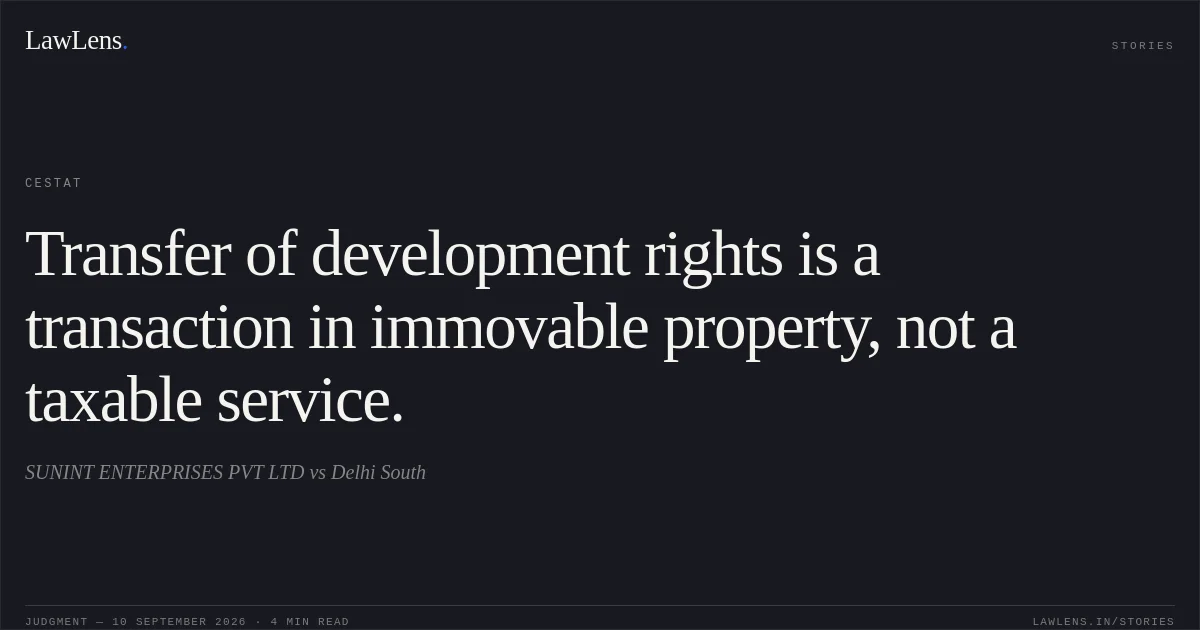
It held that the transfer of development rights was a transaction in immovable property and not a taxable service; accordingly, the service-tax demand of ₹1,06,66,772 and the penalties under Sections 77 and 78 of the Finance Act, 1994 were set aside.
Source reference: para. 12The recovery of CENVAT credit under Rule 14 was upheld only for the normal limitation period, while the penalty under Rule 15 was set aside.
Source reference: paras. 10, 12The Tribunal further observed that the appellant could seek refund of the service tax wrongly paid, subject to Section 11B and the applicable doctrine of unjust enrichment.
Source reference: para. 11Original Court PDF
SUNINT ENTERPRISES PVT LTDvsDelhi South
Click to open original judgment
Original judgment, available to read, download and summarize on LawLens.in