Facts
The plaintiff (appellant) filed a suit for declaration of title and permanent injunction regarding 0.55 acres of land (Khasra No. 480/1-ख), claiming ownership via a registered sale deed dated 08.06.1994 from vendors Mahetaru and Ghasiram.
Source reference: p. 2-3While mutation was initially granted in 2004, it was cancelled by the Naib Tehsildar on 07.10.2004, restoring the names of the original owners.
Source reference: p. 3The original owners subsequently sold the land to Mohan Singh (Defendant No. 4/5) via a registered sale deed in 2005.
Source reference: p. 3-4The defendants contended that the 1994 deed was fraudulent, executed without the required Power of Attorney, and violated statutory protections for tribal land.
Source reference: p. 5-6Both the Trial Court and the First Appellate Court dismissed the plaintiff's suit, finding the 1994 sale deed void and the plaintiff's possession unproven.
Source reference: p. 9-10Issues
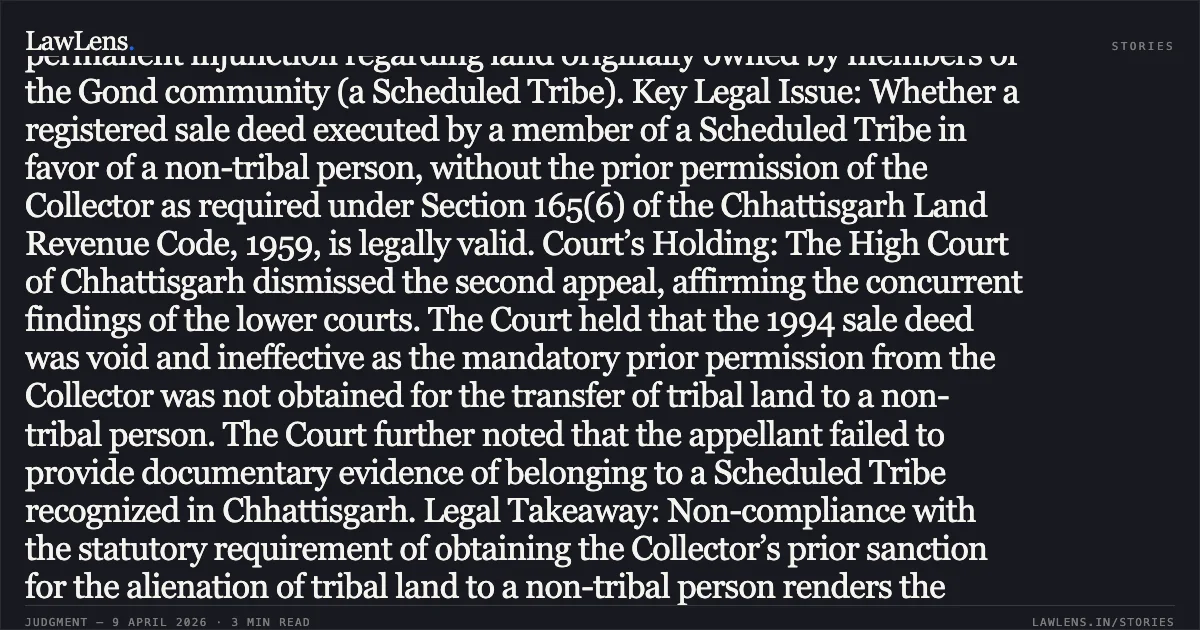
1. Whether the sale deed dated 08.06.1994 was legally valid and effective to confer title, given the restrictions on the transfer of tribal land under Section 165(6) of the Chhattisgarh Land Revenue Code, 1959.
Source reference: p. 7-82. Whether the concurrent findings of fact regarding the plaintiff's lack of title and possession involve a substantial question of law under Section 100 of the CPC.
Source reference: p. 14-15Law Applied
The Court primarily applied Section 165(6) of the Chhattisgarh Land Revenue Code, 1959, which mandates prior permission from the Collector for any transfer of land from a member of a Scheduled Tribe to a non-tribal person.
Source reference: p. 7-8It further applied Section 100 of the Code of Civil Procedure (CPC), 1908, which restricts the scope of second appeals to "substantial questions of law" and prohibits interference with concurrent findings of fact unless they are perverse.
Source reference: p. 14The Court also relied on the principle from State of Rajasthan v. Shiv Dayal (2019) 8 SCC 637, establishing that concurrent findings are binding unless recorded de hors the pleadings or based on a misreading of material evidence.
Source reference: p. 15Reasoning
The Court found that the vendors belonged to the Gond community (a Scheduled Tribe) and the land was situated in a notified Scheduled Area.
Source reference: p. 7-8Since the plaintiff failed to prove he belonged to a Scheduled Tribe in Chhattisgarh or that he obtained the Collector's prior permission, the 1994 sale deed was held void ab initio under Section 165(6) of the Land Revenue Code.
Source reference: p. 8, 13The Court noted significant discrepancies in the plaintiff's case, including the absence of a Power of Attorney for the sale and the fact that the plaintiff's father allegedly misused his official position as a government officer to obtain the deed.
Source reference: p. 6, 8, 12The Court observed that the revenue records (B-1 and Khasra Panchshala) supported the possession and title of the subsequent purchaser, Mohan Singh.
Source reference: p. 12The Court concluded that the challenges raised by the appellant were essentially factual and did not meet the threshold of a "substantial question of law" required for interference under Section 100 CPC.
Source reference: p. 15Holding
The Court held that the plaintiff failed to establish title or possession, and the concurrent findings of the lower courts were neither perverse nor illegal.
The 1994 sale deed was declared void for non-compliance with Section 165(6) of the Chhattisgarh Land Revenue Code.
Source reference: p. 8The High Court dismissed the Second Appeal and upheld the judgments of the lower courts.
Source reference: p. 16No substantial question of law was found to exist.
Source reference: p. 16Acts & Sections Cited
4 provisions across 1 statute referred to in this judgment. Each provision opens on LawLens.
Code of Civil Procedure, 19084
Original Court PDF
Suresh KumarvsSmt. Janaki Bai
Click to open original judgment
Original judgment, available to read, download and summarize on LawLens.in