Facts
The petitioners are partners of M.S. & Sons, a coal-handling firm. Between 2018 and 2019, Respondent No. 1 provided transportation logistics services to the petitioners’ firm for moving coal from its washery in Odisha to a company in Chhattisgarh
Source reference: para. 5, 17Respondent No. 1 alleged that out of a total invoice value of INR 66,44,798, an amount of INR 24,55,852 remained outstanding
Source reference: para. 5Respondent No. 1 filed complaints under Section 35(1) of the Consumer Protection Act, 2019, before the District Consumer Disputes Redressal Commission, Raigarh
Source reference: para. 5The District Commission allowed the complaints, directing the petitioners to pay the outstanding dues along with compensation for mental agony and litigation costs
Source reference: para. 2–4The petitioners unsuccessfully sought a revision from the State Commission and subsequently challenged the District Commission's orders via writ petitions under Article 226, arguing lack of jurisdiction
Source reference: para. 5–6Issues
1. Whether the writ petition is maintainable despite the availability of an alternative statutory remedy of appeal under the Consumer Protection Act, 2019
Source reference: para. 19, 212. Whether a commercial arrangement for transportation logistics between two business entities qualifies as a "consumer dispute" under Section 2(7) of the Consumer Protection Act, 2019
Source reference: para. 19, 32Law Applied
Article 226 of the Constitution of India regarding the High Court’s discretionary power to entertain writs despite alternative remedies
Source reference: para. 22–25Whirlpool Corpn. v. Registrar of Trade Marks, establishing that alternative remedy is not a bar where the order is wholly without jurisdiction
Source reference: para. 22Sections 2(5), 2(6), and 2(7) of the Consumer Protection Act, 2019, which exclude persons obtaining services for "commercial purpose" from the ambit of a "consumer"
Source reference: para. 32–33Annapurna B. Uppin v. Malsiddappa, which held that commercial transactions for profit/gain are outside the purview of the Consumer Protection Act and must be adjudicated by civil courts
Source reference: para. 38Reasoning
The Court first addressed the maintainability of the writ, reasoning that while a statutory appeal exists, the rule of alternative remedy is one of discretion, not compulsion
Source reference: para. 27Since the petitioners challenged the District Commission’s very jurisdiction to entertain a commercial debt recovery suit, it constituted a "pure question of law" and a "jurisdictional error," justifying the exercise of writ jurisdiction
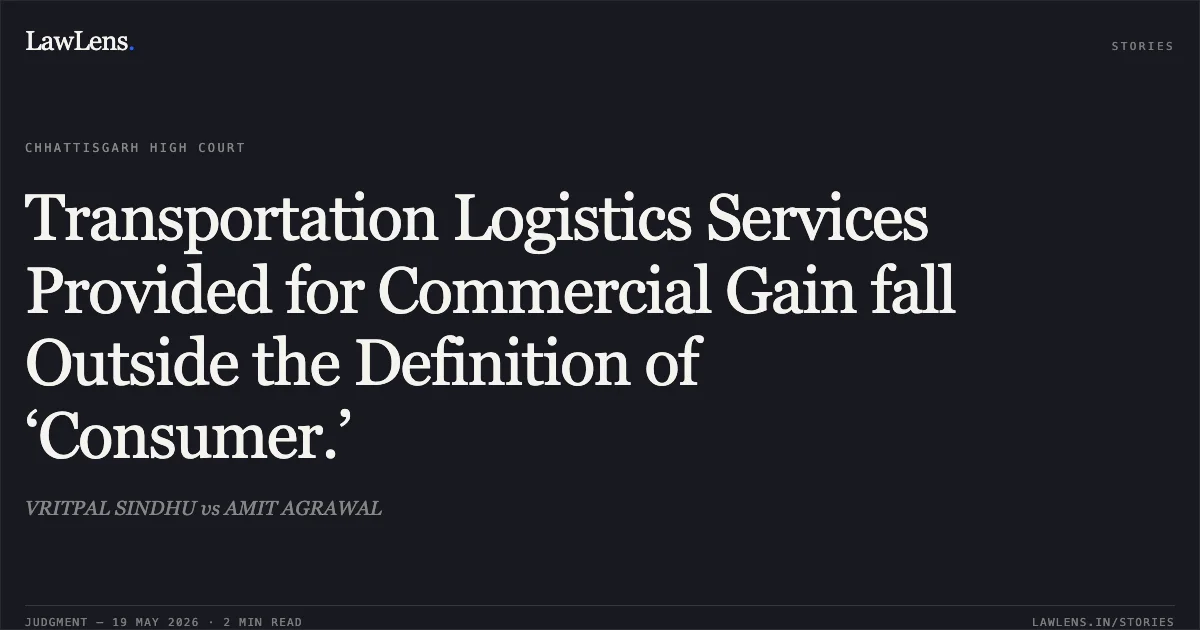
Source reference: para. 28–31On the merits, the Court found that Respondent No. 1 provided logistics services to the petitioners’ coal business for commercial gain
Source reference: para. 32Applying the "commercial purpose" exception in Section 2(7), the Court determined that Respondent No. 1 was not a "consumer" and the transaction was a simple commercial understanding
Source reference: para. 32, 35Consequently, the Respondent lacked the locus standi to be a "complainant" under Section 2(5), and the District Commission’s exercise of power was deemed colorable as it essentially acted as a civil court for money recovery
Source reference: para. 34–36, 39Holding
The Court held that the writ petitions were maintainable because the impugned orders were passed without jurisdiction
It further held that Respondent No. 1 is not a "consumer" as defined under the Act due to the commercial nature of the logistics services provided
Source reference: para. 39The Court set aside the District Commission's orders dated 27.10.2021 in Case Nos. CC/2020/172 and CC/2020/171. Respondent No. 1 was granted liberty to approach a competent civil court for the recovery of dues
Source reference: para. 39Acts & Sections Cited
3 provisions across 1 statute referred to in this judgment. Each provision opens on LawLens.
Consumer Protection Act, 20193
Original Court PDF
VRITPAL SINDHUvsAMIT AGRAWAL
Click to open original judgment
Original judgment, available to read, download and summarize on LawLens.in