Facts
The appellant-plaintiff instituted a partition suit and sought temporary injunction restraining the defendants from constructing upon, altering the nature and character of, or disturbing his possession over the A1 schedule property.
Source reference: para. 17–18The application alleged that respondent no.12, acting as attorney for respondent nos.3–10, entered the property on 2 February 2025 and demolished a pathological centre operated by the appellant using a JCB machine.
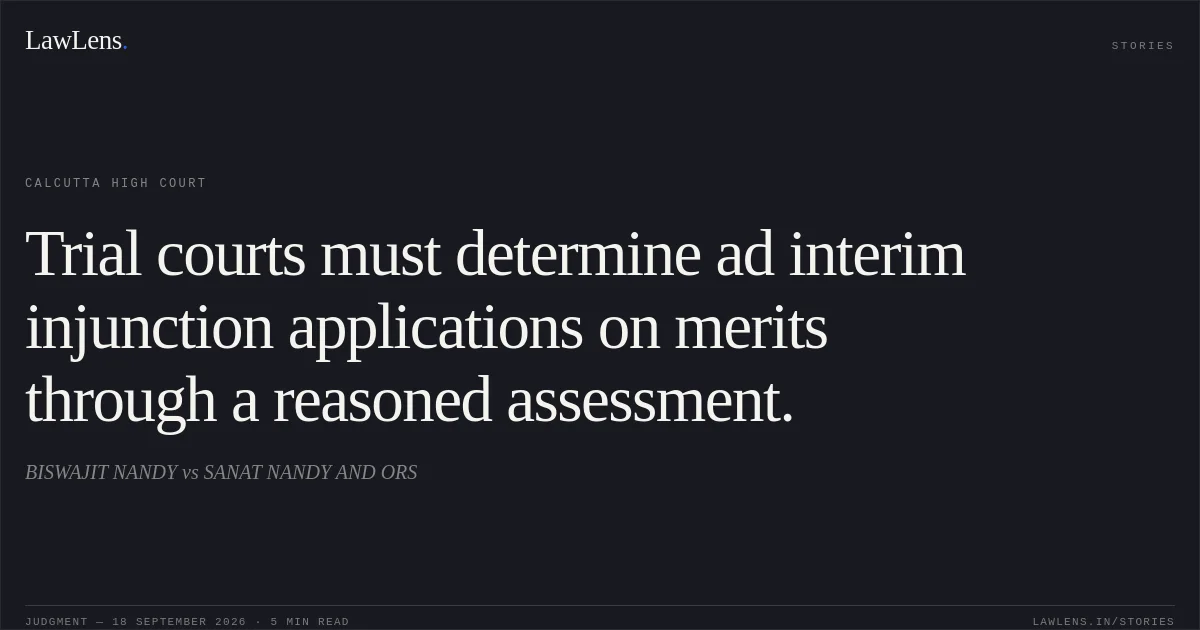
Source reference: para. 17–18The Trial Court refused ad interim injunction, principally on the ground that the defendants ought to be given a reasonable opportunity before an order was passed, without examining the merits or the established tests for injunction.
Source reference: para. 19, 22–24The appellant initially pursued an appeal before the District Court, which admitted the appeal and granted interim protection.
Source reference: para. 6–9That appeal was subsequently dismissed on 31 July 2026 for want of pecuniary jurisdiction.
Source reference: para. 6–9The appellant filed the present appeal on 7 August 2026, after a delay of approximately 388 days, or 335 days according to the Stamp Reporter.
Source reference: para. 6–9The High Court condoned the delay under Section 14 of the Limitation Act, 1963, admitted the appeal under Order XLI Rule 11 of the Code of Civil Procedure, 1908, and considered the injunction application on merits.
Source reference: para. 10–16The respondents contended that the appellant had taken an inconsistent position in a subsequent declaratory suit by claiming exclusive ownership of the A1 schedule property, and that the pleadings in the present suit disclosed the appellant’s dispossession, disentitling him from an injunction.
Source reference: para. 20–21Issues
1. Whether the delay in preferring the appeal was liable to be condoned by extending the benefit of Section 14 of the Limitation Act, 1963, where the appellant had bona fide pursued the same matter before a court lacking pecuniary jurisdiction?
Source reference: para. 6–122. Whether the Trial Court was justified in refusing ad interim injunction without considering the pleadings, materials, prima facie case, balance of convenience, and irreparable injury?
Source reference: para. 22–243. Whether the appellant, as an alleged co-sharer in a partition suit, was entitled to protection against alteration of the nature and character of the A1 schedule property and interference with possession?
Source reference: para. 29–354. Whether the appellate court could grant relief restraining transfer or creation of third-party interests when such relief had not been sought in the original injunction application?
Source reference: para. 36–39Law Applied
The Court applied Section 14 of the Limitation Act, 1963, which permits exclusion of time spent prosecuting a proceeding with due diligence and in good faith before a court that is unable to entertain it for want of jurisdiction.
Source reference: para. 10–12It applied Order XLI Rule 11 of the Code of Civil Procedure, 1908 in admitting the appeal for hearing.
Source reference: para. 14–15On temporary injunctions, the Court relied on the settled requirements of a prima facie case, balance of convenience, and likelihood of irreparable injury, and held that the Trial Court must judicially consider those criteria rather than refuse interim relief solely because the defendants have not yet been heard.
Source reference: para. 22–24, 32–33The Court further applied the principle that, in a partition suit, possession of one co-sharer is ordinarily deemed possession on behalf of the other co-sharers, absent a legally established ouster.
Source reference: para. 31An appellate court cannot enlarge the scope of the injunction application by granting relief not sought before the Trial Court; such additional relief must be pursued by amendment before that court.
Source reference: para. 36–39Reasoning
The High Court found the delay sufficiently explained because the appellant had pursued the same impugned order before the District Court in good faith, where the appeal had been entertained and interim protection granted, and the matter was dismissed only later for want of pecuniary jurisdiction.
Source reference: para. 6–12The appellant approached the High Court within one week of that dismissal, justifying exclusion of the earlier period under Section 14 of the Limitation Act.
Source reference: para. 6–12On the injunction issue, the Trial Court had merely recited the pleadings and submissions and declined relief on the procedural premise that the defendants required an opportunity of hearing; it had not assessed the merits or the three governing tests for interim injunctions.
Source reference: para. 22–24The High Court therefore held that the impugned order was non-speaking and reflected a failure to exercise jurisdiction.
Source reference: para. 22–24The alleged demolition of only a portion of the A schedule property did not, by itself, establish that the appellant had been dispossessed, and the co-sharer principle applied in the context of the partition suit.
Source reference: para. 29–32The pleaded demolition and threatened alteration of the property established a sufficient prima facie case, while the balance of convenience and risk of irreparable injury favoured preservation of the property and the appellant’s alleged possessory rights.
Source reference: para. 32–35However, because restraint against transfer or creation of third-party interests had not formed part of the original injunction prayer, the High Court declined to grant that additional relief in appeal and instead permitted the appellant to seek amendment before the Trial Court.
Source reference: para. 36–39Holding
The High Court allowed CAN 1 of 2026 and condoned the delay in filing the appeal under Section 14 of the Limitation Act, without costs.
The appeal was admitted and allowed against the appearing respondents and ex parte against respondent nos.1 and 2; the Trial Court’s order dated 8 May 2025 was set aside.
Source reference: para. 14–16, 40The respondents, their men, and agents were restrained from changing the nature and character of the A1 schedule property or disturbing the appellant’s possession until disposal of the temporary injunction application by the Trial Court.
Source reference: para. 40The appellant was permitted to seek amendment of the injunction application to include restraint against transfer or creation of third-party interests; objections were directed to be filed within the prescribed time, and the Trial Court was directed to decide the amendment and injunction applications expeditiously.
Source reference: para. 41–45The Court clarified that it had not expressed any final view on the merits of the injunction application or the suit, which were to be independently decided by the Trial Court.
Source reference: para. 46Acts & Sections Cited
1 provisions across 1 statute referred to in this judgment. Each provision opens on LawLens.
Limitation Act, 19631
Original Court PDF
BISWAJIT NANDYvsSANAT NANDY AND ORS
Click to open original judgment
Original judgment, available to read, download and summarize on LawLens.in