Facts
The assessee filed its return for Assessment Year 1996–97 declaring income of ₹1,87,06,270 on 18 February 1998.
Source reference: p.2An assessment under Section 143(3) of the Income Tax Act, 1961 was completed on 31 March 1999, determining total income at ₹20,10,90,540.
Source reference: p.2The assessee’s appeal before the Commissioner (Appeals) was dismissed on 27 March 2001 because it had not paid the tax due on the returned income as required by Section 249(4)(a), and the delay in filing the appeal was not accepted as justified.
Source reference: p.3In further appeal, the Income Tax Appellate Tribunal noted that the assessee’s bank accounts and assets had been attached in connection with block-assessment dues, leaving it without sufficient liquid funds to pay the admitted tax liability when the appeal was filed.
Source reference: pp.9–11The assessee subsequently paid ₹71,23,100 on 30 March 2007, in addition to an earlier adjustment of ₹18,53,095 from a refund.
Source reference: pp.8–9The Tribunal condoned the delay, directed the Commissioner (Appeals) to admit the appeal, and ordered adjudication on merits.
Source reference: pp.3–4, 11–12The Revenue challenged that direction before the High Court.
Source reference: no citationIssues
1. Whether the Tribunal was justified in directing the Commissioner (Appeals) to admit and decide the assessee’s appeal on merits despite the assessee’s failure to comply with Section 249(4)(a) of the Income Tax Act at the time of filing the appeal.
Source reference: p.2 / para. 22. Whether the assessee’s subsequent payment of the admitted tax liability and its established financial inability to make the payment at the time of filing justified relief from the consequence of non-compliance with Section 249(4)(a).
Source reference: pp.9–12 / paras. 3.4–3.5Law Applied
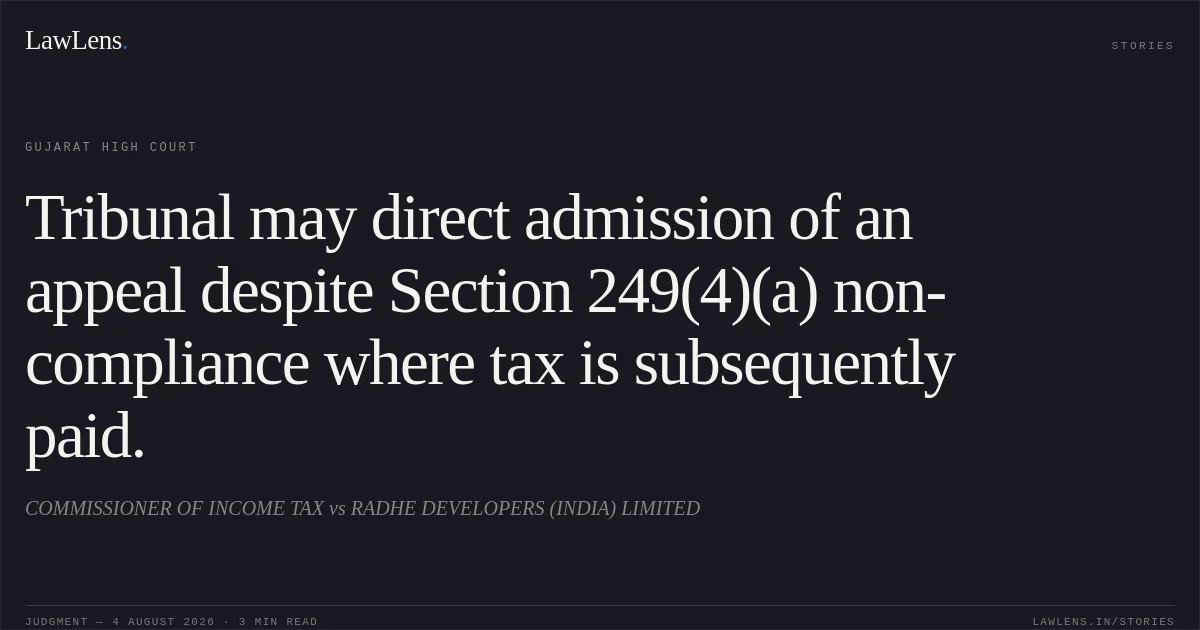
Section 249(4)(a) of the Income Tax Act provides that an appeal cannot be admitted unless, where a return has been filed, the assessee has paid the tax due on the returned income at the time of filing the appeal.
Source reference: pp.5–7 / para. 3.4The provision must be construed in the context of the assessee’s statutory right of appeal and applied to advance its object without causing undue denial of appellate adjudication.
Source reference: pp.6–8 / para. 3.4The Court relied on Collector, Land Acquisition v. MST Katiji, (1987) 167 ITR 471 (SC), for a liberal and justice-oriented approach to condonation of delay.
Source reference: p.4 / para. 3.3The Court relied on S.T. Texturisers v. Union of India, (2002) 142 ELT 306 (Guj.) and Scan Computer Consultancy v. Union of India, (2006) 73 RLT 120 (Guj.), concerning the Tribunal’s power to secure the ends of justice in appropriate circumstances.
Source reference: pp.10–12 / para. 3.5The Court also considered the principle recognised in J.K. Synthetics Ltd. v. Collector of Central Excise, (1996) 6 STC 92 (SC), that a tribunal possessing power to secure the ends of justice may grant appropriate procedural relief where strict application of a procedural requirement would result in manifest injustice.
Source reference: pp.13–15 / paras. 4.1–4.2Reasoning
The Tribunal found, on the documentary material, that the assessee was unable to pay the admitted tax when the appeal was filed because its bank accounts and assets had been attached by the Department in connection with block-assessment dues, and its funds were consequently unavailable.
Source reference: pp.9–12 / paras. 3.4–3.5The assessee had also paid ₹71,23,100 in 2007 and had an earlier refund of ₹18,53,095 adjusted towards its liability.
Source reference: pp.8–9In these circumstances, the Tribunal treated the subsequent payment and the assessee’s demonstrated financial incapacity as sufficient grounds to direct admission of the appeal and adjudication on merits.
Source reference: no citationThe High Court held that this approach was consistent with a liberal construction of Section 249(4)(a), the assessee’s right of appeal, and the Tribunal’s jurisdiction to prevent manifest injustice and secure the ends of justice.
Source reference: pp.15–16 / paras. 5–6The Tribunal therefore had not committed an error in issuing the direction.
Source reference: no citationHolding
The High Court answered the substantial question of law in favour of the assessee and against the Revenue.
It upheld the Tribunal’s direction requiring the Commissioner (Appeals) to admit the assessee’s appeal and decide it on merits, notwithstanding the initial non-compliance with Section 249(4)(a), particularly because the assessee had subsequently paid the relevant amount and had shown that it lacked the financial capacity to make the payment when the appeal was filed.
Source reference: pp.15–16 / paras. 5–6The Revenue’s appeal was accordingly dismissed.
Source reference: p.16 / para. 7Acts & Sections Cited
7 provisions across 1 statute referred to in this judgment. Linked provisions open on LawLens.
Income Tax Act, 19617
Original Court PDF
COMMISSIONER OF INCOME TAXvsRADHE DEVELOPERS (INDIA) LIMITED
Click to open original judgment
Original judgment, available to read, download and summarize on LawLens.in