01Facts
The petitioner challenged his transfer from Delhi to Aurangabad and the consequential relieving order before the Central Administrative Tribunal in OA 1225/2026.
¶ 2The Tribunal declined to interfere with the transfer but quashed the relieving order dated 30 March 2026, directed the respondents to decide the petitioner’s representation by a reasoned order, and restrained his relieving until such decision.
¶ 3, 3(i)–(iv)The petitioner thereafter filed Review Application No. 88/2026, contending that several submissions made in the original proceedings had not been considered.
¶ 4The Review Application was dismissed by a detailed order passed in circulation, without hearing the parties.
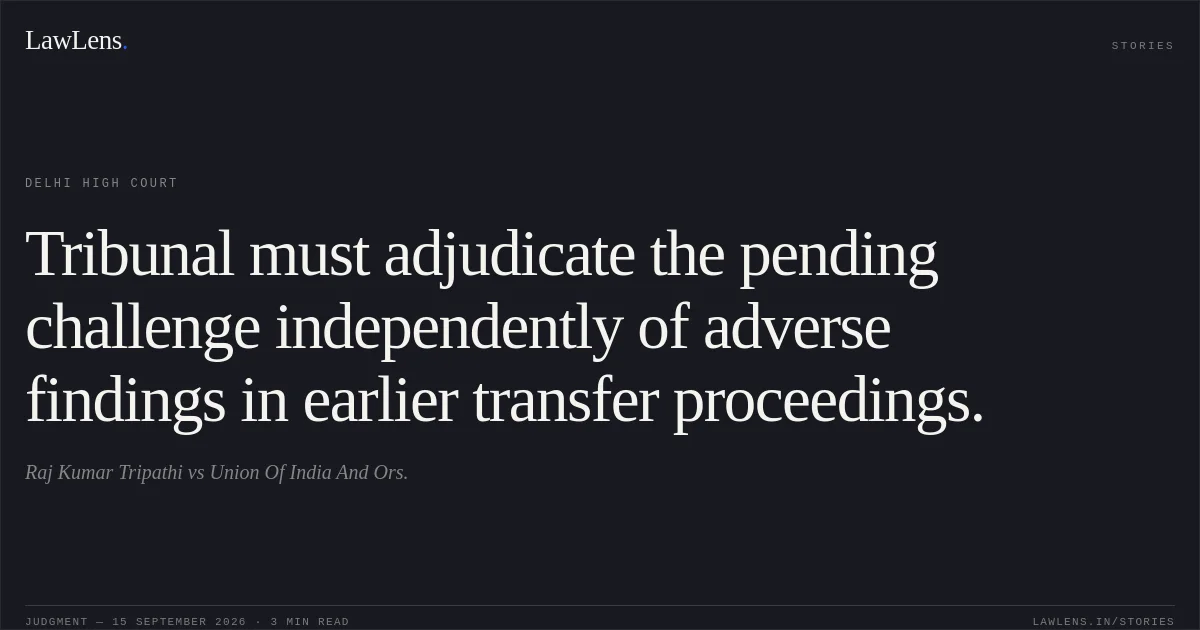
¶ 4During the writ proceedings, the petitioner stated that he had filed a subsequent OA No. 2723/2026 challenging the adverse decision on his representation, and apprehended that the Tribunal might be influenced by the findings in the earlier proceedings.
¶ 8–902Issues
i.Whether the Tribunal’s dismissal of the Review Application by a detailed order, without personally hearing the parties, required interference on grounds of procedural fairness and natural justice.
¶ 4–5ii.Whether the petitioner required protection against the Tribunal being influenced, while deciding OA No. 2723/2026, by observations adverse to him in the orders dated 8 July 2026 and 7 August 2026.
¶ 8–10iii.Whether any further adjudication on the merits of the transfer, relieving order, or representation was warranted in the writ petition.
¶ 10–1503Law Applied
The Court applied the principle of natural justice that where a detailed and reasoned order is required to be passed in a review proceeding, the affected parties ought ordinarily to be personally heard before such order is made.
¶ 5It also applied the principle that a matter pending before a judicial or quasi-judicial forum must be decided independently and on its own merits, without being prejudiced by adverse observations made in earlier proceedings, particularly where the subsequent proceeding concerns the petitioner’s challenge to a later decision.
¶ 10No specific statutory provision or precedent was relied upon in the order.
04Reasoning
The Court observed that the Tribunal had substantially protected the petitioner in the original OA by quashing the relieving order, requiring reconsideration of his representation, and preserving his opportunity to challenge any adverse decision.
¶ 3, 8Although the Court noted that the Review Application had been dismissed without hearing the parties despite containing a detailed order, it did not undertake a merits review of the transfer dispute.
¶ 9–11Instead, addressing the petitioner’s stated apprehension, the Court directed that OA No. 2723/2026 be adjudicated uninfluenced by any observations adverse to the petitioner in the earlier orders.
¶ 9–11With the consent of the parties, the Court also requested the Tribunal to take up the pending OA on 16 September 2026 and hear it finally, while making clear that neither side would seek an adjournment on that date.
¶ 12–1405Holding
The writ petition was disposed of without expressing any opinion on the merits.
¶ 10–15The High Court clarified that, while deciding OA No. 2723/2026, the Tribunal must proceed uninfluenced by observations adverse to the petitioner in the orders dated 8 July 2026 in OA 1225/2026 and 7 August 2026 in RA 88/2026.
¶ 10–11The Tribunal was requested to hear OA No. 2723/2026 finally on 16 September 2026 and pronounce its judgment expeditiously; no party was permitted to seek an adjournment on that date.
¶ 13–15Original Court PDF
Raj Kumar TripathivsUnion Of India And Ors.
Click to open original judgment
Original judgment, available to read, download and summarize on LawLens.in