Facts
The petitioner sought bail on behalf of Smt. Sima Devi and Smt. Soni Devi, who were arrested on 5 April 2026 in connection with R.K. Pur P.S. Case No. 32 of 2016, registered under Sections 20(b)(ii)(c) and 29 of the Narcotic Drugs and Psychotropic Substances Act, 1985 (“NDPS Act”).
Source reference: p.1Acting on secret information, police intercepted a bus at Garjee Naka Point, Belonia Chittamara. The accused were allegedly found travelling with four nylon sacks containing 27.8 kg of ganja recovered from Soni Devi and 26 kg from Sima Devi; both were arrested at the spot.
Source reference: p.2The principal ground for bail was that the arrest memos did not bear the signature of a family member or a respectable person of the locality, allegedly violating Section 36 of the Bharatiya Nagarik Suraksha Sanhita, 2023 (“BNSS”) and rendering the arrests illegal.
Source reference: p.2–5The prosecution stated that the accused’s husbands had been informed of the arrests by telephone through a person known as Lalan Chouhan, and that the printed arrest-memo form did not contain a column for such attestation.
Source reference: p.6, 10Issues
1. Whether non-obtaining of the signature of a family member or respectable person of the locality on the arrest memo, in alleged violation of Section 36 of the BNSS, automatically rendered the arrests illegal and entitled the accused to bail
Source reference: p.2–5, 14–152. Whether, notwithstanding the alleged procedural violation, the accused satisfied the mandatory twin conditions for bail under Section 37(1)(b)(ii) of the NDPS Act in a case involving commercial quantity of ganja
Source reference: p.6–10, 15–163. Whether the principles in D.K. Basu v. State of West Bengal and Articles 21 and 22 of the Constitution required release on bail in the absence of any allegation of illegal detention, false arrest, custodial torture, or lack of transparency
Source reference: p.10–15Law Applied
Section 36(b)(i) of the BNSS requires an arrest memorandum to be attested by at least one witness who is a member of the arrested person’s family or a respectable person of the locality; Section 62 of the BNSS requires arrests to be made in accordance with the BNSS or any other applicable law.
Source reference: p.5The safeguards in D.K. Basu v. State of West Bengal, (1997) 1 SCC 416, particularly preparation and attestation of the arrest memo, flow from Articles 21 and 22 and aim to secure transparency and accountability in arrest and custody.
Source reference: p.2–4However, D.K. Basu does not hold that every infraction of those directions automatically invalidates an arrest or creates an indefeasible right to bail, particularly where there is no illegal detention, fabricated arrest, custodial abuse, or mala fide conduct.
Source reference: p.13–14Section 37(1)(b)(ii) of the NDPS Act imposes a stringent restriction on bail in cases involving commercial quantity: the Public Prosecutor must be given an opportunity to oppose bail, and the Court must be satisfied that there are reasonable grounds for believing that the accused is not guilty and is unlikely to commit an offence while on bail.
Source reference: p.6–7The Court also relied on Narcotics Control Bureau v. Mohit Aggarwal, State of Punjab v. Sukhwinder Singh @ Gora, and State of Punjab v. Balraj Singh @ Billa for the mandatory nature of the Section 37 conditions.
Source reference: p.8–10Reasoning
The Court held that the omission to obtain the signature of a relative or respectable local person on the arrest memo did not, in the circumstances, automatically invalidate the arrests.
Source reference: p.10, 15The arrest memos recorded the names and addresses of the accused persons’ husbands, and the case diary indicated that the husbands were informed of the arrests and the grounds of arrest by telephone.
Source reference: p.10, 15The Court also noted that the prescribed printed form itself was defective because it did not provide a space for the required attestation, although it directed that such defects be rectified prospectively.
Source reference: p.6, 15–16Emphasising that the safeguards under Section 36 BNSS and D.K. Basu principally address custodial abuse, transparency, and accountability, the Court found no allegation of illegal detention, false demonstration of arrest, custodial torture, or mala fide conduct in the present case.
Source reference: p.13–15Since the alleged recovery substantially exceeded the commercial-quantity threshold and incriminating material was available in the case diary, the Court found that the accused did not satisfy the twin conditions under Section 37(1)(b)(ii) of the NDPS Act.
Source reference: p.15–16Holding
The Court answered the issues against the accused. It held that the alleged non-compliance with Section 36 of the BNSS did not, on the facts of the case, render the arrests illegal or override the restrictions imposed by Section 37 of the NDPS Act.
As the accused failed to establish reasonable grounds for believing that they were not guilty and that they were unlikely to commit an offence while on bail, the bail application was rejected.
Source reference: p.16The case diary was returned to the Public Prosecutor, the Trial Court record was re-consigned, and any pending applications were disposed of.
Source reference: p.16Acts & Sections Cited
20 provisions across 4 statutes referred to in this judgment. Each provision opens on LawLens.
Narcotic Drugs and Psychotropic Substances Act, 19857
Bharatiya Nagarik Suraksha Sanhita, 20232
Code of Criminal Procedure, 1973
Indian Penal Code, 18602
Original Court PDF
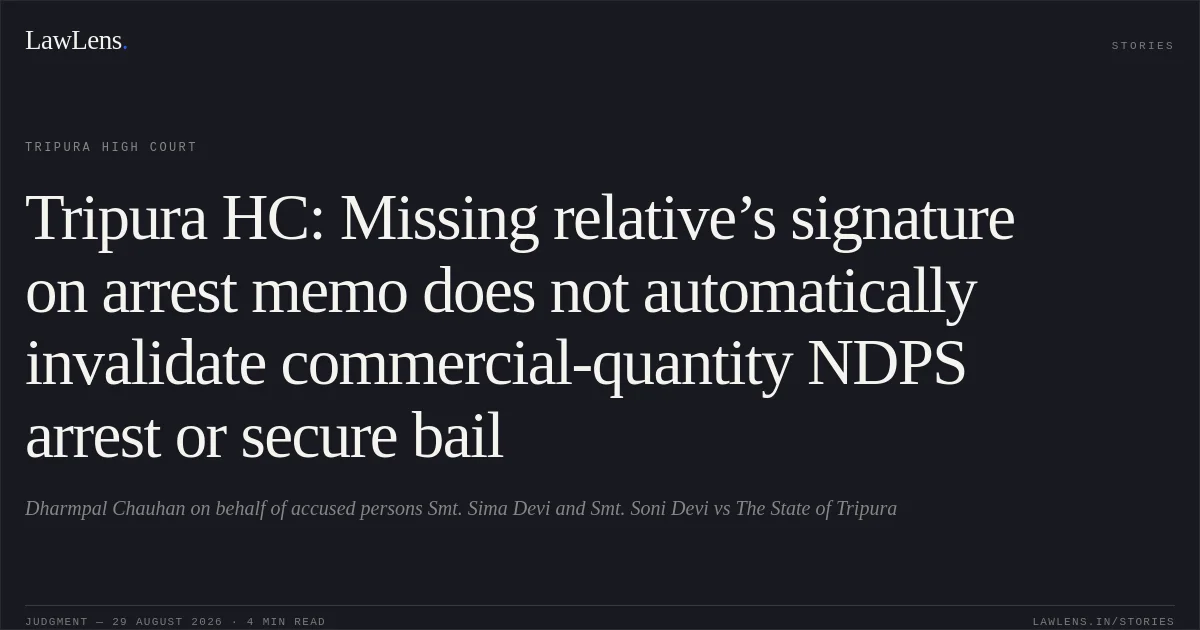
Dharmpal Chauhan on behalf of accused persons Smt. Sima Devi and Smt. Soni DevivsThe State of Tripura
Click to open original judgment
Original judgment, available to read, download and summarize on LawLens.in
![A police constable cannot be removed for unauthorized absence without a Rule 359-compliant inquiry.. Mohammad Sidiq Khan vs D/o Home Ut Of Jammu & Kashmir. CAT - ['Srinagar']. LawLens](/stories/thumbnails/a-police-constable-cannot-be-removed-for-unauthorized-absence-without-a-rule-359-compliant-7b43fc316bd94f22a62676153bbc9d54.webp)
![A Review DPC lacks authority to determine or alter inter se seniority.. SAURABH KUMAR vs REVENUE. CAT - ['Patna']. LawLens](/stories/thumbnails/a-review-dpc-lacks-authority-to-determine-or-alter-inter-se-seniority-4b21640f20af46fcabdfc8273d2ce959.webp)