Facts
Unison Hotels Private Limited (“UHPL”) insured its hotel under a Standard Fire and Special Perils Policy and a Fire Loss of Profit Policy issued by IFFCO Tokio General Insurance Company Limited (“Insurance Company”). Following a fire on 26 January 2008, UHPL claimed approximately ₹68.64 crores under the material-damage policy and ₹100 crores under the loss-of-profit policy. The Insurance Company paid ₹20 crores and ₹30 crores respectively and asserted that the claims had been fully and finally settled through discharge vouchers.
Source reference: paras. 4–6UHPL invoked the arbitration clause contained in Clause 13 of the policies. A three-member Arbitral Tribunal was constituted on 27 April 2012. The Tribunal reserved the award on 6 March 2021 and pronounced it on 6 March 2023, after a delay of approximately two years. The Tribunal rejected the Insurance Company’s plea that the claims stood discharged by accord and satisfaction, holding that the discharge vouchers had been executed under financial duress and coercion. It consequently awarded UHPL ₹65,12,97,874, along with interest and costs.
Source reference: paras. 7–9The Insurance Company challenged the award under Section 34 of the Arbitration and Conciliation Act, 1996, principally contending that the award was vitiated by inordinate and unexplained delay and that, under Clause 13, only disputes concerning quantum were arbitrable where liability had otherwise been admitted. The learned Single Judge set aside the award, holding that the delay had adversely affected the Tribunal’s consideration of jurisdiction and arbitrability, particularly in relation to Clause 13. UHPL appealed under Section 37(2)(b).
Source reference: paras. 10–20Issues
Whether an arbitral award can be set aside solely because there was a substantial delay between reservation and pronouncement of the award?
Source reference: paras. 1–3, 17, 36–38.7Whether delay in pronouncing an award vitiates it only when the delay is unexplained and has an explicit adverse impact on the findings recorded in the award?
Source reference: paras. 37.5–37.12, 38.4–38.7Whether the Insurance Company was required to invoke Section 14(2) of the Arbitration and Conciliation Act, 1996, or whether it could challenge the delayed award directly under Section 34?
Source reference: paras. 37.4, 55–56Whether the Arbitral Tribunal had failed to address the arbitrability of the dispute under Clause 13 of the insurance policies?
Source reference: paras. 39–54, 68Whether the learned Single Judge was justified in setting aside the award without examining the merits of the award or identifying any particular finding adversely affected by the delay?
Source reference: paras. 57–66Law Applied
The Court applied Sections 34 and 37 of the Arbitration and Conciliation Act, 1996, under which an arbitral award may be set aside only on the statutorily recognised and narrowly construed grounds, and appellate interference under Section 37 cannot exceed the limitations applicable under Section 34.
Source reference: paras. 59–61Relying principally on Lancor Holdings Ltd. v. Prem Kumar Menon, the Court held that delay in pronouncing an award is not, by itself, a ground for setting aside the award; delay becomes legally significant only where its negative effect is explicit, it adversely reflects on the findings, it remains unexplained, and the award is materially affected by the consequences of such delay.
Source reference: paras. 37.5–37.12C. Velusamy v. K. Indhera reaffirmed that delay alone does not invalidate an award and that the Section 14 remedy is not a condition precedent to a Section 34 challenge.
Source reference: paras. 38.4–38.7The Court also applied Section 14(1)(a) and Section 14(2), Section 29A, the principle of minimal judicial intervention, and the rule that remand under Section 37 is permissible only in exceptional circumstances.
Source reference: paras. 33–35, 55–63Under Clause 13, only disputes concerning quantum were arbitrable where liability was otherwise admitted; however, a challenge based on accord and satisfaction could be adjudicated as part of determining whether any further quantum remained payable.
Source reference: paras. 48–53Reasoning
The Court held that the learned Single Judge had applied an impermissible presumption that the arbitrators might have forgotten the parties’ submissions merely because the award was delivered two years after it was reserved. The Single Judge did not identify any particular argument that had been forgotten, any finding affected by the delay, or any specific prejudice caused to the Insurance Company.
Source reference: paras. 57–58Under Lancor Holdings and Velusamy, actual and demonstrable adverse impact on the award—not a mere possibility of diminished memory—was essential.
Source reference: no citationThe delay was also not wholly unexplained. The Tribunal recorded the disruption caused by the COVID-19 pandemic, delays by the parties in filing written submissions, and the need for deliberation among three arbitrators, including senior retired judges.
Source reference: paras. 69–73Unlike the award in Lancor Holdings, the present award was detailed, reasoned, unanimous, and addressed the material issues. The Insurance Company could not identify a single submission raised before the Tribunal that had not been considered in the award.
Source reference: paras. 75–78The Court further found that the Insurance Company’s pleadings did not specifically contend that the dispute was non-arbitrable under Clause 13. Its principal objection was that the claims had been discharged by accord and satisfaction. The Tribunal exhaustively examined that objection and held that the discharge vouchers were executed under financial duress and therefore did not extinguish UHPL’s claims.
Source reference: paras. 41–43, 46Once the discharge was found ineffective, the dispute remained one concerning the quantum payable, while the Insurance Company’s underlying liability under the policies remained undisputed; consequently, the dispute fell within Clause 13.
Source reference: paras. 48–54Finally, the Single Judge’s refusal to examine the merits was contrary to the legal test governing delay-based challenges, because determining whether delay had adversely affected the award necessarily required scrutiny of the award’s findings.
Source reference: paras. 64–66Since the Single Judge had not considered the merits at all, the case warranted remand rather than final adjudication by the Division Bench.
Source reference: paras. 62–63Holding
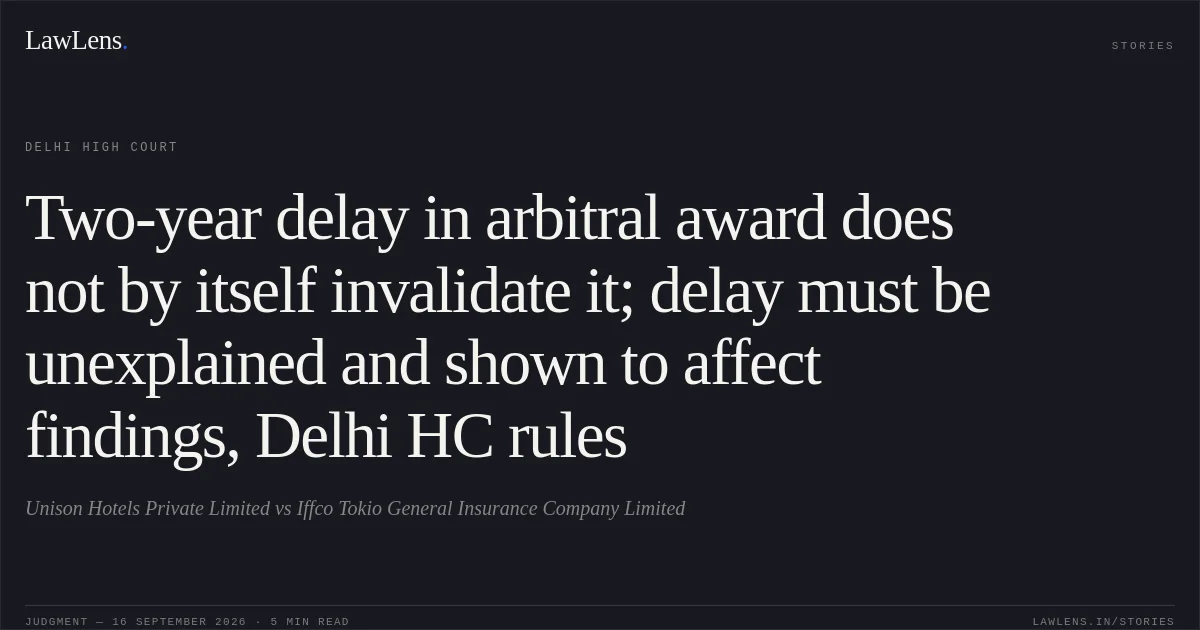
The Division Bench held that delay in pronouncing an arbitral award is not, by itself, sufficient to invalidate the award. The delay must be unexplained and must be shown to have explicitly and adversely affected the findings in the award.
In the present case, the delay was adequately explained, the award comprehensively addressed the issues, and no specific finding or submission was shown to have been affected by the delay.
Source reference: paras. 71–78, 85The Court also held that the Tribunal had effectively addressed the maintainability and arbitrability issues arising from Clause 13, and that the Single Judge had erred in presuming that the Tribunal had forgotten the parties’ submissions.
Source reference: paras. 68, 85(vi)The impugned judgment dated 30 January 2026 was therefore quashed and set aside. The Section 34 petition, OMP (COMM) 197/2023, was remanded to the learned Single Judge for fresh consideration on merits, uninfluenced by the earlier judgment.
Source reference: paras. 86–88The appeal was allowed without an order as to costs.
Source reference: para. 89Acts & Sections Cited
14 provisions across 3 statutes referred to in this judgment. Each provision opens on LawLens.
Arbitration and Conciliation Act, 1996
Indian Contract Act, 18722
Original Court PDF
Unison Hotels Private LimitedvsIffco Tokio General Insurance Company Limited
Click to open original judgment
Original judgment, available to read, download and summarize on LawLens.in