Facts
The appellants, Ukrainian nationals, were arrested on 13 March 2026 in FIR/RC No. 7/2026/NIA/DLI, registered for an offence under Section 18 of the Unlawful Activities (Prevention) Act, 1967 (“UAPA”), concerning an alleged conspiracy involving local ethnic armed groups and activities prejudicial to national security.
Source reference: paras. 3, 21The National Investigation Agency (“NIA”) applied under Section 43D(2)(b) of the UAPA read with Section 187 of the Bharatiya Nagarik Suraksha Sanhita, 2023, seeking extension of the investigation and detention period from 90 to 180 days.
Source reference: para. 22On 4 June 2026—before expiry of the initial 90-day period—the Special Court allowed the application after considering the Public Prosecutor’s report, case diaries, the progress of investigation, and the reasons for continued detention.
Source reference: paras. 23–25The appellants filed an appeal under Section 21 of the National Investigation Agency Act, 2008 (“NIA Act”), contending that the extension order effectively postponed or defeated their statutory right to default bail.
Source reference: paras. 5–16The NIA objected that the order was interlocutory and therefore non-appealable under Section 21.
Source reference: paras. 5–16Issues
Whether an order granting extension of the investigation and detention period from 90 to 180 days under Section 43D(2)(b) of the UAPA is an interlocutory order and consequently not appealable under Section 21 of the NIA Act.
Source reference: para. 18Whether, notwithstanding the non-maintainability of the statutory appeal, the High Court could examine the challenge by exercising inherent jurisdiction under Section 482 of the Code of Criminal Procedure, 1973 (“CrPC”)/Section 528 of the BNSS.
Source reference: paras. 31, 38–39Law Applied
The Court applied Section 21(1) and (3) of the NIA Act, under which an appeal lies against a judgment, sentence, or non-interlocutory order of a Special Court, while Section 21(4) separately provides an appeal against an order granting or refusing bail.
Source reference: p. 6Section 43D(2)(b) of the UAPA permits extension of the 90-day investigation and detention period up to 180 days where the Court is satisfied, on the Public Prosecutor’s report, regarding the progress of investigation and the specific reasons for continued detention.
Source reference: pp. 7–8Applying the classification of orders into final, interlocutory, and intermediate orders recognised in Madhu Limaye v. State of Maharashtra, (1977) 4 SCC 551, the Court held that an order granting extension merely postpones the accused’s entitlement to default bail and does not finally determine that right.
Source reference: paras. 34–36It relied on Syed Shahid Yousuf v. National Investigation Agency, 2018 SCC OnLine Del 9329, for the proposition that such an order is interlocutory but may be judicially reviewed under Section 482 CrPC/Section 528 BNSS.
Source reference: para. 31The Court also considered State (NCT of Delhi) v. Anamul Ansari, 2024:DHC:9588-DB, which treated an order refusing extension as appealable because of its irreversible consequences for the prosecution, and the decisions in Jai Kishan Sharma v. Union of India, 2019 SCC OnLine Gau 5814, and National Investigation Agency v. Akhil Gogoi, 2022 SCC OnLine Gau 1446, which treated an order granting extension as interlocutory.
Source reference: paras. 27–33Reasoning
The Court distinguished between an order refusing extension and one granting extension.
Source reference: no citationAlthough the grant of extension prevents the accused from claiming default bail on expiry of the initial 90-day period, the Court held that the statutory right is not extinguished; its exercise is merely postponed until the extended period expires, i.e., to the 181st day rather than the 91st day.
Source reference: para. 34The extension order does not finally terminate the proceedings, conclusively determine the accused’s rights, or impose irretrievable consequences.
Source reference: paras. 34–36It represents a conditional exercise of judicial discretion based on the Public Prosecutor’s report, the progress of investigation, and specific reasons for continued detention.
Source reference: paras. 34–36Consequently, the order lacked the finality or intermediate character necessary to take it outside the category of interlocutory orders.
Source reference: paras. 35–37Section 21 of the NIA Act therefore did not confer a statutory right of appeal against it.
Source reference: paras. 35–37Nevertheless, following Syed Shahid Yousuf, the Court held that the legality of the extension could be examined through the High Court’s inherent jurisdiction, and that requiring the appellants to institute separate proceedings would cause unnecessary multiplicity, particularly since they remained in custody.
Source reference: paras. 38–40Holding
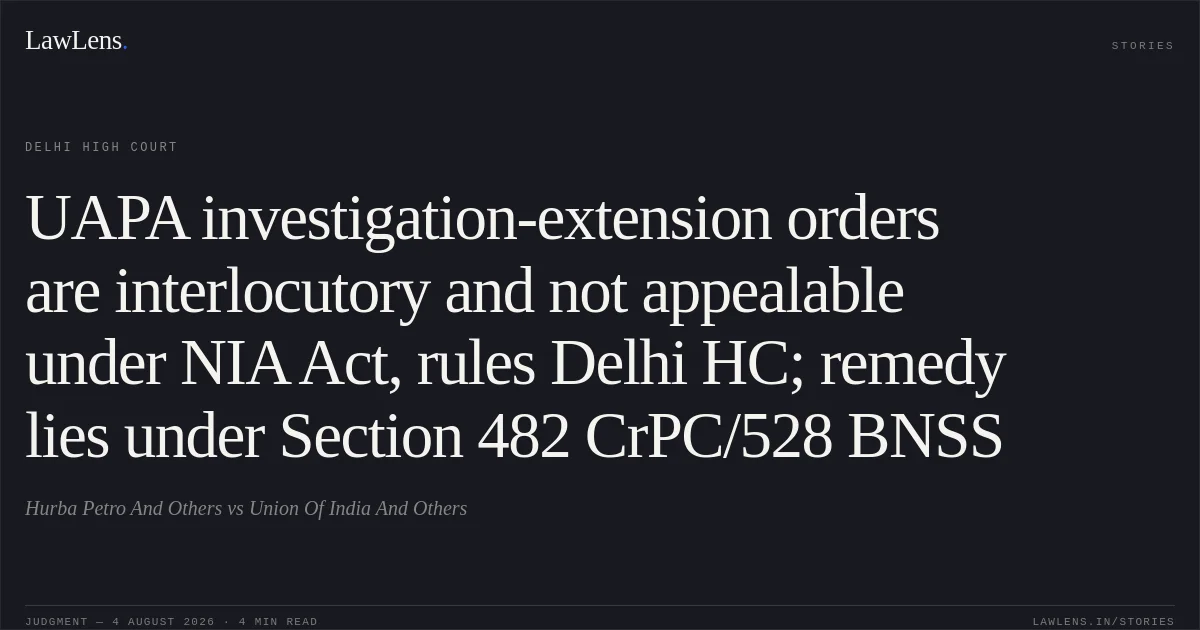
The Court held that an order granting extension of the investigation and detention period under Section 43D(2)(b) of the UAPA is interlocutory and is not appealable under Section 21 of the NIA Act.
However, such an order is amenable to judicial review under Section 482 CrPC/Section 528 BNSS.
Source reference: para. 38Accordingly, instead of dismissing the proceedings outright, the Court directed that the appeal be renumbered and treated as a writ petition/application under Section 482 CrPC/Section 528 BNSS and listed before the appropriate Roster Bench.
Source reference: para. 39Original Court PDF
Hurba Petro And OthersvsUnion Of India And Others
Click to open original judgment
Original judgment, available to read, download and summarize on LawLens.in