Facts
The Appellant/Complainant filed a complaint under Section 138 of the Negotiable Instruments Act (NI Act).
Source reference: p. 3She alleged that the Accused issued a cheque (Ext. P1) for ₹55,000 on 20.09.2005 to discharge a liability.
Source reference: p. 2The cheque was dishonoured upon presentation with the bank memo citing "alteration in date" and "requires full signature".
Source reference: p. 3The Accused contended that the cheque was issued in 2004 for a sum of ₹25,000 and was materially altered by the Complainant by changing the year '04' to '05' without his authentication.
Source reference: p. 6The Trial Court acquitted the accused on 27.11.2006, ruling that the cheque was void due to material alteration.
Source reference: p. 1, 3-4Issues
1. What is the legal effect of correcting the date of a cheque without authentication by the drawer’s signature?
Source reference: p. 52. What are the legal consequences of a material alteration found in a Negotiable Instrument?
Source reference: p. 53. Whether the Trial Court was correct in holding that the accused did not commit an offence under Section 138 of the NI Act because the instrument was void?
Source reference: p. 5Law Applied
The Court primarily applied Section 87 of the Negotiable Instruments Act, 1881, which governs the effect of material alterations.
Source reference: p. 6Under this provision, any material alteration of a negotiable instrument renders it void against any party who is a party at the time of the alteration and does not consent to it, unless the alteration was made to carry out the common intention of the original parties.
Source reference: p. 6-7The court noted that a change in date constitutes a material alteration that requires authentication by the drawer's full signature to remain valid.
Source reference: p. 7Reasoning
The Court examined Ext. P1 and the bank memo (Ext. P2), noting that the year '05' had been rewritten after erasing the previous entry.
Source reference: p. 5-6Applying Section 87 of the NI Act, the Court reasoned that for an altered cheque to remain a valid basis for prosecution, the alteration must be authenticated by the drawer's full signature at the place of correction.
Source reference: p. 7Since the correction from '04' to '05' lacked the drawer’s signature, it was deemed a material alteration made without the proven common intention of the parties.
Source reference: p. 7Because a void instrument cannot form the basis of a criminal prosecution under Section 138, the statutory presumptions under Section 139 could not be invoked by the Complainant.
Source reference: p. 4, 7Holding
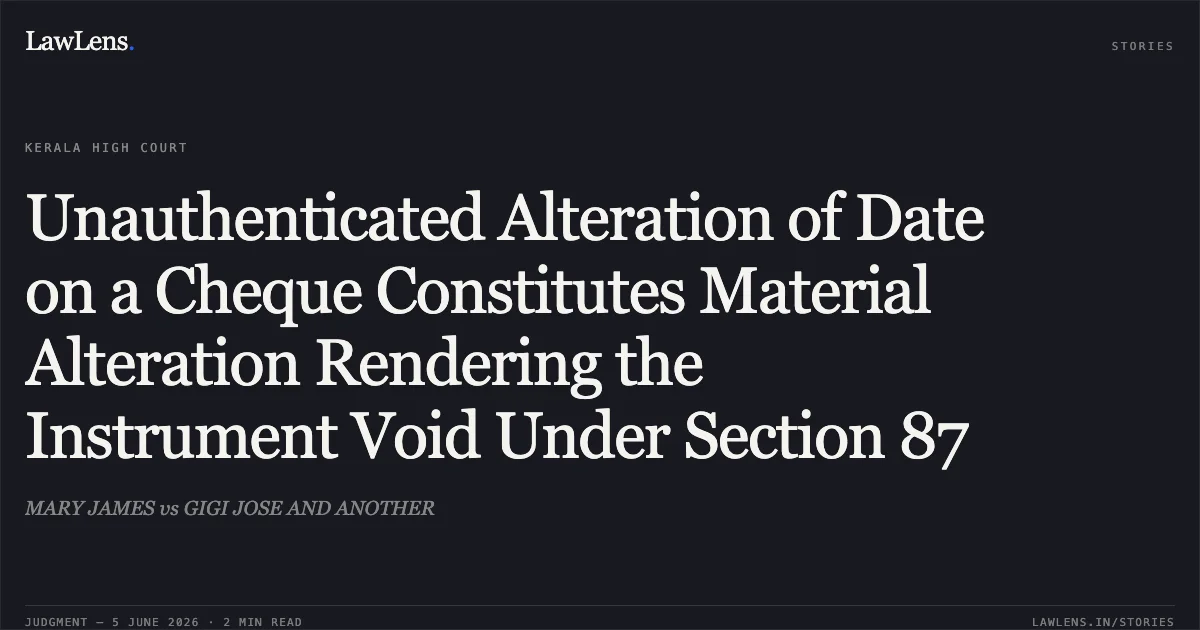
The Court answered that a correction in the date without the drawer's signature constitutes a material alteration that renders the instrument void.
The High Court upheld the Trial Court's verdict, holding that no prosecution under Section 138 of the NI Act is permissible based on a void cheque.
Source reference: p. 7-8The criminal appeal was dismissed, and the acquittal of the accused was confirmed.
Source reference: p. 8Acts & Sections Cited
3 provisions across 1 statute referred to in this judgment. Each provision opens on LawLens.
Negotiable Instruments Act, 18813
Original Court PDF
MARY JAMESvsGIGI JOSE AND ANOTHER
Click to open original judgment
Original judgment, available to read, download and summarize on LawLens.in