Facts
The petitioner claimed title over land situated at Village Padra, Tehsil Huzur, District Rewa, recorded in Khasra Nos. 469/1 and 470/1, measuring approximately 0.035 hectare and 0.099 hectare respectively.
Source reference: para. 3; p. 2In 2005, the Municipal Corporation, Rewa allegedly occupied approximately 2,340.80 square feet of the petitioner’s land and constructed a WBM road without initiating acquisition proceedings or paying compensation.
Source reference: para. 3; p. 2The petitioner sought demarcation of the land. Pursuant to the Tahsildar’s order dated 27 December 2006, the Patwari conducted demarcation on 8 December 2007 and submitted a report and panchnama. The Tahsildar confirmed the demarcation report by order dated 30 January 2008.
Source reference: paras. 3, 7; pp. 2–3The petitioner subsequently applied for compensation before the Municipal Corporation and other authorities, including under Section 79-A of the Madhya Pradesh Municipal Corporation Act, 1956, but no compensation was paid.
Source reference: para. 3; p. 2The Municipal Corporation opposed the petition on the grounds of delay and laches and contended that the disputed land did not belong to the petitioner, relying upon a Google Map location.
Source reference: para. 5; p. 3Issues
Whether the respondents deprived the petitioner of his land for construction of a public road without following the procedure prescribed by law and without payment of compensation?
Source reference: paras. 7, 10; pp. 3, 8Whether delay and laches barred the petitioner from seeking compensation for the continuing deprivation of his property?
Source reference: paras. 5, 7–10; pp. 3, 8Whether the petitioner was entitled to a direction treating the unauthorised occupation as deemed acquisition and requiring payment of compensation with statutory benefits?
Source reference: para. 10; p. 8Law Applied
Article 300-A of the Constitution prohibits deprivation of property except by authority of law; State action taking possession of private property must therefore be supported by a statutory acquisition, requisition, or other legally permissible procedure.
Source reference: para. 8; pp. 3–4In Tukaram Kana Joshi v. MIDC, (2013) 1 SCC 353, the Supreme Court held that the State cannot take private property through executive fiat or administrative arbitrariness and that delay or laches is not an absolute bar where the State has unlawfully deprived a person of property.
Source reference: para. 8; pp. 3–5The same principles were reaffirmed in Sukh Dutt Ratra v. State of H.P., (2022) 7 SCC 508, Vidya Devi v. State of H.P., (2020) 2 SCC 569, and Jilubhai Nanbhai Khachar v. State of Gujarat, 1995 Supp (1) SCC 596, including the proposition that the State cannot evade its legal responsibility merely on the ground of delay where the cause of action is continuing or the circumstances shock the judicial conscience.
Source reference: paras. 8–9; pp. 3–8Sections 78 and 79 of the Madhya Pradesh Municipal Corporation Act, 1956 were applied as the statutory framework for determining and granting compensation by the Municipal Corporation.
Source reference: para. 10; p. 8Reasoning
The Court found that the revenue records established the petitioner’s status as Bhumiswami and that the demarcation conducted by the revenue authorities, followed by confirmation by the Tahsildar, demonstrated that the WBM road encroached upon the petitioner’s land.
Source reference: para. 7; p. 3The respondents neither established lawful acquisition nor showed that compensation had been paid.
Source reference: no citationThe Court rejected the Municipal Corporation’s reliance on Google Maps, holding that such material could not override the official revenue demarcation proceedings.
Source reference: para. 10; p. 8The Court also rejected delay and laches as a defence.
Source reference: no citationThe petitioner had objected to the encroachment through proceedings under Section 32 of the Madhya Pradesh Land Revenue Code and had thereafter made formal claims for compensation. These circumstances demonstrated that he had neither consented to nor acquiesced in the construction of the road.
Source reference: para. 10; p. 8Applying Article 300-A and the principles in Tukaram Kana Joshi, Sukh Dutt Ratra, and Vidya Devi, the Court held that the continuing deprivation of property without lawful acquisition could not be validated by the petitioner’s delayed approach to the Court.
Source reference: paras. 8–10; pp. 3–8Holding
The petition was allowed.
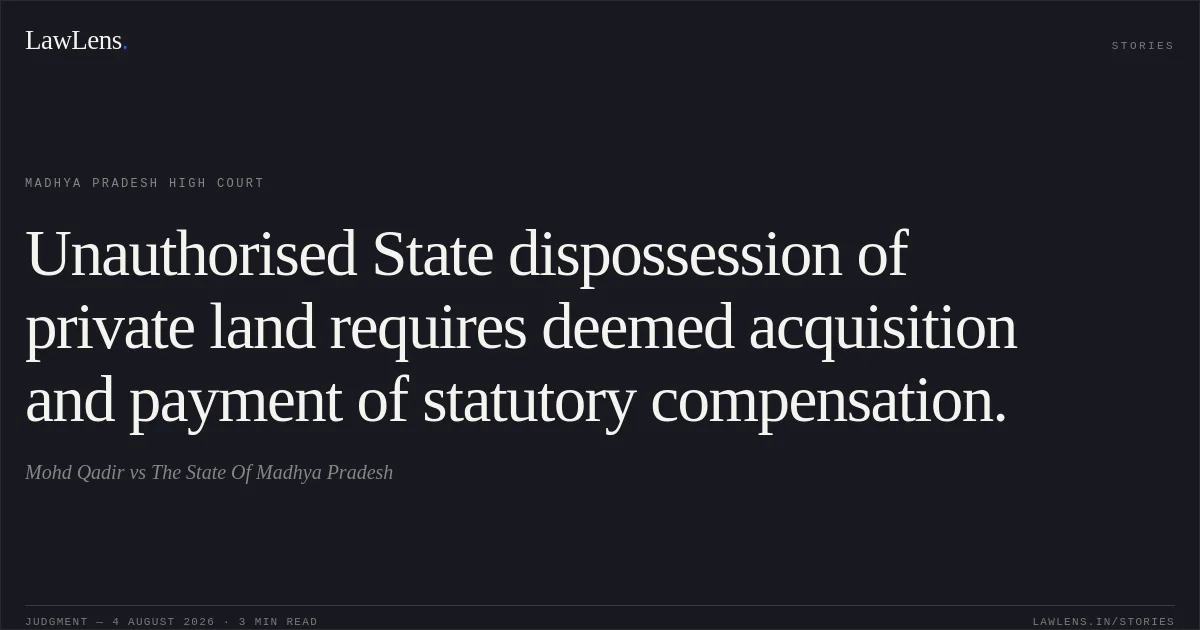
The Court held that the respondents had occupied the petitioner’s land for construction of the WBM road without following the procedure established by law and without paying compensation, thereby violating the petitioner’s constitutional protection under Article 300-A.
Source reference: para. 10; p. 8The encroached land was directed to be treated as deemed acquired, and Respondent No. 3—the Municipal Corporation, Rewa—was directed to proceed under Sections 78 and 79 of the Madhya Pradesh Municipal Corporation Act, 1956 and pay compensation together with all statutory benefits within four months.
Source reference: para. 10; p. 8The Collector, Rewa was directed to provide necessary cooperation to the Municipal Commissioner.
Source reference: para. 10; p. 8Acts & Sections Cited
1 provisions across 1 statute referred to in this judgment. Each provision opens on LawLens.
MP Land Revenue Code 19591
Original Court PDF
Mohd QadirvsThe State Of Madhya Pradesh
Click to open original judgment
Original judgment, available to read, download and summarize on LawLens.in