Facts
The plaintiffs (appellants) filed a suit for possession of land, demolition of structures, and mesne profits, claiming their ancestor Niku had migrated to Kullu and appointed a neighbor, Dhaniya (defendants’ ancestor), as a caretaker (Rakhwala)
Source reference: para 2The defendants contested, asserting they were non-occupancy tenants who became owners by operation of the H.P. Tenancy and Land Reforms Act
Source reference: para 3Revenue records from 1954-1963 initially showed Dhaniya as a tenant paying 1/4th produce as rent (Gallabatai), but later entries deleted the rent details without explanation
Source reference: para 15-16, 21Both the Trial Court and the First Appellate Court dismissed the plaintiffs' suit, finding that a tenancy existed rather than a caretaker arrangement
Source reference: para 7-8Issues
Whether the Courts below erroneously held the defendants to be tenants despite an alleged failure to prove tenancy via a formal application
Source reference: para 9Whether the Courts below misconstrued the revenue documents Ext.P1 to P4
Source reference: para 9Law Applied
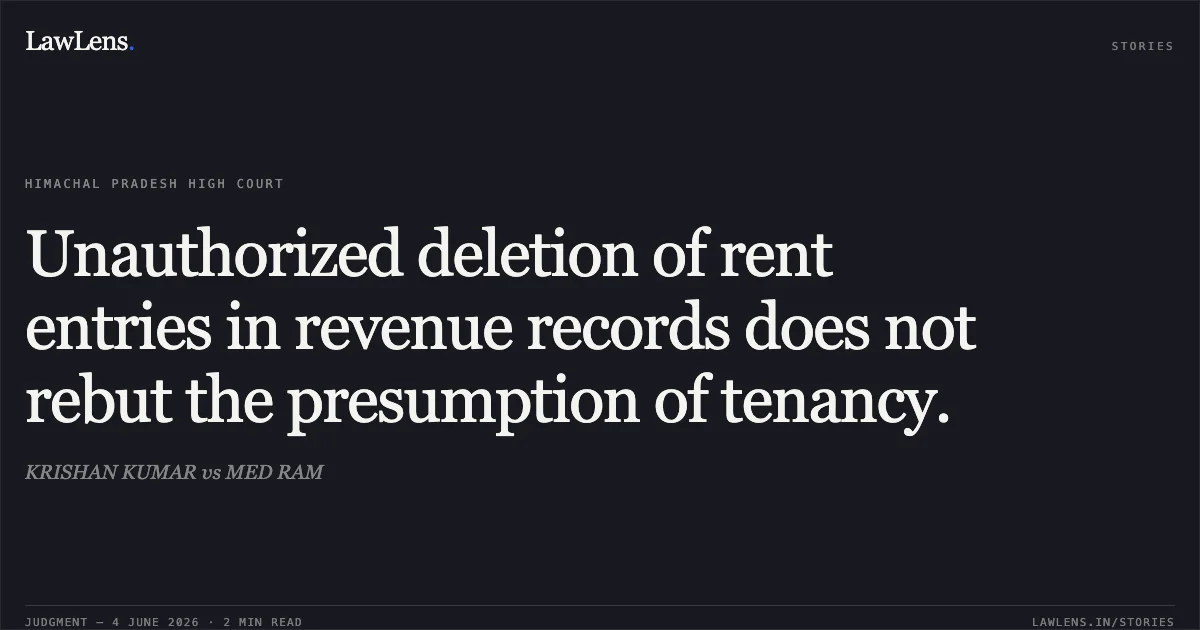
The court applied the principle that a presumption of truth attaches to revenue entries under the Punjab Land Revenue Act (as applicable to H.P.), but this presumption is rebuttable if a change in entries was made unauthorizedly or without following due process
Source reference: para 19-20Relying on Shyam Lal v. Johli [para 16] and Harbans Singh v. State of H.P. [para 19], the court held that any change in rights, rents, or possession in the Khasra Girdawari must involve notice to the affected party and an inquiry by a Revenue Officer as per the Land Records Manual
Source reference: para 16-17Further, the court applied the doctrine from Durga v. Milkhi Ram that later revenue entries stand rebutted if the alteration was made mistakenly or without material justification
Source reference: para 20Reasoning
The Court observed that earlier records (Ext.P3 and Ext.P4) explicitly recorded Dhaniya as a non-occupancy tenant paying rent
Source reference: para 16The subsequent deletion of the rent column in later jamabandis was deemed illegal because there was no evidence of a reported arrangement or an inquiry by revenue authorities before the change
Source reference: para 16, 21Applying the cited precedents, the Court held that the unauthorized deletion of "rent" did not extinguish the tenancy status.
Source reference: para 21Regarding the plaintiffs' "caretaker" theory, the Court found the oral evidence of PW3 and PW4 contradictory and unreliable, noting they could not even agree on who was present during the alleged agreement
Source reference: para 24-25Conversely, the defendants' long-standing possession and the construction of three houses on the land supported the conclusion of a tenancy rather than a mere watchman role
Source reference: para 25, 28-29Holding
The Court answered both issues against the appellants, holding that there is no legal requirement for a tenant to file a specific proforma to establish an existing tenancy
The Court affirmed that the revenue entries (Ext. P1-P4) were correctly interpreted to reflect a tenancy that was not validly altered by subsequent administrative omissions
Source reference: para 21, 29The appeal was dismissed, upholding the concurrent findings of the lower courts that the defendants were tenants and the plaintiffs were not entitled to possession
Source reference: para 31-32Acts & Sections Cited
2 provisions across 1 statute referred to in this judgment. Each provision opens on LawLens.
Punjab Land-Revenue Act, 18872
Original Court PDF
KRISHAN KUMARvsMED RAM
Click to open original judgment
Original judgment, available to read, download and summarize on LawLens.in