01Facts
The petitioner, a Sahayak Sachiv of Gram Panchayat Samaspur, challenged under Section 482 of the Code of Criminal Procedure, 1973, FIR Crime No. 160/2017 registered at Police Station Malthon, District Sagar, for an offence under Section 420 of the Indian Penal Code.
¶ 1The FIR alleged that amounts aggregating to approximately ₹1,61,050/- had been transferred from the Gram Panchayat’s bank account to Pawan Suvidha Kendra and that the petitioner had dishonestly and fraudulently withdrawn Panchayat funds while exercising financial powers during a strike by Panchayat Secretaries.
¶ 2The petitioner contended that the amounts were used for legitimate Panchayat works, including the purchase of construction, electrical and other materials, and relied upon bills, vouchers and photographs of the completed works.
¶ 3The complainant subsequently filed an affidavit stating that the complaint had been lodged under a misconception, that the petitioner had not committed the alleged offence and that she did not wish to prosecute the matter; the complainant later died during the pendency of the petition.
¶ 4The State opposed quashing, asserting that the allegations involved public money and that the genuineness of the bills and vouchers required investigation or trial.
¶ 502Issues
i.Whether the allegations in the FIR, taken at face value, disclosed the essential ingredients of cheating under Section 420 IPC, including deception and fraudulent or dishonest inducement leading to delivery of property?
¶ 6ii.Whether the High Court should exercise its inherent jurisdiction under Section 482 CrPC to quash the FIR and consequential proceedings in view of the absence of the foundational ingredients of cheating and the subsequent affidavit of the complainant?
¶ 10–1403Law Applied
The Court applied Section 482 CrPC, which preserves the High Court’s inherent power to prevent abuse of process and secure the ends of justice, and Sections 415 and 420 IPC, under which cheating requires deception coupled with fraudulent or dishonest inducement resulting in delivery of property or an act causing or likely to cause damage or harm.
¶ 7Relying on Hridaya Ranjan Prasad Verma v. State of Bihar, (2000) 4 SCC 168, the Court reiterated that dishonest or fraudulent intention must exist at the inception of the transaction; it also relied on Dalip Kaur v. Jagnar Singh, (2009) 14 SCC 696, which held that the essential ingredients of cheating must emerge from the allegations and that every financial dispute does not constitute cheating.
¶ 8The Court further applied the principles in State of Haryana v. Ch. Bhajan Lal, 1992 Supp (1) SCC 335, permitting quashing where continuation of criminal proceedings would amount to an abuse of process.
¶ 14Provisions in the judgment · 3 · Linked ones open on LawLens
Code of Criminal Procedure, 1973 Section 482
Indian Penal Code, 1860 Section 420Section 415
04Reasoning
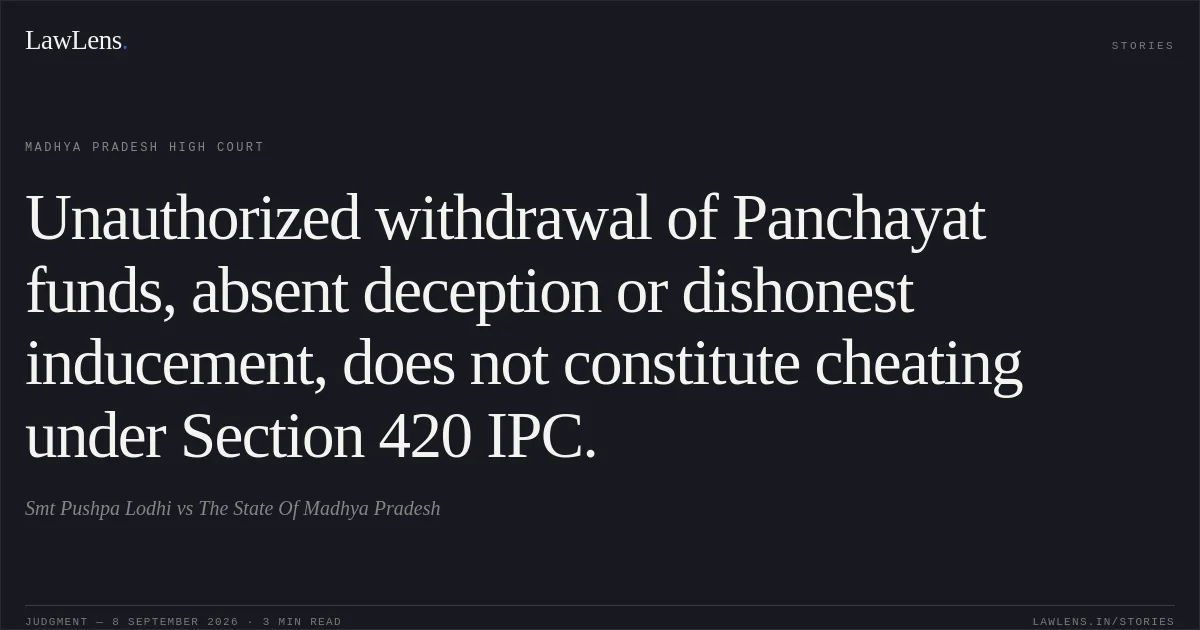
The Court found that the FIR merely alleged unauthorized withdrawal or transfer of Gram Panchayat funds but did not identify any specific deception, fraudulent representation or dishonest inducement by the petitioner that caused any person to deliver property.
¶ 9Since unauthorized withdrawal, without more, does not automatically constitute cheating under Section 420 IPC, the FIR lacked the foundational statutory ingredients of the offence.
¶ 9Although the Court ordinarily would not conduct a detailed appreciation of defence documents under Section 482 CrPC, the bills, vouchers and photographs supported the petitioner’s assertion that the amounts were spent on Panchayat works and were relevant when considered alongside the deficient allegations in the FIR.
¶ 10The complainant’s affidavit withdrawing the allegation was treated as corroborative material rather than the sole basis for quashing; her subsequent death, by itself, was not considered sufficient to terminate the prosecution.
¶ 11The Court therefore held that it was not conducting a mini-trial but was addressing a fundamental legal defect in the FIR, namely, the absence of deception and dishonest inducement.
¶ 12In the absence of material demonstrating those elements, continuation of the prosecution would serve no useful purpose and would constitute an abuse of process.
¶ 13–1405Holding
The Court answered the principal issue in favour of the petitioner, holding that the FIR did not disclose the essential ingredients of cheating under Section 420 IPC.
¶ 14–15Exercising jurisdiction under Section 482 CrPC and applying the principles in Bhajan Lal, the Court allowed the petition and quashed FIR Crime No. 160/2017 registered at Police Station Malthon, District Sagar, along with all consequential criminal proceedings, insofar as they related to Smt. Pushpa Lodhi.
¶ 14–15Original Court PDF
Smt Pushpa LodhivsThe State Of Madhya Pradesh
Click to open original judgment
Original judgment, available to read, download and summarize on LawLens.in