Facts
On 24 October 2020, the appellant, an agricultural coolie, was struck from behind by a truck while returning from a morning walk and sustained injuries.
Source reference: pp. 3–5; paras. 3–8He claimed that his injuries prevented him from continuing agricultural work.
Source reference: pp. 3–5; paras. 3–8The Motor Accidents Claims Tribunal assessed his monthly income at ₹13,250, fixed whole-body disability at 8%, awarded compensation of ₹3,28,490, and attributed 25% contributory negligence to him.
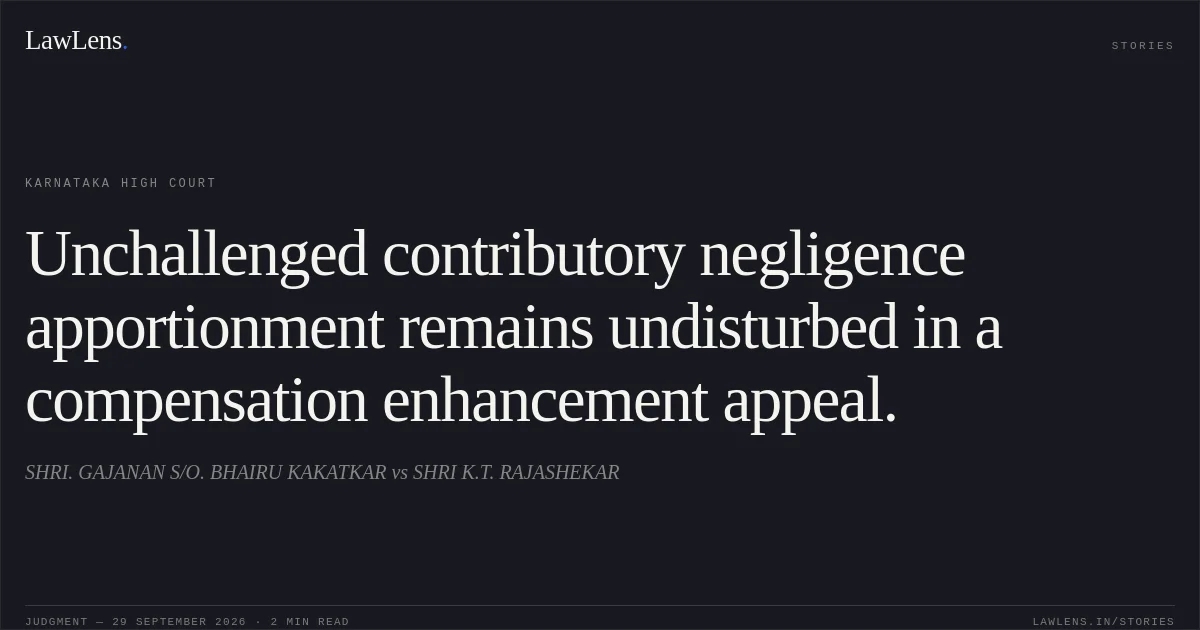
Source reference: pp. 3–5; paras. 3–8He appealed, seeking enhancement of compensation; the negligence finding was not challenged.
Source reference: pp. 3–5, 8; paras. 3–8, 9, 28The High Court identified the appeal as concerning the adequacy of compensation.
Source reference: p. 7; para. 13Issues
1. Whether the compensation awarded by the Tribunal was inadequate and warranted modification
Source reference: p. 7; para. 13(i)2. Whether the Tribunal’s finding attributing 25% contributory negligence to the appellant should be disturbed, despite not being challenged in the appeal
Source reference: p. 11; para. 28Law Applied
Under Section 173(1) of the Motor Vehicles Act, 1988, an aggrieved party may appeal an award of the Claims Tribunal.
Source reference: p. 2For calculating loss of future income, the Court applied the multiplier of 17 for the appellant’s age of 28, relying on Sarla Verma v. Delhi Transport Corporation, 2009 ACJ 1298.
Source reference: p. 8; para. 17In the absence of proof of income, it accepted the Karnataka State Legal Services Authority’s guideline income of ₹13,250 per month for an accident occurring in 2020.
Source reference: p. 8; para. 16The Court assessed functional disability by reference to the injuries and medical evidence, and applied the established approach of calculating future income loss by multiplying monthly income by 12, the applicable multiplier, and the whole-body disability percentage.
Source reference: p. 9; para. 19An unchallenged finding of contributory negligence was left undisturbed, and compensation was reduced accordingly.
Source reference: p. 11; para. 28Reasoning
The appellant had not proved his income, so the Court retained the Tribunal’s monthly income assessment of ₹13,250.
Source reference: p. 8; para. 16However, having regard to the medical evidence of spinal and other injuries, the doctor’s disability assessment, and the appellant’s reported restrictions, it found the Tribunal’s 8% whole-body disability assessment too low and reassessed it at 11%.
Source reference: pp. 8–9; paras. 16–19Applying the multiplier of 17, it calculated future income loss at ₹2,97,330.
Source reference: pp. 8–9; paras. 16–19It also increased compensation for pain and suffering and food and nourishment, allowed compensation for loss of amenities, and assessed three months’ loss of income during the laid-up period; medical expenses and travel expenses were left unchanged.
Source reference: pp. 9–10; paras. 20–25As the appellant had not challenged the 25% contributory-negligence finding, the Court applied that deduction to the revised total.
Source reference: p. 11; para. 28Holding
The appeal was allowed in part.
The Court enhanced the gross compensation from ₹3,28,490 to ₹4,81,080 and, after deducting 25% for contributory negligence, held the appellant entitled to ₹3,60,810.
Source reference: pp. 11–13; paras. 27–29The enhanced compensation carries interest at 6% per annum from the date of the petition until payment.
Source reference: pp. 11–13; paras. 27–29The insurer was directed to deposit the enhanced compensation with accrued interest before the Tribunal within six weeks of receiving the certified copy of the judgment.
Source reference: pp. 11–13; paras. 27–29Acts & Sections Cited
1 provisions across 1 statute referred to in this judgment. Each provision opens on LawLens.
Motor Vehicles Act, 19881
Original Court PDF
SHRI. GAJANAN S/O. BHAIRU KAKATKARvsSHRI K.T. RAJASHEKAR
Click to open original judgment
Original judgment, available to read, download and summarize on LawLens.in