Facts
The petitioner, a CISF constable, was proceeded against departmentally on three articles of charge. Articles I and II alleged that he failed to attend parade, physical training, and the orderly room of the Assistant Commandant on specified dates, contrary to an office memorandum dated 4 April 1992. The disciplinary authority imposed the major penalty of removal from service by order dated 6 August 1994, with effect from 5 April 1995.
Source reference: p.1, para.1In an earlier writ proceeding, the Calcutta High Court set aside Article III as perverse and unsustainable, but recorded that Articles I and II had been established and remitted the matter to the appellate authority only for reconsideration of the quantum of punishment.
Source reference: pp.7–8, para.11The appellate authority thereafter declined to interfere with the removal order by order dated 28 August 2017, referred to in parts of the judgment as dated 28 July 2017.
Source reference: p.1, para.1; p.10, para.17The petitioner challenged the appellate order, contending that the office memorandum was post-dated because, although dated 4 April 1992, it bore certification/signature dated 5 May 1993; that Articles I and II were therefore unsustainable; and that the punishment was discriminatory when compared with the lesser penalty imposed on another CISF constable, S. Biswas.
Source reference: pp.2–4, para.2–6The Union contended that the date of 5 May 1993 represented certification of a true copy, not the date of issuance, and that the petitioner was barred from re-agitating Articles I and II.
Source reference: pp.5–6, para.7–9Issues
Whether the petitioner could re-agitate the validity and proof of Articles I and II after the earlier judgment had left those findings undisturbed and remitted only the question of punishment?
Source reference: pp.7–9, paras.11–13Whether the office memorandum dated 4 April 1992 was invalid or incapable of supporting Articles I and II merely because its copy was certified on 5 May 1993?
Source reference: pp.2–3, para.4; p.9, para.14Whether the appellate authority properly reconsidered the quantum of punishment in accordance with the earlier judgment and Rule 47 of the CISF Rules, 1969?
Source reference: pp.7–8, para.11; pp.10–11, paras.16–17Whether the High Court, exercising judicial review, should interfere with the findings of guilt or the penalty of removal in the absence of perversity, illegality, or procedural violation?
Source reference: pp.9–10, paras.14, 17–18Law Applied
Section 10(a) of the Central Industrial Security Force Act, 1968 requires every member of the Force promptly to obey and execute lawful orders issued by a superior authority.
Source reference: p.10, para.15Rule 34 of the CISF Rules, 1969 governs the procedure for imposing major penalties, Rule 42 provides for appeals against penalty orders, and Rule 47 prescribes the matters to be considered by the appellate authority, including the legality of the proceedings, the findings, and the adequacy of the penalty.
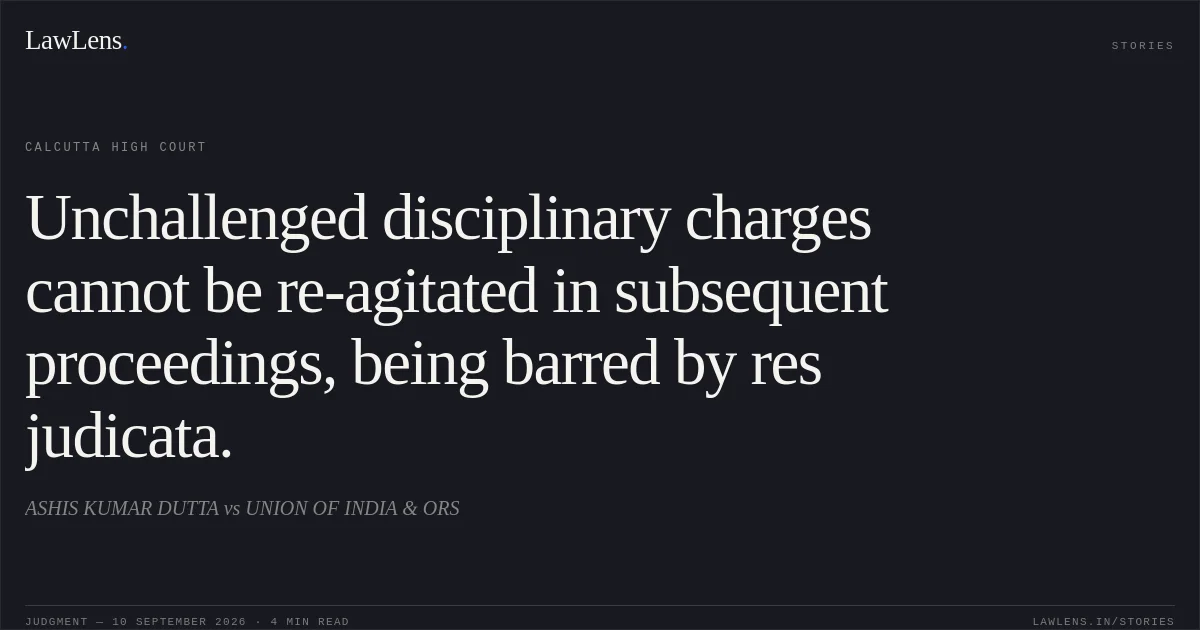
Source reference: p.10, para.16The Court applied the principle of res judicata/finality of adjudication, holding that issues relating to Articles I and II, which had not been successfully challenged in the earlier proceeding, could not be reopened.
Source reference: p.9, para.13It also applied the judicial-review principle that a writ court does not substitute its own view for a reasonable factual finding of the disciplinary or appellate authority merely because another view is possible.
Source reference: p.9, para.14The earlier decision in Ashis Kumar Dutta v. Union of India, CO 2065 (W) of 1996, governed the scope of remand by setting aside only Article III and directing reconsideration of punishment on the basis of Articles I and II.
Source reference: pp.7–8, para.11Reasoning
The Court held that the earlier judgment had expressly left the findings on Articles I and II undisturbed and had remitted only the issue of punishment. Consequently, the petitioner was barred by the principle of res judicata from challenging those charges afresh.
Source reference: p.9, paras.12–13On the alleged post-dating of the office memorandum, the Court accepted the respondents’ explanation that 5 May 1993 was the date of certification of a true copy supplied during the disciplinary proceedings, not the date on which the memorandum was issued.
Source reference: p.9, para.14The appellate authority had found, on the materials before it, that the memorandum dated 4 April 1992 was communicated to the petitioner and other personnel, requiring them to perform regimental duties; the petitioner nevertheless failed to attend parade, PT, and the orderly room.
Source reference: p.9, para.14These findings were factual and were not shown to be perverse or unsupported by evidence.
Source reference: p.9, para.14The Court further found that the appellate authority had complied with the earlier remand order by considering whether removal remained appropriate on the basis of Articles I and II and by examining the adequacy of the penalty under Rule 47.
Source reference: pp.8, 10–11, paras.11, 16–17Given the disciplinary requirements of an armed force and the statutory duty to obey lawful orders under Section 10(a), the Court considered the respondents better placed to assess the seriousness of the misconduct and the appropriate penalty.
Source reference: p.10, para.18No ground was therefore made out for interference in judicial review.
Source reference: p.10, para.18Holding
The Court answered the issues against the petitioner. It held that the findings on Articles I and II could not be reopened; the office memorandum dated 4 April 1992 was not invalid merely because its copy was certified on 5 May 1993; and the appellate authority had lawfully reconsidered and upheld the penalty of removal in accordance with the earlier judgment and Rule 47.
The writ petition was accordingly dismissed, with no order as to costs.
Source reference: p.11, para.20Acts & Sections Cited
1 provisions across 1 statute referred to in this judgment. Each provision opens on LawLens.
Central Industrial Security Force Act, 19681
Original Court PDF
ASHIS KUMAR DUTTAvsUNION OF INDIA & ORS
Click to open original judgment
Original judgment, available to read, download and summarize on LawLens.in