Facts
The prosecution alleged that on May 19, 2014, the appellant, a security guard at an apartment complex, lured the eight-year-old victim (PW5) into a security cabin and sexually molested her by touching her vagina.
Source reference: para 4, 21The Special Court (POCSO), Ernakulam, convicted the appellant under Section 7 r/w Section 8 of the Protection of Children from Sexual Offences (POCSO) Act, 2012, and Section 354 of the Indian Penal Code (IPC), sentencing him to three years of rigorous imprisonment.
Source reference: para 5The appellant challenged the conviction, primarily arguing that the prosecution failed to prove the victim's age through documentary evidence as mandated by law, relying solely on the oral testimony of the victim and her mother.
Source reference: para 6Issues
1. What is the legally recognized mode of proof for the age of a victim in POCSO Act cases?
Source reference: para 11, 122. Whether the unchallenged oral testimony of the victim and her mother is sufficient to prove that the victim was below 18 years of age at the time of the occurrence?
Source reference: para 11, 153. Whether the prosecution successfully established the ingredients of Section 7 r/w Section 8 of the POCSO Act and Section 354 of the IPC?
Source reference: para 11, 27Law Applied
The court primarily applied Section 94 of the Juvenile Justice (Care and Protection of Children) Act and the principles established in Jarnail Singh v. State of Haryana, which mandate a hierarchical priority for age determination: (i) matriculation certificate, (ii) school birth certificate, (iii) municipal/panchayat birth certificate, and (iv) medical ossification tests in the absence of the former.
Source reference: para 12It further relied on the Division Bench ruling in Biju v. State of Kerala, which held that the Indian Evidence Act allows a fact in issue, such as age, to be proved via unchallenged oral testimony of a parent if the status of the victim as a "child" is not disputed during trial.
Source reference: para 9, 14, 15Reasoning
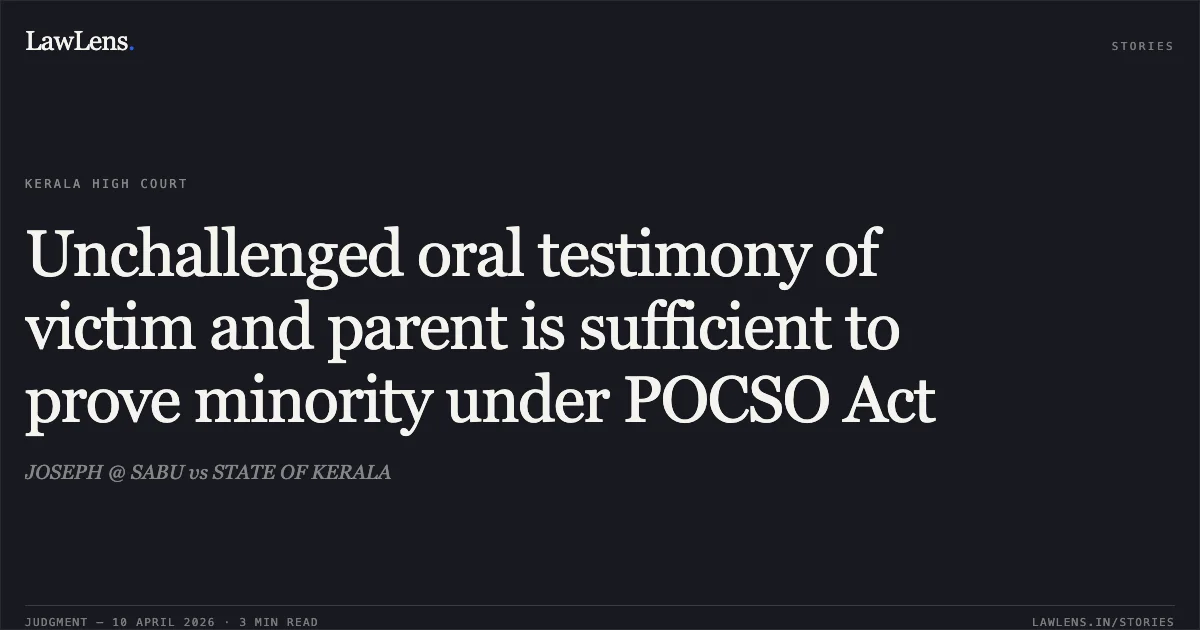
While acknowledging the strict documentary requirements in Jarnail Singh, the Court reasoned that if an accused concedes to the jurisdiction of a POCSO Court and fails to challenge the victim’s status as a minor during cross-examination, the oral testimony of the mother (PW2) and the victim (PW5) can be treated as sufficient proof under the Indian Evidence Act.
Source reference: para 12, 15Here, PW5 and PW2 testified the victim was eight years old, a fact that remained substantially unchallenged by the defense.
Source reference: para 14Regarding the merits, the Court found the victim's testimony to be of "sterling quality," corroborated by the medical professional (PW1), who noted the victim's consistent narrative and emotional state, and the mother's immediate first information statement (Ext.P2).
Source reference: para 20, 21The act of touching the child's vagina with sexual intent satisfied the physical contact requirements of Section 7 of the POCSO Act.
Source reference: para 19, 27Holding
The High Court dismissed the appeal and confirmed the conviction and sentence imposed by the Special Court.
It held that while documentary evidence is the preferred mode of proving age, unchallenged oral testimony of the parents is admissible and sufficient to establish that a victim is a "child" under Section 2(d) of the POCSO Act.
Source reference: para 15The appellant's sentence of three years of rigorous imprisonment and a fine of ₹5,000 was upheld, as it met the statutory minimum for the offence.
Source reference: para 27The appellant was directed to surrender immediately to undergo the remaining sentence.
Source reference: para 27Acts & Sections Cited
9 provisions across 4 statutes referred to in this judgment. Each provision opens on LawLens.
Protection of Children from Sexual Offences Act, 20126
Indian Penal Code, 18601
Code of Criminal Procedure, 19731
Juvenile Justice (Care and Protection of Children) Act, 2015.1
Original Court PDF
JOSEPH @ SABUvsSTATE OF KERALA
Click to open original judgment
Original judgment, available to read, download and summarize on LawLens.in