01Facts
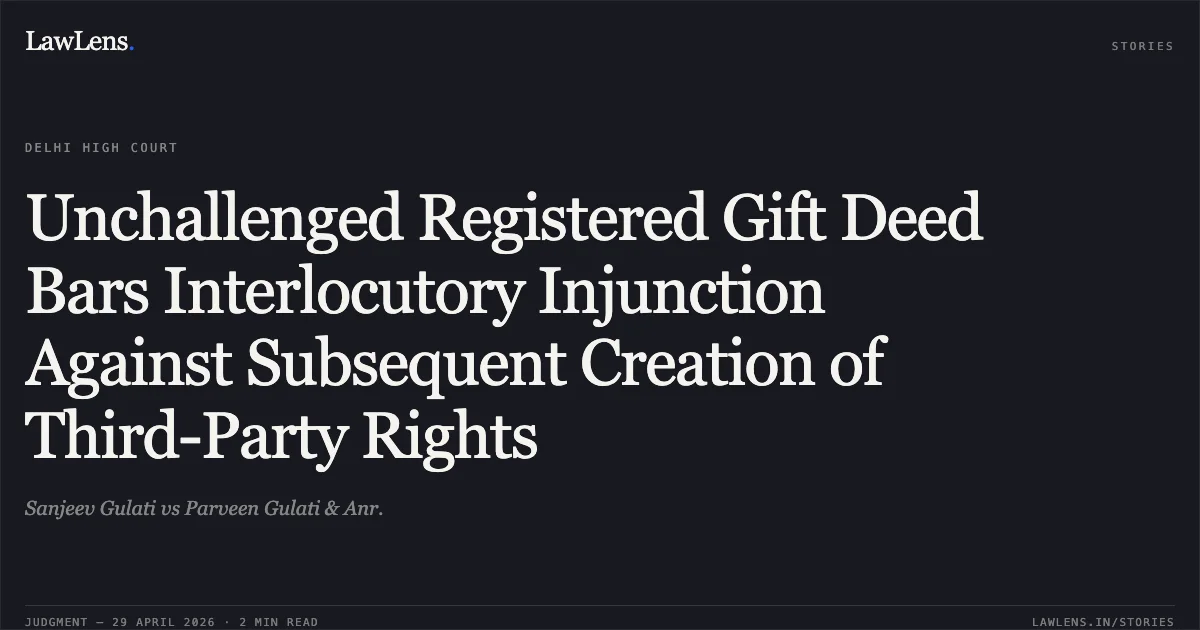
The Appellant/Plaintiff filed a suit for declaration, partition, and injunction against his siblings (Respondents/Defendants) regarding the second floor of property J-5/70, Rajouri Garden.
pp. 1-2The property was originally gifted to the parties' mother, Smt. Saroj Gulati, by their grandfather in 2001.
p. 3The Appellant challenged a registered gift deed dated 22.06.2007, executed by the mother in favor of Respondent No. 1, alleging it was obtained through fraud and coercion due to the mother’s poor health.
p. 2The Appellant claimed he only gained knowledge of the deed's nature in 2022.
p. 3The Trial Court dismissed the Appellant’s application under Order XXXIX Rules 1 and 2 of the CPC, which sought to restrain the Respondents from creating third-party rights.
pp. 1-202Issues
i.1. Whether the Appellant satisfied the "triple test" (prima facie case, irreparable loss, and balance of convenience) required for the grant of a temporary injunction under Order XXXIX Rules 1 and 2 CPC
p. 4 · ¶ 13ii.2. Whether the long-standing nature of a registered gift deed (15 years) and the lack of contemporaneous protest by the donor weigh against the grant of interim relief
p. 4 · ¶ 12-1403Law Applied
The Court applied the "triple test" for temporary injunctions as articulated in Gujarat Bottling Co. Ltd. v. Coca Cola Co. (1995) 5 SCC 545, requiring the presence of a prima facie case, likelihood of irreparable loss, and a balance of convenience in favor of the applicant.
pp. 4-5It further relied on the legal presumption of validity attached to registered documents and the principle that delay and laches, particularly in challenging a title deed after the death of the executant, are critical factors in denying equitable relief.
p. 404Reasoning
The Court observed that the impugned gift deed was a registered document from 2007 that remained unchallenged for 15 years during the lifetime of Smt. Saroj Gulati, who passed away in 2022.
p. 4Although the Appellant alleged fraud, the Court noted that neither the mother nor the Appellant filed any complaints regarding the deed when they allegedly discovered the "fraudulent" execution in August 2022.
p. 4The Court found no prima facie case because the Appellant was not in possession of the suit property and failed to provide concrete evidence of coercion beyond vague averments.
pp. 4-5Consequently, the balance of convenience did not favor the Appellant, as Respondent No. 1 held a valid registered title that had been settled for over a decade.
p. 505Holding
The High Court answered the issues in the negative, holding that the Appellant failed to satisfy the requirements for an interim injunction.
p. 5The Court upheld the Trial Court's order dated 20.12.2025, finding no infirmity or perversity in its reasoning.
p. 5The appeal (FAO 107/2026) was dismissed, with the clarification that the observations made were only for the disposal of the interim application and would not influence the final trial.
p. 5Original Court PDF
Sanjeev GulativsParveen Gulati & Anr.
Click to open original judgment
Original judgment, available to read, download and summarize on LawLens.in