Facts
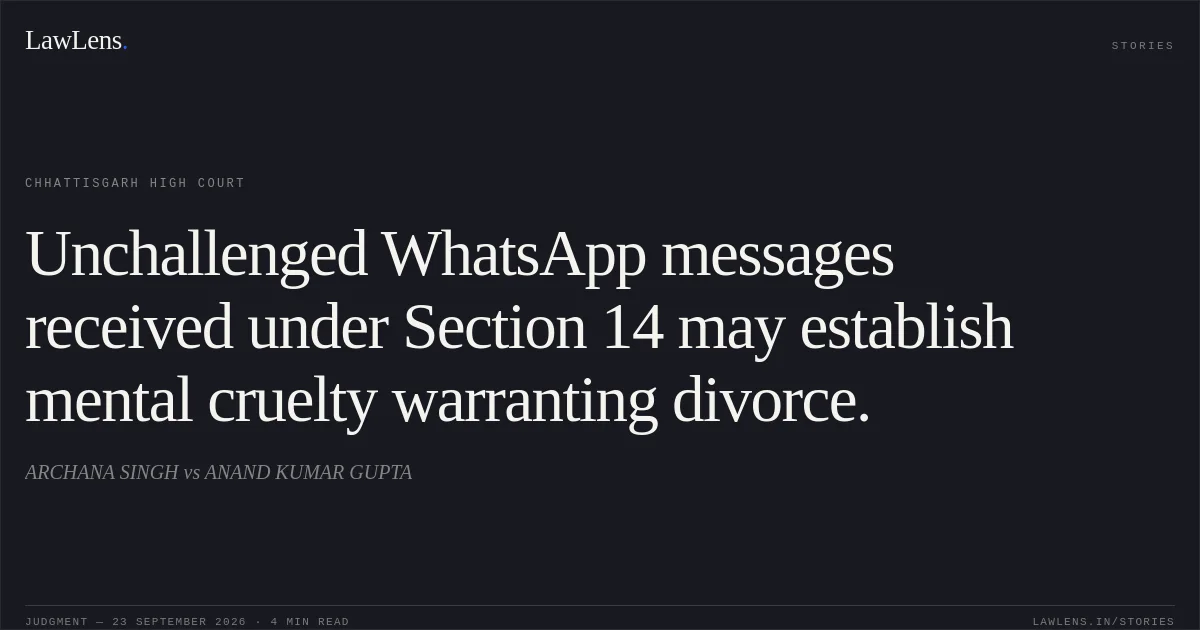
Archana Singh and Anand Kumar Gupta were married according to Hindu rites on 5 December 2021. The wife alleged that, shortly after marriage, the husband abused and assaulted her, threatened to kill her, demanded an air-conditioner as dowry, threatened to sell her jewellery, and sent abusive WhatsApp messages to her and her sisters. She consequently left the matrimonial home and resided separately at Ambikapur.
Source reference: pp. 2–4, paras. 4–6She instituted Civil Suit No. 169A/2022 before the Family Court, Ambikapur, seeking divorce on the ground of cruelty under Section 13(1)(i-a) of the Hindu Marriage Act, 1955. The husband did not appear despite service and was proceeded ex parte. The Family Court dismissed the suit, holding that cruelty had not been proved.
Source reference: pp. 4–5, paras. 7–9In appeal under Section 19(1) of the Family Courts Act, 1984, the wife sought to produce a subsequent FIR under Order XLI Rule 27 CPC. The High Court rejected the application, but reconsidered the unchallenged oral evidence and WhatsApp material already on record.
Source reference: pp. 5–10, paras. 10–26Issues
1. Whether the FIR sought to be produced by the appellant under Order XLI Rule 27 CPC could be admitted as additional evidence at the appellate stage.
Source reference: p. 6, para. 13(i); pp. 9–10, paras. 20–252. Whether the Family Court was justified in holding that the wife had failed to prove cruelty under Section 13(1)(i-a) of the Hindu Marriage Act, 1955.
Source reference: p. 6, para. 13(ii); pp. 11–16, paras. 28–383. Whether the wife was entitled to a decree of divorce on the ground of cruelty.
Source reference: p. 6, para. 13(iii); pp. 11–17, paras. 27–40Law Applied
The Court applied Section 13(1)(i-a) of the Hindu Marriage Act, 1955, under which a marriage may be dissolved where one spouse has treated the other with cruelty.
Source reference: p. 11, para. 28Cruelty is not exhaustively defined and may be physical or mental; its assessment depends on the nature of the conduct, the parties’ social circumstances, and its cumulative effect on the complaining spouse. Relying on Samar Ghosh v. Jaya Ghosh, (2007) 4 SCC 511, the Court held that sustained abusive, humiliating, reprehensible or unjustifiable conduct causing serious mental anguish, making matrimonial life intolerable, may constitute mental cruelty.
Source reference: pp. 12–15, para. 31It also relied on Vishwanath Agrawal v. Sarla Vishwanath Agrawal, (2012) 7 SCC 288, for the principle that cruelty must be evaluated in the context of human conduct, social milieu, relationship, temperament and emotions.
Source reference: p. 15, para. 32Section 14 of the Family Courts Act, 1984 permits the Family Court to receive any report, statement, document, information or material that may assist it in effectively adjudicating the dispute, even if it would otherwise be inadmissible under the Evidence Act.
Source reference: pp. 15–16, paras. 35–36Additional evidence in appeal is governed by Order XLI Rule 27 CPC and is permissible only in the circumstances specified therein.
Source reference: pp. 9–10, paras. 20–24Reasoning
The High Court held that the subsequent FIR did not satisfy Order XLI Rule 27 CPC because the wife had not shown that it could not have been produced earlier despite due diligence, and the FIR merely recorded allegations whose truth had not been established through investigation or trial.
Source reference: pp. 9–10, paras. 21–25On the merits, however, the Court found that the wife’s testimony was corroborated by her mother and remained wholly unchallenged because the husband had chosen not to appear or cross-examine the witnesses; an adverse inference could therefore be drawn against him.
Source reference: p. 12, para. 30The WhatsApp messages, though not supported by formal proof under the Evidence Act, were relevant material under the broader evidentiary discretion available in family proceedings under Section 14 of the Family Courts Act. Since the husband had the opportunity to dispute the ownership of the mobile number or authorship of the messages but failed to do so, the Court found no reason to disregard them.
Source reference: pp. 15–16, paras. 33–38The abusive messages directed even at the wife’s sisters, considered together with the allegations of assault, threats and dowry-related harassment, demonstrated sustained humiliating conduct causing serious mental anguish and amounted to mental cruelty. The Family Court had therefore erred in rejecting the wife’s case.
Source reference: pp. 15–17, paras. 33–39Holding
The application under Order XLI Rule 27 CPC was rejected because the FIR was neither shown to satisfy the statutory requirements for additional evidence nor necessary for deciding the appeal.
The appeal was allowed, the Family Court’s judgment and decree dated 2 April 2024 were set aside, and the marriage solemnized on 5 December 2021 was dissolved by a decree of divorce under Section 13(1)(i-a) of the Hindu Marriage Act, 1955, on the ground of cruelty.
Source reference: p. 17, paras. 39–40Since the wife had not claimed permanent alimony, liberty was reserved to her to seek it separately under Section 25 of the Hindu Marriage Act.
Source reference: p. 17, para. 41Acts & Sections Cited
5 provisions across 3 statutes referred to in this judgment. Each provision opens on LawLens.
Family Courts Act, 19842
Code of Civil Procedure, 19081
Hindu Marriage Act, 19552
Original Court PDF
ARCHANA SINGHvsANAND KUMAR GUPTA
Click to open original judgment
Original judgment, available to read, download and summarize on LawLens.in