Facts
The petitioner, initially appointed as a Driver in the Family Court, Janjgir in 2010 and regularized in 2012, challenged the "Poor" remarks in his Annual Confidential Reports (ACRs) for the periods 18.07.2019 to 31.08.2020 and 01.09.2020 to 06.01.2021
Source reference: p.1-2From 2012 to 2019, the petitioner had consistently received "Good" and "Very Good" ratings
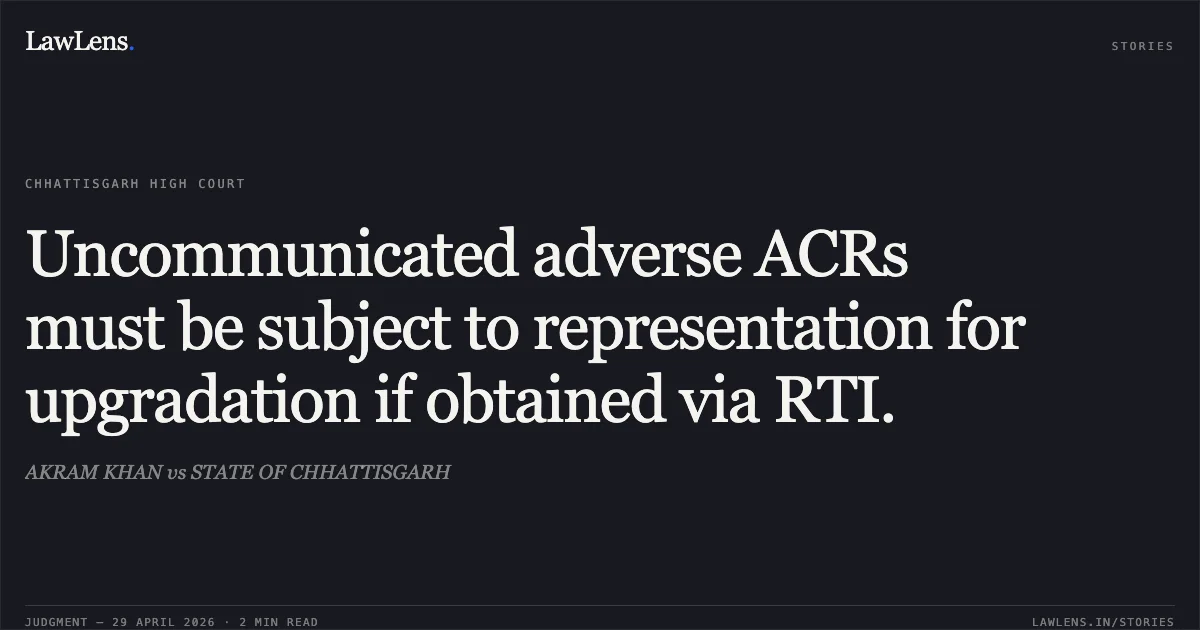
Source reference: p.2The petitioner contended that the adverse ACRs were not communicated to him and were only discovered via an RTI application, preventing him from filing a timely representation for upgradation
Source reference: p.2The respondents argued that the remarks were based on the petitioner’s conduct and integrity, noting a prior termination and subsequent reinstatement in 2022
Source reference: p.3Issues
1. Whether the adverse ACRs for the years 2020 and 2021 are liable to be expunged or reconsidered due to non-communication to the employee.
Source reference: p.3, para. 62. Whether the petitioner should be granted liberty to prefer a representation for the upgradation of ACR remarks before the competent authority.
Source reference: p.3, para. 7Law Applied
The court's decision is grounded in the principles of natural justice and administrative law regarding the mandatory communication of adverse entries in ACRs to public servants.
Source reference: no citationThe court applied the established legal doctrine that non-communication of ACR entries (whether adverse or below a benchmark) violates the employee's right to be considered for promotion/benefits, as it denies them the opportunity to make a representation for improvement or rectification
Source reference: p.3The court also operated under Article 226 of the Constitution of India regarding its writ jurisdiction to ensure fair administrative procedure
Source reference: p.1Reasoning
The Court observed that the record clearly indicated the ACRs for 2020 and 2021 were obtained by the petitioner under the RTI Act, 2005, which evidenced that these reports were never formally communicated to him by the reporting authority
Source reference: p.3, para. 6Under administrative jurisprudence, the failure to communicate adverse remarks is a procedural lapse that justifies allowing the employee a belated opportunity to contest those remarks. The Court found the petitioner's request to submit a representation to the competent authority (the Registrar General) to be "reasonable" under these circumstances
Source reference: p.3, para. 7The Court avoided ruling on the merits of the "Poor" remarks (conduct and integrity), leaving that determination to the expert internal machinery of the High Court administration
Source reference: p.4, para. 8Holding
The Court disposed of the writ petition without expressing an opinion on the merits
It granted the petitioner liberty to submit a detailed representation to the Registrar General, High Court of Chhattisgarh, within 30 days for the upgradation of the ACR remarks for 2020 and 2021. The respondent authority was directed to consider and decide the said representation in accordance with the law within a period of 90 days from the receipt of the copy
Source reference: p.4Original Court PDF
AKRAM KHANvsSTATE OF CHHATTISGARH
Click to open original judgment
Original judgment, available to read, download and summarize on LawLens.in