Facts
On 15 September 2018, the SHO of Mufassil Police Station, Munger, allegedly received secret information that the appellant, an accused in another case, was storing a large quantity of ammunition at his house.
Source reference: paras. 3–4, 13A police raiding party proceeded to the appellant’s village and allegedly saw a person emerge from the appellant’s house and flee.
Source reference: paras. 3–4, 13During the chase, the person allegedly threw a black polythene bag containing 122 bullets and cartridges of different calibres, including ammunition said to relate to AK-47, SLR and INSAS rifles.
Source reference: paras. 3–4, 13The person escaped and was allegedly identified as the appellant by a local police chowkidar, Brijnandan Paswan.
Source reference: paras. 34, 37–37.4However, the chowkidar was neither examined at trial nor was his statement recorded under Section 161 Cr.P.C.
Source reference: paras. 34, 37–37.4The appellant was charged under Sections 25(1-A), 25(1-AA), 25(1-B)(a), 26(1) and 35 of the Arms Act.
Source reference: para. 2The trial court convicted him under Sections 25(1-A), 25(1-B)(a) and 26(1) of the Arms Act and imposed concurrent sentences, including eight years’ imprisonment under Section 25(1-A).
Source reference: paras. 6, 12Issues
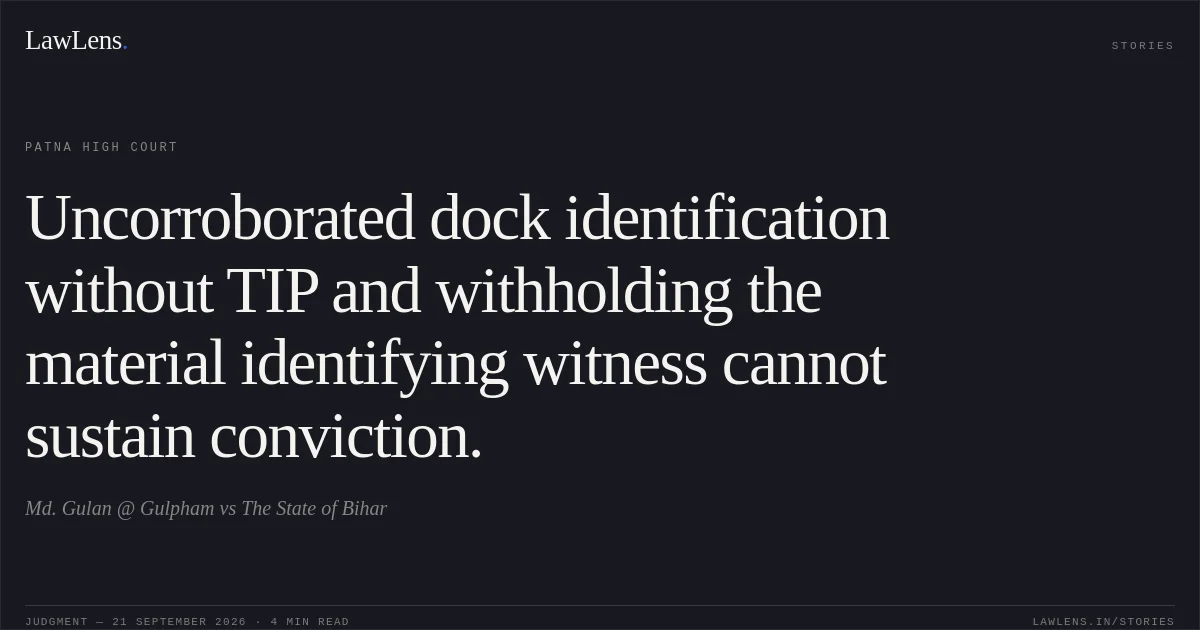
Whether the prosecution proved beyond reasonable doubt that the person who emerged from the appellant’s house and threw the bag containing ammunition was the appellant?
Source reference: paras. 34–39.3Whether the first-time identification of the appellant in court, in the absence of a Test Identification Parade and prior acquaintance of the police witnesses with him, could safely be relied upon?
Source reference: paras. 14–15, 38–39.2Whether the prosecution’s failure to examine Brijnandan Paswan, the alleged identifying witness, warranted an adverse inference under Section 114(g) of the Indian Evidence Act, 1872?
Source reference: paras. 16–17, 37–37.4Whether the contradictions regarding the distance between the appellant’s house and the place of recovery, and the failure to establish exclusive possession or occupancy of the house, materially weakened the prosecution case?
Source reference: paras. 40–42Law Applied
The Court applied Section 60 of the Indian Evidence Act, 1872, requiring oral evidence of a fact capable of being seen to come from a person who actually saw it.
Source reference: para. 36It applied Section 114(g) of the Evidence Act, under which the court may draw an adverse inference where a material witness who could clarify an essential part of the prosecution case is withheld without satisfactory explanation.
Source reference: paras. 16–17, 37.1–37.4The Court relied on P. Sasikumar v. State, (2024) 8 SCC 600, and Nazim v. State of Uttarakhand, 2025 SCC OnLine SC 2117, for the principle that although dock identification is substantive evidence and a Test Identification Parade is only an investigative step, courts must exercise great caution where the accused was a stranger to the witnesses and no TIP was conducted; in such circumstances, dock identification may be insufficient to establish identity beyond reasonable doubt.
Source reference: paras. 14–15, 39.1–39.2It also relied on Govindaraju @ Govinda v. State, (2012) 4 SCC 722, and Takhaji Hiraji v. Thakore Kubersing Chamansing, (2001) 6 SCC 145, concerning the adverse inference arising from non-examination of a material witness.
Source reference: paras. 16, 37.1The prosecution bore the overall burden of proving the appellant’s identity and guilt beyond reasonable doubt.
Source reference: no citationReasoning
The Court accepted that the police witnesses consistently described the raid, the escape of a person from the vicinity of the appellant’s house, and the recovery of ammunition from the polythene bag.
Source reference: paras. 35, 43However, the witnesses who identified the appellant in court were not previously acquainted with him, and their identification was based either on a fleeting observation while the person was fleeing or on the alleged identification by Brijnandan Paswan.
Source reference: paras. 25–30, 34, 37Since no TIP was conducted, the first-time dock identification could not be treated as reliable without strong corroboration.
Source reference: paras. 38–39.3The chowkidar was the only person whom the prosecution claimed knew the appellant and identified him at the spot.
Source reference: paras. 37–37.4His non-examination, coupled with the failure even to record his statement under Section 161 Cr.P.C., left the central question of identity unsupported and justified an adverse inference under Section 114(g) of the Evidence Act.
Source reference: paras. 37–37.4The prosecution evidence also materially conflicted regarding the distance between the appellant’s house and the recovery site—variously stated as approximately 10 metres, 100 metres and 200–250 metres—and the investigation did not establish who occupied the house or whether it was in the appellant’s exclusive possession.
Source reference: paras. 40–42Consequently, proof of recovery did not establish that the appellant was the person who possessed or threw the ammunition.
Source reference: paras. 42–43The Court therefore found it unnecessary to sustain the conviction on the basis of the alleged nature of the ammunition when the prosecution had failed at the threshold to prove the appellant’s identity as the offender.
Source reference: paras. 42–43Holding
The Court held that although the prosecution established the fact of recovery and that a person emerged from the vicinity of the appellant’s house and threw the ammunition bag, it failed to prove beyond reasonable doubt that the person was the appellant.
The conviction dated 30 September 2024 and the sentence order dated 19 October 2024 were accordingly set aside.
Source reference: paras. 43–46The appeal was allowed, and the appellant was directed to be released forthwith unless required in any other case.
Source reference: paras. 43–46The trial court records were ordered to be transmitted for compliance.
Source reference: paras. 43–46Acts & Sections Cited
6 provisions across 2 statutes referred to in this judgment. Each provision opens on LawLens.
Arms Act, 19594
Code of Criminal Procedure, 19732
Original Court PDF
Md. Gulan @ GulphamvsThe State of Bihar
Click to open original judgment
Original judgment, available to read, download and summarize on LawLens.in