01Facts
The respondent-decree-holder obtained a decree in O.S. No. 370/2010 on 06.11.2010 before the Additional Subordinate Judge, Irinjalakuda, against the revision petitioners.
¶ 2(i)It filed E.P. No. 297/2024 on 19.10.2024 before the Subordinate Judge, Thrissur (Execution Court).
¶ 2(ii)The judgment debtors objected that the execution petition was barred by limitation.
¶ 2(iii)The Execution Court rejected the objection, relying on the Supreme Court's COVID-19 limitation directions in In Re: Cognizance for Extension of Limitation.
¶ 2(iv)The judgment debtors filed this revision petition.
¶ 2(v)The ordinary twelve-year period from the decree expired on 06.11.2022, so the petition was prima facie out of time.
¶ 7The judgment debtors contended that the 150-day interval between 03.10.2021 and 01.03.2022 must also be deducted.
¶ 4The decree-holder contended that the entire period from 15.03.2020 to 28.02.2022 is excluded.
¶ 502Issues
i.1. Whether the execution petition filed on 19.10.2024, against a decree dated 06.11.2010, is within limitation after applying the Supreme Court's exclusion directions for 15.03.2020 to 28.02.2022.
¶ 7, 8ii.2. Whether the period between 03.10.2021 and 01.03.2022 must be deducted in computing limitation, in addition to the exclusion under Direction I of In Re: Cognizance.
¶ 4, 16iii.3. Whether the impugned order of the Execution Court suffers from any error, illegality, or impropriety warranting revisional interference.
¶ 603Law Applied
The ordinary limitation for execution of a decree is twelve years from the date of decree.
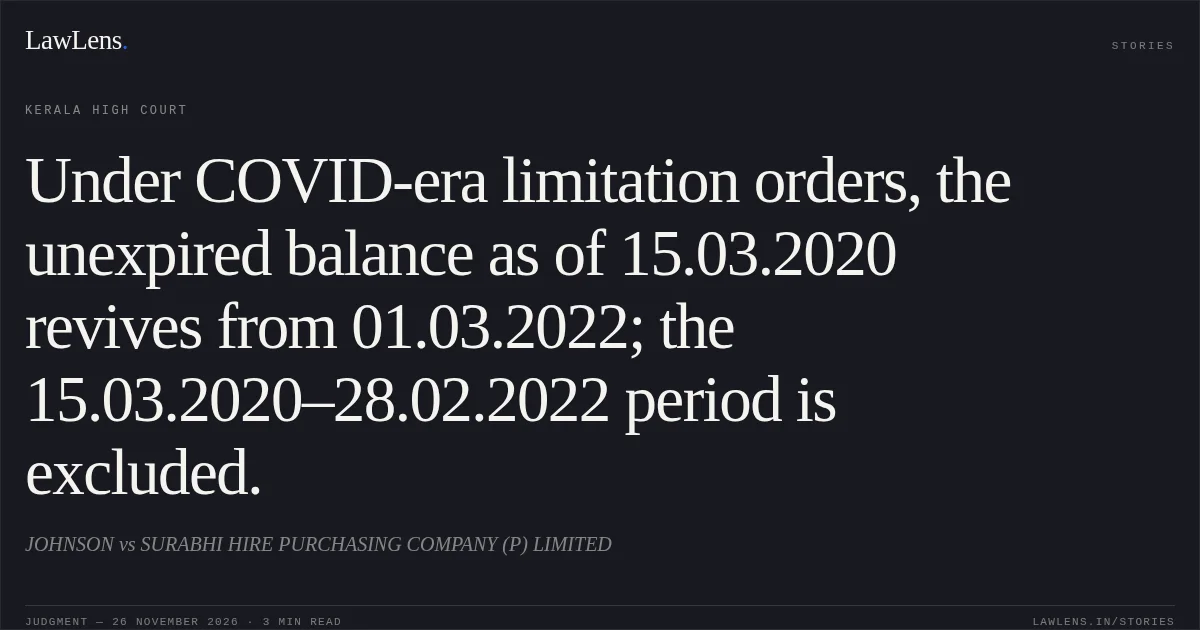
¶ 7Under the Supreme Court's directions in In Re: Cognizance for Extension of Limitation, 2022 (1) KHC 240, the period from 15.03.2020 to 28.02.2022 stands excluded; the balance limitation remaining on 03/10/2021 becomes available from 01.03.2022; and a 90-day period applies where limitation would have expired during the excluded window.
¶ 9Prakash Corporates v. Dee Vee Projects Ltd. treats the suo motu orders as extraordinary measures that must be given full effect and excludes the period in computing limitation.
¶ 10Arif Azim Co. Ltd. v. Aptech Ltd. holds that the balance limitation as of 15.03.2020 is available from 01.03.2022.
¶ 11Ajay Protech Pvt. Ltd. v. General Manager applies the same exclusion approach.
¶ 12The consistent line of Kerala High Court decisions in Swaminathan, Rajeela, Sunil Kumar and C.M. Kunhabdulla.
¶ 13The 90-day window is not a fresh independent period but protects only where limitation would otherwise expire during the excluded period.
¶ 1504Reasoning
The court computed the unexpired balance of limitation as on 15.03.2020, which was 966 days from the ordinary expiry date of 06.11.2022.
¶ 14That balance, made available from 01.03.2022, extended the period to 22.10.2024.
¶ 14The execution petition, filed on 19.10.2024, fell three days within that period and was therefore within time.
¶ 14Because the limitation had not expired by 15.03.2020, the 90-day protection under Direction III was not triggered. The court held that it "does not curtail a longer balance period."
¶ 15Direction II cannot be read in isolation from Direction I, which expressly excludes the whole period from 15.03.2020 to 28.02.2022.
¶ 16The subsequent decisions in Arif Azim and Ajay Protech apply the exclusion by preserving the balance and making it available from 01.03.2022, so no further deduction for 03.10.2021 to 01.03.2022 is permissible.
¶ 16The court found the Execution Court's reasoning sound, notwithstanding the judgment debtors' complaint that it was cryptic.
¶ 4, 1705Holding
The execution petition was within limitation. The balance of 966 days, as on 15.03.2020, became available from 01.03.2022 and expired on 22.10.2024, and the petition filed on 19.10.2024 was in time.
¶ 14The deduction of the 03.10.2021–01.03.2022 interval is rejected, as Direction II must be read with Direction I.
¶ 16Finding no error, illegality, or impropriety in the impugned order, the court dismissed the revision petition as devoid of merit and upheld the Execution Court's rejection of the limitation objection.
¶ 17The execution proceedings in E.P. No. 297/2024 may continue.
¶ 17Original Court PDF
JOHNSONvsSURABHI HIRE PURCHASING COMPANY (P) LIMITED
Click to open original judgment
Original judgment, available to read, download and summarize on LawLens.in