01Facts
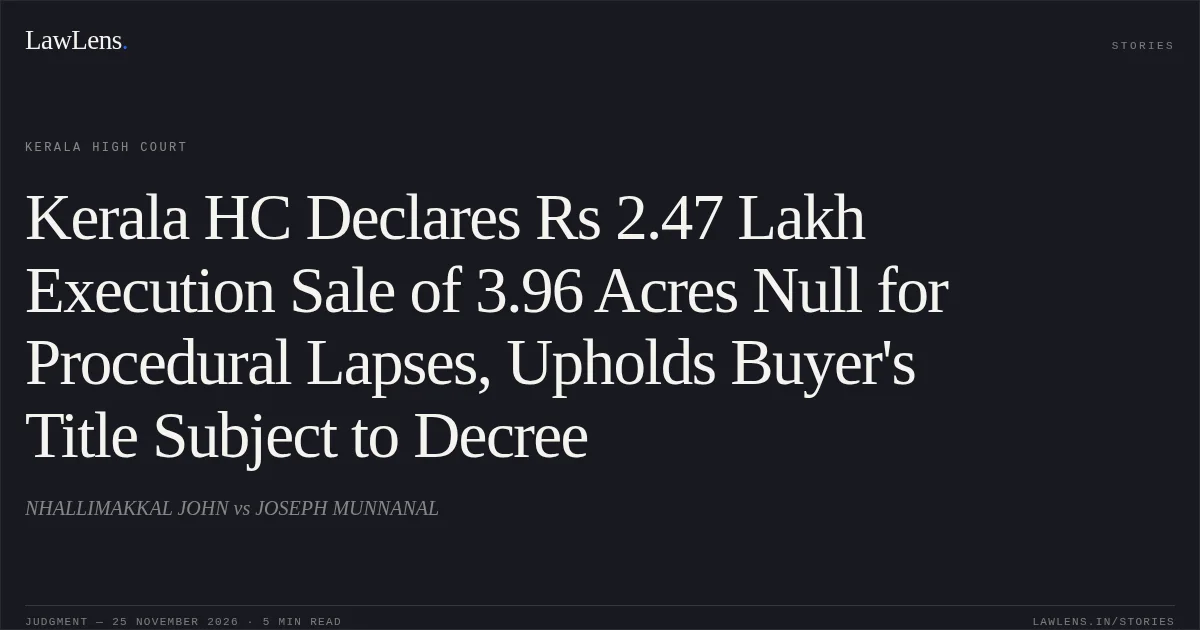
The decree-holder (R1) sued Defendants 1 and 2 in O.S. No. 28/2002 (Sub Court, Payyannur) to recover a ₹2,11,000 advance paid under a sale agreement dated 21.06.2000 for 3.96 acres, with a total consideration of ₹9.75 lakhs.
¶ 2.1The suit and an attachment application were filed on 10.04.2002, and a conditional attachment order was passed on 23.04.2002.
¶ 2.1 · ¶ 16Before the attachment was effected on 29.04.2002, the defendants sold the property to the appellant (a third party) by two registered sale deeds dated 17.04.2002 (Nos. 650 and 651 of 2002).
¶ 2.1 · ¶ 11The decree of 08.10.2002 allowed recovery of ₹2,11,000 with 6% interest but granted no charge over the property.
¶ 2.1In EP No. 85/2003, the appellant was not impleaded, although the sale was reflected in the encumbrance certificate.
¶ 2.2The executing court accepted a draft sale proclamation fixing an upset price of ₹2,47,275, and R1 purchased the 3.96-acre property for ₹2,47,285.
¶ 2.2The appellant's Order XXI Rule 97 application (EA No. 119/2006) was dismissed by the Sub Court, and the District Court affirmed in AS No. 38/2017.
¶ 2.2 · ¶ 3The appellant filed this Execution Second Appeal.
¶ 302Issues
i.1. Whether, once a sale is effected on the basis of an attachment obtained in the suit, the decree-holder can fall back on the statutory charge under Section 55(6)(b), TPA, 1882.
¶ 8(1) · ¶ 18 · ¶ 28–29ii.2. Whether the appellant's sale is affected by the doctrine of lis pendens under Section 52, TPA, 1882, and, if so, whether it is void.
¶ 8(2) · ¶ 13–17iii.3. Whether an attachment before judgment, effected after the defendant has transferred the property, confers any right on the attaching creditor.
¶ 8(3) · ¶ 12iv.4. Whether the appellant's title can be upheld in Rule 97 proceedings although the sale was not challenged under Order XXI Rule 90.
¶ 8(4) · ¶ 10v.5. Whether the sale to the decree-holder is a nullity for non-compliance with Order XXI Rules 64 and 66(2).
¶ 19–23vi.6. Whether the High Court can examine these questions in a second appeal under Section 100, CPC.
¶ 2403Law Applied
Order XXI Rule 97 CPC requires that competing title claims be determined, and Rule 103 provides that the order is deemed a decree.
¶ 10 · ¶ 24Order XXI Rules 54, 64 and 66(2) CPC require the court to apply its mind to the property's value and to sell only so much property as is needed to satisfy the decree, and a non-compliant sale is a nullity.
¶ 19, 23Section 52, TPA, 1882 (the lis pendens doctrine) bars transfers during pending litigation that affect the rights of other parties under any resulting decree, subject to the court's authority; the court followed Savithri Naidu R. v. Cotton Corporation of India Ltd. (SC, 2026) and Annakkili v. Murugan (AIR 2022 Mad 63) on the application of Section 52 to money suits where property is attached.
¶ 13–15Section 55(6)(b), TPA, 1882 creates a statutory charge on property for unpaid purchase money, binding subsequent purchasers with notice.
¶ 18Section 3, TPA, 1882 recognises constructive notice arising from registration.
¶ 25–26Under L.K. Prabhu v. K.T. Mathew (SC, 2025), an attachment takes effect only when effected under Order XXI Rule 54.
¶ 12Shalimar Cinema v. Bhasin Film Corp. (1987) 4 SCC 717, Mahakal Automobiles v. Kishan Swaroop Sharma (2008) 13 SCC 113, and Mariyappa v. Siddappa (2005) 10 SCC 235 hold that Rules 54 and 66 are mandatory.
¶ 20–22Provisions in the judgment · 6 · Linked ones open on LawLens
Transfer of Property Act, 1882 Section 55Section 52Section 100Section 3
Code of Civil Procedure, 1908 Section 100Section 97
04Reasoning
The Rule 97 forum could not set aside the sale, but that did not justify dismissing the appellant's competing title claim.
¶ 10Because the defendants sold on 17.04.2002 and the attachment was effected only on 29.04.2002, the attachment had no legal effect, and the decree-holder acquired no title under the sale certificate.
¶ 11–12Section 52 applied because the suit and attachment application were pending from 10.04.2002, so the appellant's purchase was subject to the decree, but the sale was not void on that account.
¶ 16–17The statutory charge under Section 55(6)(b) did not defeat the appellant's registered title, since the appellant lacked notice and the charge does not invalidate a registered sale.
¶ 18The decree-holder could not rely on the charge to cure a sale that was itself invalid, having elected to proceed by attachment and proclamation.
¶ 28–29The executing court accepted a draft proclamation valued at ₹2,47,275 without independent valuation, despite the agreement valuing the land at ₹9.75 lakhs, and excluded the known subsequent purchaser, contrary to Rules 64 and 66(2) and natural justice.
¶ 19 · ¶ 25–26The decree-holder, being a non-bona fide auction purchaser, was held to a stricter standard.
¶ 23Balancing the equities, the court found that a ₹2.11 lakh debt did not justify transferring 3.96 acres to the decree-holder, while the appellant had offered to pay the full decretal amount with interest.
¶ 30–31The questions of law, including the scope of Section 55(6)(b) and Section 52, fell within Section 100, CPC.
¶ 2405Holding
On Issue 1, the court answered in the negative: once the sale rests on an attachment, the decree-holder cannot fall back on the Section 55(6)(b) charge.
¶ 32(1)On Issue 2, the appellant's sale is subject to the decree under Section 52 but is not a nullity.
¶ 32(2)On Issue 3, the attaching creditor acquired no right because the property had already been transferred before the attachment.
¶ 32(3)On Issue 4, the sale to the decree-holder was a nullity for non-compliance with Rules 64 and 66, so the appellant's title is declared in Rule 97 proceedings.
¶ 32(4)The Execution Second Appeal is allowed. The orders of the Sub Court (10.04.2017) and the District Court (AS No. 38/2017) are set aside, EA No. 119/2006 is allowed, the sale to the decree-holder is declared null and void, and the appellant's title to the decree schedule is declared subject to Section 52, TPA. The appellant must deposit the entire decree debt with interest within one month, failing which the decree-holder may initiate fresh sale steps. No costs.
Conclusion · pp. 26–27Original Court PDF
NHALLIMAKKAL JOHNvsJOSEPH MUNNANAL
Click to open original judgment
Original judgment, available to read, download and summarize on LawLens.in