01Facts
The petitioner was charged under Sections 341 and 323 of the Indian Penal Code in C.C. No. 265/2019 before the Judicial First Class Magistrate, Kalpetta.
p. 3On 22.12.2023 the Magistrate found him guilty but released him after admonition under Section 3 of the Probation of Offenders Act, 1958.
p. 3The victim appealed. On 16.09.2026 the Sessions Court modified the judgment and directed the petitioner to pay ₹25,000 as victim compensation under Section 395(3) of the Bharatiya Nagarik Suraksha Sanhita, 2023 (BNSS), read with Section 5 of the Probation of Offenders Act.
p. 3Direction (e) of the appellate judgment described this sum as a "fine amount" to be deposited within six weeks, failing which the jurisdictional court would initiate recovery.
pp. 3–4The petitioner, a U.D. Clerk in the Education Department, contended that the "fine" label could prejudice his service. He relied on Mahadevanna v. State of Karnataka [2026 KLT OnLine 4191] and Unnikrishnan v. State of Kerala (Crl.Rev.Pet. No. 245/2010, dated 19.01.2010).
pp. 4–5The Senior Public Prosecutor opposed the submission.
¶ 302Issues
i.1. Whether the ₹25,000 directed by the appellate court, described as a "fine amount," is in substance compensation, and whether the misnomer must be corrected.
¶ 4 · pp. 5–7ii.2. Whether Section 395(3) BNSS can be invoked where the admonition under Section 3 of the Probation of Offenders Act has been imposed "instead of sentence" and no sentence exists.
¶ 4 · pp. 5–6iii.3. Whether the admonition coupled with the compensation direction disqualifies the petitioner from government service.
¶ 4 · p. 703Law Applied
Section 395(3) BNSS permits compensation to a person who suffered loss by the offence "by way of compensation" where the court imposes a sentence that does not include a fine.
pp. 5–6Section 3 of the Probation of Offenders Act, 1958, under which admonition is given "instead of sentence."
p. 6Section 5(1)(a) of the Probation of Offenders Act, which uses the expression "such compensation."
pp. 6–7Section 5(2) of the Probation of Offenders Act permits recovery of such compensation as a fine under Sections 386 and 387 of the Code, but this does not alter its character.
p. 4 · p. 7Section 12 of the Probation of Offenders Act bars disqualification from service arising from probation-based dispositions.
p. 7The Court relied on Mahadevanna v. State of Karnataka and Unnikrishnan v. State of Kerala. The order does not expressly set out the propositions those two decisions laid down.
p. 7Provisions in the judgment · 6 · Linked ones open on LawLens
Indian Penal Code, 1860 Section 341Section 323
Probation of Offenders Act, 1958 Section 3Section 5Section 12
Bharatiya Nagarik Suraksha Sanhita, 2023 Section 395
04Reasoning
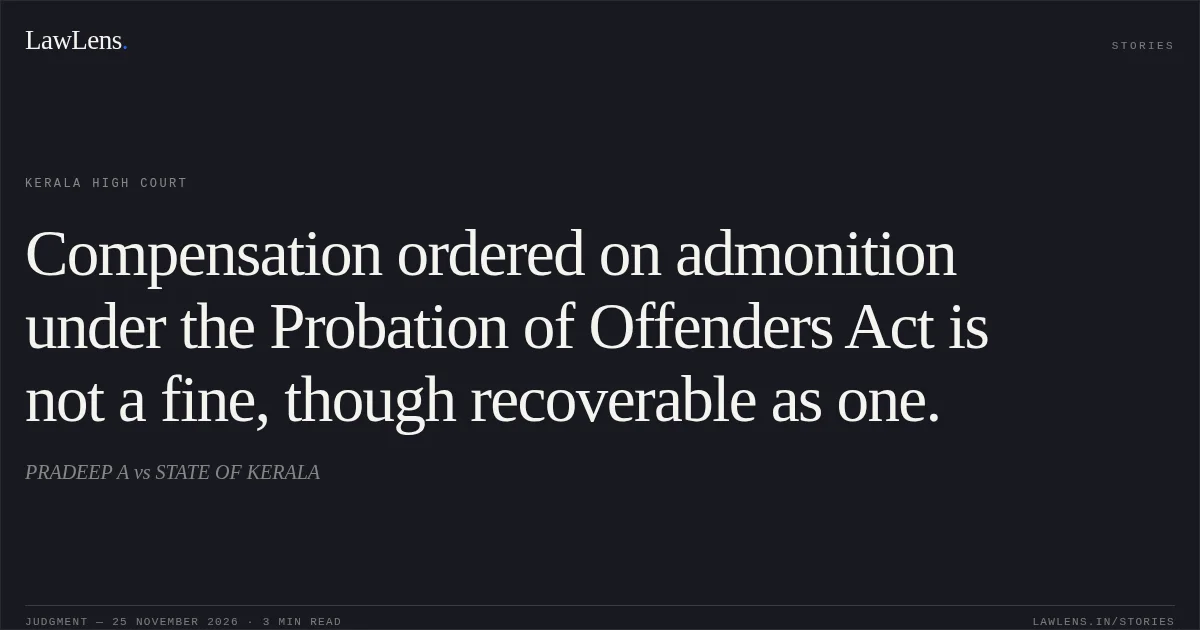
The Court held that the appellate directions made clear that the amount was compensation, not a fine.
¶ 4The Court doubted whether Section 395(3) BNSS was properly invoked, since the Section 3 admonition is given instead of sentence and no sentence was imposed. Section 5 of the Probation of Offenders Act alone was the appropriate source of power.
¶ 4 · p. 6The Court then held that the character of the payment would be compensation under either provision. Section 5(2) only provides a mode of recovery; it does not convert compensation into a fine, and "there cannot be any fine, except accompanied by a sentence."
p. 7The phrase "fine amount" in direction (e) of paragraph 19 was therefore a misnomer.
p. 7Because the admonition is not a sentence and compensation is not a fine, the disqualification argument failed. Relying on Mahadevanna, Unnikrishnan, and Section 12, the Court held that the admonition with a compensation direction carries no service disqualification.
¶ 4 · p. 705Holding
The Court held that the amount of ₹25,000 is compensation and not a fine, and that the admonition coupled with the compensation direction does not disqualify the petitioner from service.
¶ 4 · p. 7The Revision Petition is allowed. The phrase "fine amount shall be deposited" in direction (e) of paragraph 19 of the appellate judgment is modified to read "compensation shall be deposited." The petitioner is to remit ₹25,000 within one week. Any non-bailable warrant issued against him is held in abeyance for ten days.
¶ 4–5 · pp. 7–8Original Court PDF
PRADEEP AvsSTATE OF KERALA
Click to open original judgment
Original judgment, available to read, download and summarize on LawLens.in