01Facts
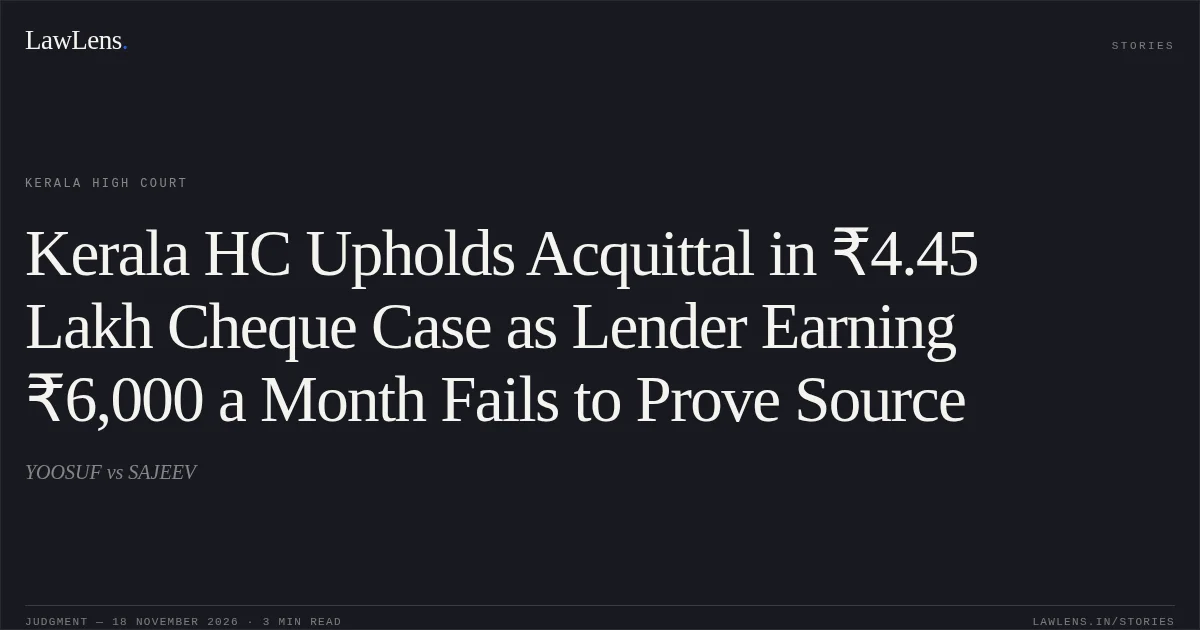
The complainant, Yoosuf, filed a complaint under Section 138 of the Negotiable Instruments Act, 1881 (NI Act) against the accused, Sajeev, alleging that the accused borrowed ₹4,45,000 on 15.08.2005 and issued Ext. P1 cheque dated 17.10.2005 in discharge of that debt
¶ 9The cheque was dishonoured for want of funds, a legal notice was issued, and the accused did not pay
¶ 4, 9The Judicial First Class Magistrate Court-II, Attingal, took cognizance and tried the case in summary procedure in S.T. No. 4646/2005
The complainant examined himself as PW1 and tendered Exts. P1–P6. The defence examined DW1 and DW2 and marked Ext. X1, the marriage register of the complainant's daughter, dated 23.06.2005
¶ 5, 9, 10PW1 admitted that he ran a stationery-cum-tea shop with a daily turnover of about ₹2,000 and monthly income of about ₹6,000. He also admitted borrowing small sums (₹5,000 and ₹10,000) from various persons after his daughter's marriage, part of which remained outstanding. He further stated that he sold 20 sovereigns of gold to fund the younger daughter's wedding
¶ 9, 10PW1 also deposed, under cross-examination, that he did not have sufficient funds to lend the amount
¶ 6The Magistrate acquitted the accused on 30.04.2010, holding that PW1 lacked the means to advance ₹4,45,000 and had therefore failed to prove the transaction and the execution of Ext. P1
¶ 6The complainant appealed under Section 378(4) Cr.P.C.
¶ 102Issues
i.1. Whether the learned Magistrate erred in holding that the accused did not commit the offence punishable under Section 138 of the NI Act.
¶ 8(i)ii.2. Whether the acquittal verdict warrants interference in appeal.
¶ 8(ii)iii.3. What order should be passed.
¶ 8(iii)03Law Applied
The court's reasoning rests on Section 138 of the NI Act, which penalises dishonour of a cheque issued in discharge of a legally enforceable debt
¶ 4The complainant relied on the presumptions under Sections 118 and 139 of the NI Act, which operate in favour of the holder of a cheque
¶ 7The court applied the principle that where the accused disputes the complainant's source of funds to advance the cheque amount, the complainant must give convincing, acceptable evidence of that source; if the evidence on source is improbable and not digestible to prudence, the complainant has not discharged the initial burden of proving the transaction underlying the cheque
¶ 10The judgment cites no precedent by name
Provisions in the judgment · 4 · Linked ones open on LawLens
Code of Criminal Procedure, 1973 Section 378
Negotiable Instruments Act, 1881 Section 138Section 118Section 139
04Reasoning
The court examined whether PW1 had the financial capacity to lend ₹4,45,000 on 15.08.2005. It weighed PW1's modest income from the shop, his admitted reliance on small borrowings, the gold sold for his daughter's marriage on 23.06.2005, and his own admission that he lacked sufficient funds
¶ 6, 9, 10Against this record, the court held that the source of the loan was improbable, particularly given that the sum was large in comparison to his means and was advanced only weeks after heavy marriage expenses
¶ 10, 11Because the complainant failed to establish the transaction, the court held that the presumptions under Sections 118 and 139 could not be validly invoked to fill the gap. The Magistrate's finding that the complainant failed to prove the transaction and Ext. P1's execution was therefore upheld as correct
¶ 11The judgment does not separately analyse rebuttal of the statutory presumptions, and it rests the outcome on the failure of the initial burden
05Holding
The High Court held that the Magistrate correctly found the complainant had no sufficient source to advance ₹4,45,000 and had failed to prove the transaction underlying Ext. P1
¶ 11The acquittal did not require interference
¶ 11The appeal is dismissed and the judgment of acquittal dated 30.04.2010 in S.T. No. 4646/2005 is affirmed
¶ 11Original Court PDF
YOOSUFvsSAJEEV
Click to open original judgment
Original judgment, available to read, download and summarize on LawLens.in