01Facts
The petitioner-wife, who was the opposite party in C.P. No. 1136 of 2024, sought transfer of the husband’s proceeding under Section 9 of the Hindu Marriage Act, 1955, from the Family Court-II, Bhubaneswar to the Family Court-I, Bhubaneswar, where her divorce proceeding, C.P. No. 391 of 2025 under Section 13(1)(ia) of the Act, was pending.
pp. 2-p.3 · ¶ 2, 4-5She claimed to be deserted, without independent income, dependent on her parents, and residing at her parental home.
pp. 2-p.3 · ¶ 4She further contended that separate trials would create a risk of conflicting decisions, cause multiplicity of proceedings, and impose additional legal and travel expenses.
pp. 3-p.4 · ¶ 5Although notice was served, the opposite party remained unrepresented; the Court therefore heard and disposed of the petition at the admission stage.
pp. 1-p.2 · ¶ 1Both Family Courts were situated in the same Judicial Complex, Bhubaneswar.
pp. 1-p.2 · ¶ 1 · p. 6 · ¶ 1002Issues
i.1. Whether the matrimonial proceedings pending between the parties should be tried together before one Family Court to avoid multiplicity of proceedings and conflicting decisions.
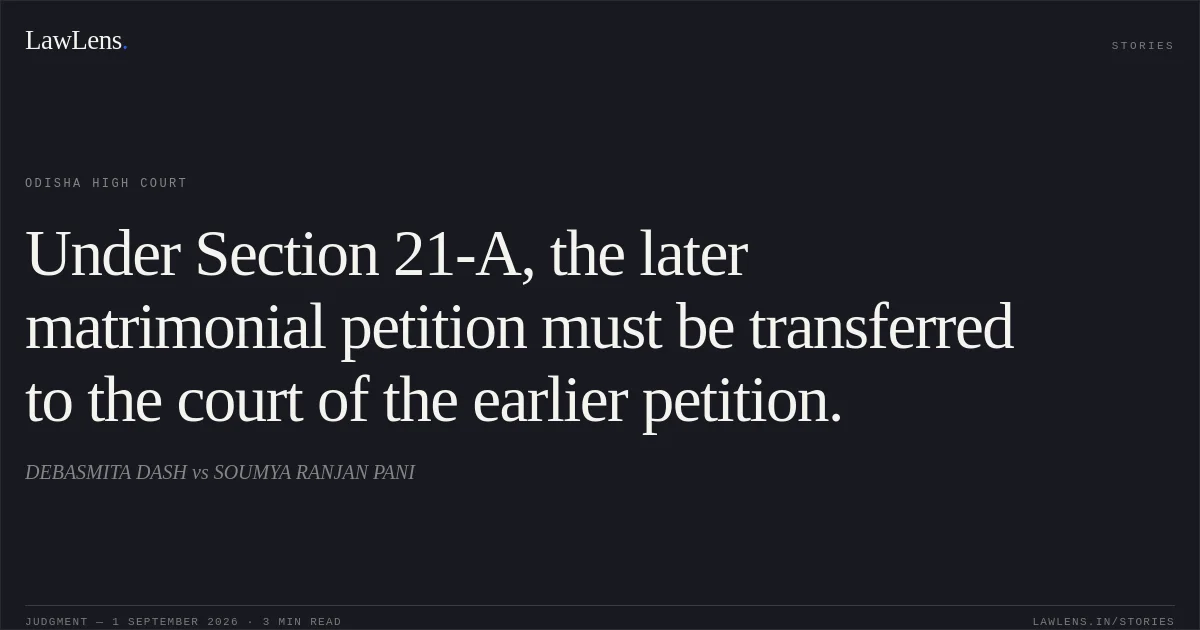
pp. 4-p.6 · ¶ 6-9ii.2. Whether, having regard to the chronological order of institution under Section 21-A(2)(b) of the Hindu Marriage Act, 1955, C.P. No. 391 of 2025 should be transferred to Family Court-II, Bhubaneswar, where the earlier proceeding, C.P. No. 1136 of 2024, was instituted.
p. 6 · ¶ 1003Law Applied
The Court applied Section 21-A of the Hindu Marriage Act, 1955, under which connected matrimonial petitions are to be heard together; where petitions are pending before different District Courts, the later petition is to be transferred to the District Court where the earlier petition was instituted.
pp. 4-p.5 · ¶ 6The Court also relied on the principle that proceedings between the same parties involving common questions of fact and law, and interdependent decisions, should ordinarily be tried together to prevent multiplicity of proceedings and conflicting judgments.
pp. 5-p.6 · ¶ 7-8This principle was supported by N.C.V. Aishwarya v. A.S. Saravana Karthik Sha, 2022 SCC OnLine SC 1199.
pp. 5-p.6 · ¶ 8Provisions in the judgment · 3 · Linked ones open on LawLens
Hindu Marriage Act, 1955 Section 9Section 10Section 13
04Reasoning
The Court found that C.P. No. 1136 of 2024 and C.P. No. 391 of 2025 were matrimonial proceedings between the same parties and that their adjudication could involve overlapping facts and issues.
pp. 2-p.4 · ¶ 2, 4-5Joint trial was therefore considered appropriate to avoid inconsistent findings, duplicated evidence, and unnecessary expense to the petitioner-wife, particularly because both proceedings were pending at Bhubaneswar.
pp. 3-p.4 · ¶ 5 · p. 6 · ¶ 9-10However, the Court did not transfer the earlier proceeding as requested.
p. 6 · ¶ 10Applying the chronological-transfer principle in Section 21-A(2)(b), it held that the later proceeding, C.P. No. 391 of 2025, should be transferred to Family Court-II, where C.P. No. 1136 of 2024 had been instituted first; this would not materially inconvenience the petitioner since both Courts were located in the same Judicial Complex.
p. 6 · ¶ 1005Holding
The transfer petition was allowed in substance.
p. 6 · ¶ 11The Family Court-I, Bhubaneswar was directed to transmit the record of C.P. No. 391 of 2025 to Family Court-II, Bhubaneswar, preferably within one week of production of the certified judgment.
p. 6 · ¶ 11Family Court-II was directed to re-register the proceeding, if necessary, and try both cases together in accordance with law after providing due opportunity to both parties.
pp. 6-p.7 · ¶ 12The Court permitted the parties to seek appearance through video conferencing where appropriate, while requiring physical presence for effective hearings such as examination and cross-examination if ordered.
p. 7 · ¶ 13The parties were directed to ascertain the posting dates, avoid unnecessary adjournments, and cooperate for expeditious disposal.
pp. 7-p.8 · ¶ 14-15The transfer petition was accordingly disposed of, interim orders, if any, were vacated, and copies of the judgment were directed to be communicated to both Family Courts.
p. 8 · ¶ 16-18Original Court PDF
DEBASMITA DASHvsSOUMYA RANJAN PANI
Click to open original judgment
Original judgment, available to read, download and summarize on LawLens.in