Facts
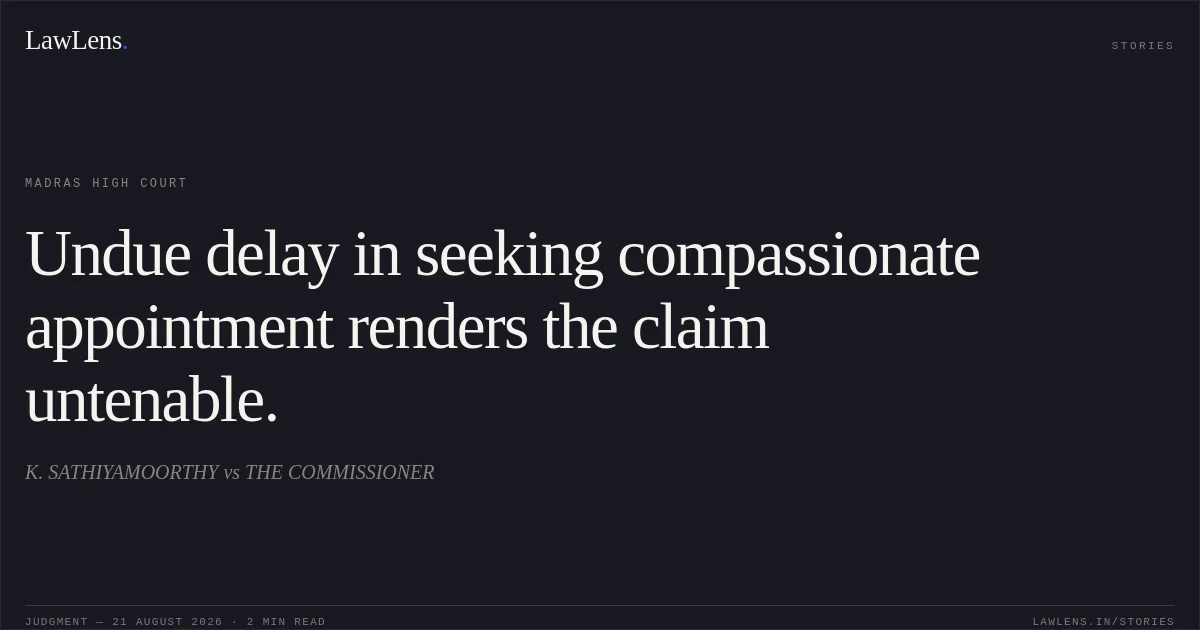
The appellant, who was the son of the deceased Chennai Corporation employee through his second wife, challenged the dismissal of his writ petition by order dated 01.08.2024 in W.P. No. 21960 of 2024.
Source reference: p.1The employee died on 02.01.2011. He had married K. Egavalli as his first wife, and three children were born from that marriage; the appellant was born through the second wife.
Source reference: p.2The appellant obtained and submitted a legal-heir certificate and applied for compassionate appointment only in 2022, approximately eleven years after the employee’s death.
Source reference: p.2The certificate indicated that five children had been born to the deceased employee before the appellant, none of whom had applied for compassionate appointment during the relevant period.
Source reference: p.2The appellant contended that, being approximately 29 years old when he applied, his claim ought to have been considered.
Source reference: p.2Issues
Whether an application for compassionate appointment submitted approximately eleven years after the employee’s death is maintainable merely because the applicant had attained the requisite age when the application was made.
Source reference: pp.2–3Whether the appellant was entitled to compassionate appointment as a legal heir of the deceased employee despite the substantial delay and the absence of proof that the family remained in financial distress.
Source reference: pp.2–3Law Applied
Compassionate appointment is an exceptional and concessional measure intended to mitigate the immediate financial hardship caused by the sudden death of a government employee; it is not a method of providing employment to every legal heir of the deceased employee.
Source reference: p.2A substantial delay in submitting the application may support a factual inference that the family was not in penurious circumstances, and an application made beyond a reasonable period is not maintainable even where the applicant subsequently satisfies the age requirement.
Source reference: pp.2–3Since compassionate appointment operates as an exception to the equality guarantees under Articles 14 and 16 of the Constitution of India, the governing scheme must be applied strictly in accordance with its prescribed terms and conditions.
Source reference: p.3Reasoning
The Court held that the appellant’s application, made in 2022—eleven years after the employee’s death—was inconsistent with the object of compassionate appointment, which is to address the immediate crisis caused by the employee’s death.
Source reference: pp.2–3The appellant’s age at the time of application did not cure the foundational defect of delay.
Source reference: pp.2–3The prolonged interval permitted the inference that the deceased employee’s family was not continuing in a state of penury requiring urgent employment assistance.
Source reference: pp.2–3The fact that other children had not applied during the relevant period also did not create an independent right in favour of the appellant.
Source reference: p.3Applying the strict nature of the scheme and its constitutional exception under Articles 14 and 16, the Court found no error in the Writ Court’s refusal to grant relief.
Source reference: p.3Holding
The Division Bench answered the issues against the appellant and held that the delayed application for compassionate appointment was not maintainable.
It declined to interfere with the order dated 01.08.2024 dismissing W.P. No. 21960 of 2024 and dismissed W.A. No. 448 of 2025 without costs.
Source reference: p.3Original Court PDF
K. SATHIYAMOORTHYvsTHE COMMISSIONER
Click to open original judgment
Original judgment, available to read, download and summarize on LawLens.in