Facts
The respondents were employed as Matrons in Government Backward Classes School Girls’ Hostels at Kollengode and Kuzhithurai.
Source reference: p.3They were issued charge memos dated 12.03.2013 alleging that, on 07.02.2011, they had paid Rs.1,500 and Rs.1,000 respectively to Ganapathy, a Hostel Warden, in violation of Rule 20(1) of the Tamil Nadu Government Servants’ Conduct Rules.
Source reference: p.3The respondents denied the allegations, but the District Collector found the charges proved and imposed the penalty of removal from service on 07.01.2014.
Source reference: p.3Their appeals were rejected on 17.12.2014.
Source reference: pp.3–4The learned Single Judge set aside both orders, holding, inter alia, that the enquiry lacked supporting evidence, the appellate authority had not properly considered the respondents’ contentions, and there was discriminatory treatment when compared with Ganapathy, who had received only compulsory retirement for the same occurrence.
Source reference: pp.4–5The State preferred the present writ appeals.
Source reference: p.2The Division Bench noted that the respondents were subordinates of Ganapathy and that no reasons had been given for imposing a harsher punishment on them.
Source reference: pp.7–8Issues
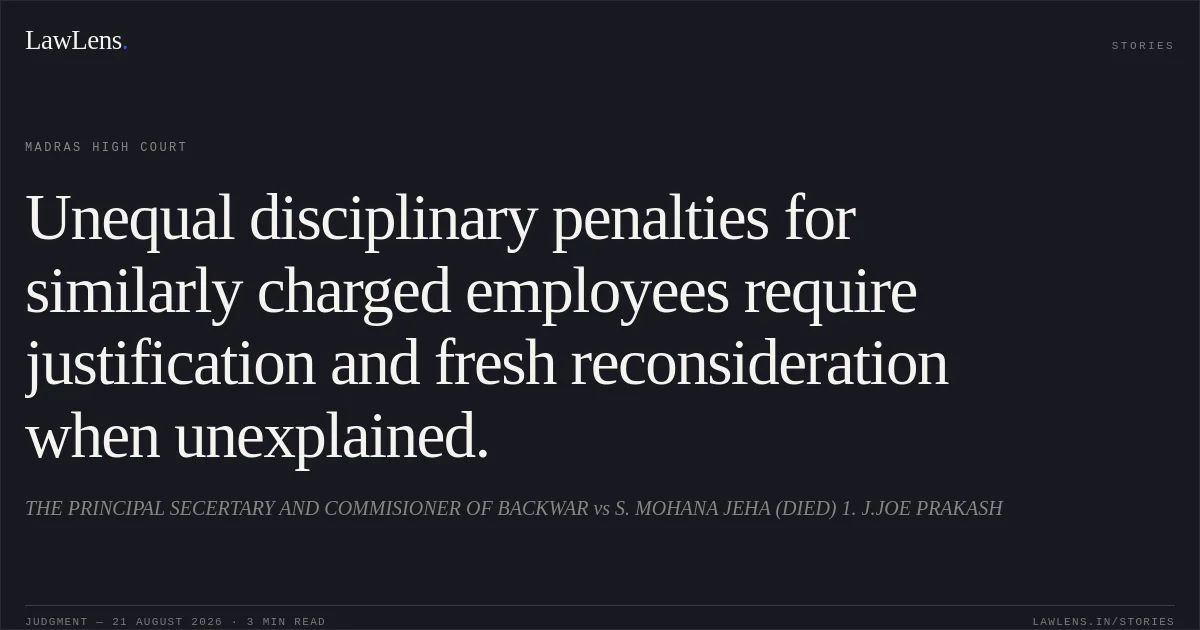
Whether the orders imposing removal from service and rejecting the respondents’ appeals were sustainable when the disciplinary authority imposed a harsher penalty on the respondents than on Ganapathy for the same or similar misconduct, without recording reasons for the disparity.
Source reference: paras. 10, 12; pp.8–9Whether the respondents could be granted complete exoneration despite the Division Bench’s conclusion that the charges against them stood proved.
Source reference: paras. 11, 13; p.8Whether the matter should be remitted to the disciplinary authority for reconsideration of the appropriate punishment after hearing the respondents.
Source reference: para. 14; p.9Law Applied
The Court applied Rule 20(1) of the Government Servants’ Conduct Rules, which prohibits conduct amounting to bribery or otherwise unbecoming of a government servant.
Source reference: p.3It further applied the administrative-law principle that similarly situated employees involved in the same misconduct should not receive materially different punishments without a rational and recorded justification; discriminatory or disproportionate punishment is liable to judicial correction.
Source reference: paras. 10, 12; pp.8–9The Court also recognised the limited scope of judicial review in disciplinary matters: while the Court would not permit an employee to escape proved misconduct, the disciplinary authority must reconsider the quantum of punishment fairly and after providing an opportunity of hearing.
Source reference: paras. 11, 13–14; pp.8–9Reasoning
The Division Bench accepted that the respondents could not be completely exonerated merely because the disciplinary proceedings were procedurally or evidentially defective in certain respects.
Source reference: paras. 11, 13; p.8It therefore disagreed with the Single Judge’s grant of complete relief and held that the charges could not be ignored.
Source reference: paras. 11, 13; p.8However, the Court found a serious disparity in punishment: Ganapathy, the Warden and superior officer involved in the same occurrence, had been awarded compulsory retirement, whereas the respondents had been removed from service.
Source reference: paras. 10, 12; pp.8–9Since the disciplinary authority had furnished no reasons for imposing the harsher penalty on the subordinate employees, the punishment orders could not stand in their existing form.
Source reference: paras. 10, 12; pp.8–9The appropriate course was consequently to set aside the existing punishment and appellate orders and direct a fresh decision on punishment after hearing the respondents and considering the penalty imposed on Ganapathy.
Source reference: para. 14; p.9Holding
The writ appeals were partly allowed by modification of the Single Judge’s order.
The orders dated 07.01.2014 imposing removal from service and dated 17.12.2014 rejecting the appeals were set aside.
Source reference: para. 14; p.9The District Collector was directed to issue fresh notice to the respondents, provide them an opportunity of hearing, and pass fresh orders regarding punishment consistently with the punishment imposed on Ganapathy.
Source reference: para. 14; p.9The exercise was to be completed within twelve weeks from receipt of the judgment.
Source reference: paras. 14–15; p.9The appeals were disposed of without costs, and the connected miscellaneous petitions were closed.
Source reference: paras. 14–15; p.9Original Court PDF
THE PRINCIPAL SECERTARY AND COMMISIONER OF BACKWARvsS. MOHANA JEHA (DIED) 1. J.JOE PRAKASH
Click to open original judgment
Original judgment, available to read, download and summarize on LawLens.in