Facts
The petitioner was engaged as a Time Keeper/daily-wage labourer at the Block Office, Saja.
Source reference: para. 2He claimed to have worked from 5 May 1990 to 6 February 1992 and again from 8 February 1995 to 22 February 1995, after which he was allegedly retrenched without payment of retrenchment compensation despite having completed more than 240 days of service.
Source reference: para. 2He approached the Labour Commissioner, who referred the dispute to the Labour Court under the Industrial Disputes Act.
Source reference: paras. 1–2The Labour Court, in Case No. 13/ I.D. Act/2013, dismissed the reference by order dated 15 October 2014, principally holding that the petitioner had approached the authorities only in 2013, nearly eighteen years after the alleged retrenchment, without satisfactorily explaining the delay.
Source reference: paras. 1–2, 4The petitioner challenged that order under Article 227 of the Constitution, contending that similarly situated employees had been reinstated and granted consequential benefits.
Source reference: para. 2Issues
Whether the Labour Court was justified in rejecting the industrial dispute as stale because the petitioner raised it nearly eighteen years after his alleged retrenchment without explaining the delay?
Source reference: para. 4Whether the Labour Court’s order dated 15 October 2014 suffered from illegality or jurisdictional error warranting interference under Article 227 of the Constitution?
Source reference: paras. 1, 8Whether the alleged reinstatement and grant of benefits to similarly situated employees entitled the petitioner to similar relief despite his unexplained delay?
Source reference: paras. 2, 4Law Applied
The Court applied the principles governing stale industrial disputes under Sections 2(k) and 10 of the Industrial Disputes Act, 1947.
Source reference: paras. 5–6In Nedungadi Bank Ltd. v. K.P. Madhavankutty, (2000) 2 SCC 455, the Supreme Court held that although the Act prescribes no limitation period for making a reference, the power under Section 10 must be exercised reasonably, and a stale dispute that no longer exists cannot be referred.
Source reference: paras. 5–6Relying on Prabhakar v. Joint Director, Sericulture Department, (2015) 15 SCC, the Court reiterated that unexplained delay may establish laches, waiver and acquiescence; a belated dispute is maintainable only if the workman satisfactorily explains the delay and demonstrates that the dispute remains alive.
Source reference: para. 6The Court also relied on A.G. Chandrappagol v. Assistant Executive Engineer, 2003 SCC OnLine Kar 667, which recognises that the Labour Court may reject a reference where prolonged and unexplained delay has rendered the claim stale, particularly where the delay prejudices the determination of facts and availability of evidence.
Source reference: para. 7Judicial review under Article 227 is warranted only where the subordinate court’s order discloses illegality or jurisdictional error.
Source reference: para. 8Reasoning
The Court found that the petitioner’s alleged retrenchment occurred in 1995, whereas he initiated proceedings only in 2013, and that he offered no sufficient explanation for remaining inactive during the intervening period.
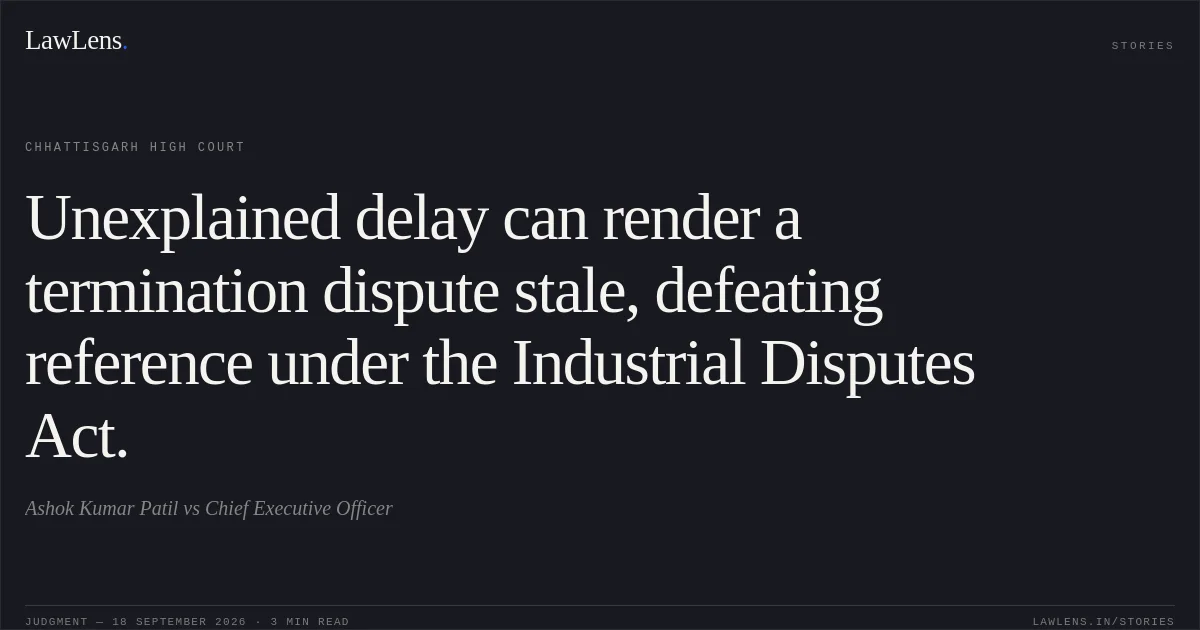
Source reference: para. 4Applying the principles in Nedungadi Bank, Prabhakar, and A.G. Chandrappagol, the Court held that the prolonged and unexplained delay indicated that the dispute had become stale and was no longer an existing industrial dispute.
Source reference: paras. 4, 5–7The petitioner’s reliance on the treatment given to other employees was insufficient because he had not demonstrated that he had continuously challenged his own termination or that circumstances kept the dispute alive.
Source reference: paras. 2, 4Consequently, the Labour Court’s rejection of the reference was neither illegal nor jurisdictionally defective.
Source reference: para. 8Holding
The High Court held that the Labour Court rightly dismissed the reference on the ground that the petitioner had raised the dispute after an unreasonable and unexplained delay, rendering it stale.
The alleged relief granted to similarly situated employees did not overcome the petitioner’s laches or establish a continuing industrial dispute.
Source reference: para. 4Finding no illegality or jurisdictional error in the Labour Court’s order dated 15 October 2014, the Court dismissed the writ petition under Article 227 of the Constitution.
Source reference: paras. 8–9Acts & Sections Cited
3 provisions across 1 statute referred to in this judgment. Linked provisions open on LawLens.
Industrial Disputes Act, 19473
Original Court PDF
Ashok Kumar PatilvsChief Executive Officer
Click to open original judgment
Original judgment, available to read, download and summarize on LawLens.in