Facts
The Appellant was convicted by the Sessions Judge, Karimganj, under Sections 457 and 324 of the IPC for allegedly breaking into the informant's house on 29.09.2000 and causing a bleeding injury by biting her face
Source reference: p. 2The informant (PW1) alleged that the Appellant entered through the southern wall and fled through the northern wall after neighbors were alerted by her screams
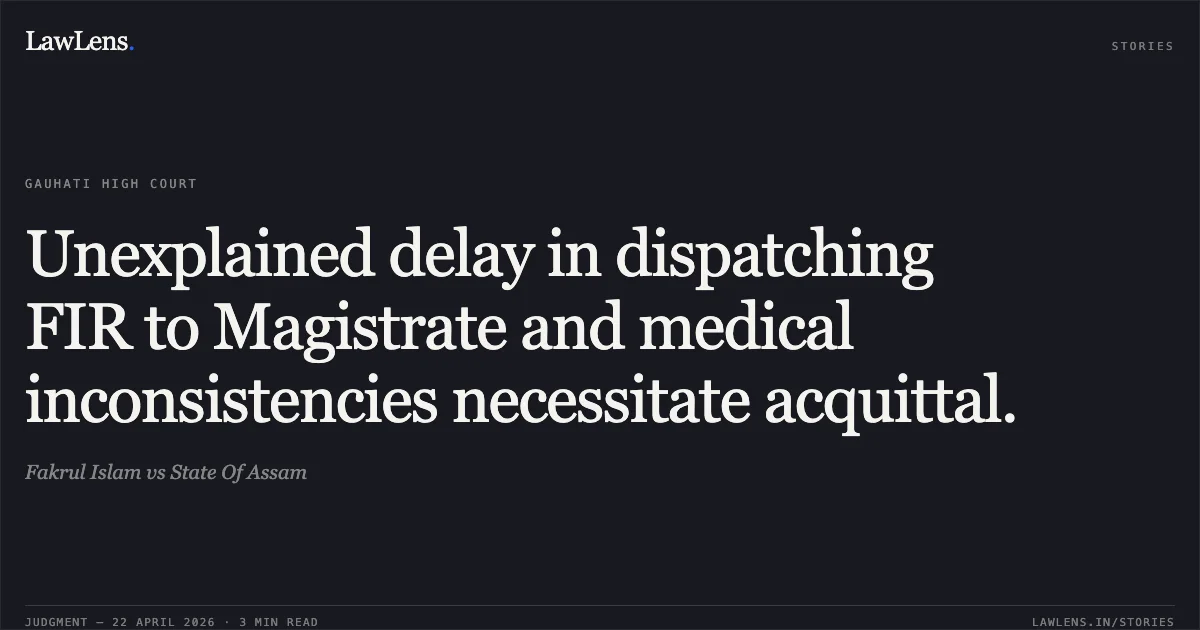
Source reference: p. 2-3Although the incident occurred on 29.09.2000 and a medical examination was conducted on 30.09.2000 via police requisition, the FIR was only registered on 01.10.2000
Source reference: p. 12, 16Furthermore, the FIR was not forwarded to the jurisdictional Magistrate until 16.10.2000, a delay of 16 days
Source reference: p. 4, 16The Appellant pleaded innocence, citing long-standing enmity and prior false litigations initiated by the informant
Source reference: p. 5, 13Issues
1. Whether the unexplained delay in lodging the FIR and the subsequent 16-day delay in forwarding it to the Magistrate, coupled with the absence of a General Diary (GD) entry, vitiated the prosecution's case
Source reference: p. 4-5, 16-172. Whether the material contradictions between the ocular testimony and the medical evidence regarding the site of the injury undermined the credibility of the informant
Source reference: p. 153. Whether the prosecution proved the charges under Sections 457 and 324 IPC beyond a reasonable doubt in light of the admitted enmity between the parties
Source reference: p. 15-16Law Applied
The court primarily applied Section 457 (lurking house-trespass by night) and Section 324 (voluntarily causing hurt by dangerous weapons or means) of the IPC
Source reference: p. 2It relied on the procedural requirements of the CrPC regarding the prompt recording of information and the mandate to forward FIRs to the Magistrate
Source reference: p. 4-5The court heavily relied on the precedent Rajeevan and Others v. State of Kerala (2003) 3 SCC 355, which establishes that FIRs are vital for corroboration and that unexplained delays in lodging or forwarding them to a Magistrate raise suspicions of "coloured versions," "embellishments," or "afterthoughts"
Source reference: p. 17-18Reasoning
The High Court found several "serious doubts" in the prosecution's narrative. First, despite the victim being sent for a medical exam on 30.09.2000, the Investigating Officer (PW5) admitted that no GD entry was made prior to the FIR registration on 01.10.2000
Source reference: p. 12, 16Second, the court noted a critical discrepancy in the medical evidence: while the informant (PW1) testified that she was bitten on her left cheek, the Medical Officer (PW3) and the medical report (Ext. 1) recorded the injury on the right cheek
Source reference: p. 15This contradiction remained unexplained by the prosecution
Source reference: p. 15Third, the court observed that the informant's testimony at trial omitted several details present in her Section 164 CrPC statement, such as the Appellant allegedly kicking her son
Source reference: p. 14Finally, the court determined that the 16-day delay in forwarding the FIR to the Magistrate, without any explanation from the Investigating Officer, was fatal to the case’s integrity, especially given the history of bitter litigation between the parties
Source reference: p. 16, 18Holding
The High Court held that the prosecution failed to prove the case beyond a reasonable doubt due to faulty investigation, delayed FIR procedures, and material contradictions in evidence
The court answered the issues in favor of the Appellant, ruling that the delay in FIR and its dispatch to the Magistrate suggested a "concocted story"
Source reference: p. 18-19The judgment and order dated 30.04.2013 passed by the Sessions Judge, Karimganj, were set aside
Source reference: p. 19The Appellant was acquitted of all charges, and his bail bond was cancelled
Source reference: p. 19Acts & Sections Cited
6 provisions across 2 statutes referred to in this judgment. Each provision opens on LawLens.
Indian Penal Code, 18604
Code of Criminal Procedure, 19732
Original Court PDF
Fakrul IslamvsState Of Assam
Click to open original judgment
Original judgment, available to read, download and summarize on LawLens.in