Facts
Respondent No. 1, a retired Executive Engineer, challenged before the Karnataka State Administrative Tribunal (KSAT) the Government’s order entrusting an enquiry dated 4 September 2017 and the consequential articles of charge dated 9 November 2017.
Source reference: p. 2The KSAT allowed his application on 11 November 2019, setting aside both on the ground of limitation under Rule 214(2)(b)(ii) of the Karnataka Civil Services Rules.
Source reference: p. 2The Karnataka Lokayukta filed this writ petition on 30 May 2023, more than three and a half years after the KSAT’s order.
Source reference: pp. 3–4It attributed the delay to the file having been entrusted to successive special counsel, but did not explain when the file was returned or what follow-up action was taken.
Source reference: pp. 3–4Issues
1. Whether the High Court should entertain the writ petition despite the delay of more than three and a half years in filing it
Source reference: pp. 3–52. Whether the Lokayukta’s explanation for the delay established sufficient cause to warrant the Court’s exercise of its writ jurisdiction
Source reference: p. 4Law Applied
A writ petition under Articles 226 and 227 of the Constitution is not subject to a fixed statutory limitation period, but the High Court may decline to exercise its discretionary jurisdiction where the petitioner approaches after an unreasonable delay without a satisfactory explanation. Delay and laches must be assessed in light of the circumstances of the case; unexplained delay may itself justify refusing relief.
Source reference: pp. 5–11The Court relied on *Mrinmoy Maity v. Chhanda Koley*, 2024 SCC OnLine SC 551, and the principles discussed there, including those in *Tridip Kumar Dingal v. State of W.B.*, (2009) 1 SCC 768, and *Karnataka Power Corporation Ltd. v. K. Thangappan*, (2006) 4 SCC 322.
Source reference: pp. 5–11Reasoning
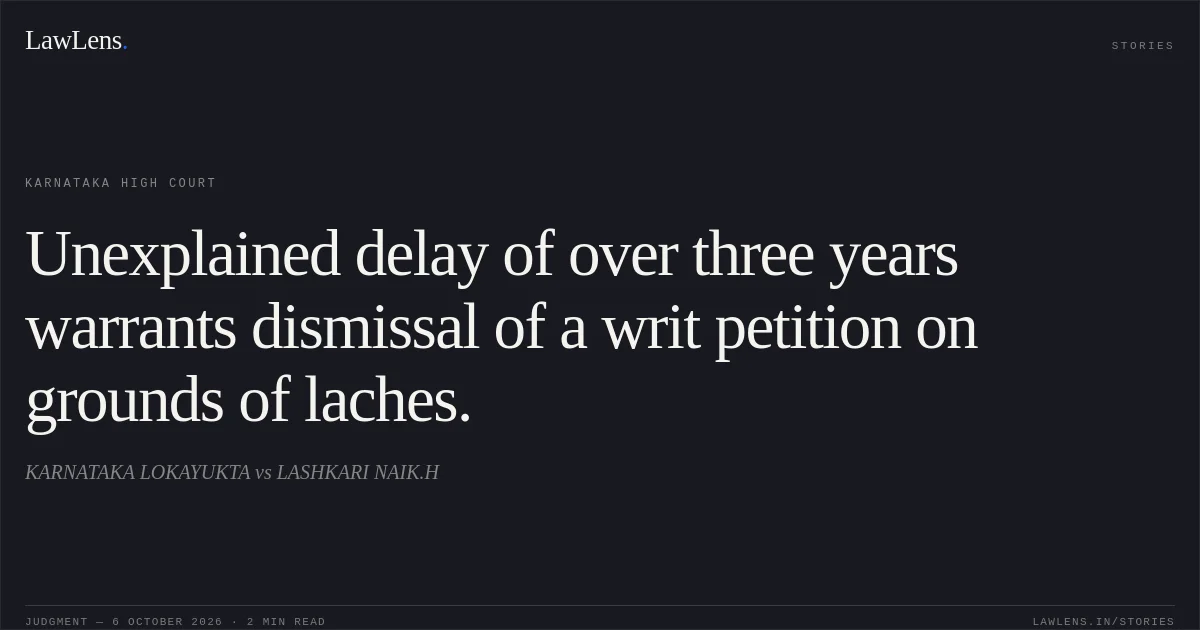
The impugned KSAT order was made on 11 November 2019, but the Lokayukta filed its petition only on 30 May 2023, after more than three and a half years.
Source reference: p. 3The Court found the explanation—that the matter had been assigned to two successive special counsel who did not file the petition—inadequate because the Lokayukta did not state when the files were returned or what steps its officers took thereafter.
Source reference: pp. 3–4In the absence of a satisfactory explanation, the delay was not reasonable, and the Court declined to exercise its discretionary writ jurisdiction.
Source reference: pp. 3, 5It did not examine the merits of the KSAT’s limitation ruling.
Source reference: pp. 3, 5Holding
The High Court rejected the writ petition solely on the ground of delay and laches.
The KSAT’s order setting aside the enquiry-entrustment order and consequential articles of charge was therefore left undisturbed; the High Court made no determination on the merits of the limitation issue under Rule 214(2)(b)(ii) of the Karnataka Civil Services Rules.
Source reference: pp. 2–3, 11Original Court PDF
KARNATAKA LOKAYUKTAvsLASHKARI NAIK.H
Click to open original judgment
Original judgment, available to read, download and summarize on LawLens.in