Facts
The prosecution alleged that A-1 had an illicit relationship with the deceased’s wife, which had led to a prior altercation and threat by A-1 against the deceased.
Source reference: paras. 2.1–2.2On 18.08.2014, while the deceased and prosecution witnesses were allegedly returning from a tea shop, all seven accused waylaid them near Kalkottai hillock.
Source reference: paras. 2.1–2.2The deceased succumbed to his injuries while being taken to hospital, and P.W.1 was treated for a simple head injury.
Source reference: paras. 2.1–2.2The FIR was registered at 4.00 a.m. on 19.08.2014 under Sections 147, 148, 341, 294(b), 302 and 307 IPC.
Source reference: para. 2.3The trial Court convicted the accused under various provisions of the IPC, including Sections 147, 148, 149, 302 and 307, and sentenced them to imprisonment for life for the offences relating to murder and attempt to murder.
Source reference: paras. 1, 3 and 6Issues
Whether the prosecution proved beyond reasonable doubt that the accused formed an unlawful assembly, wrongfully restrained and assaulted the deceased and P.W.1, thereby committing offences under Sections 147, 148, 149, 302 and 307 IPC?
Source reference: para. 10Whether the evidence of the alleged eyewitnesses was reliable despite material inconsistencies, the absence of corroborative evidence regarding the motorcycles and source of light, and the discrepancy between the ocular and medical evidence?
Source reference: paras. 11–13, 17–18Whether the delay in recording the complaint and forwarding the FIR, together with the alleged prior presence of the police at the scene, rendered Ex.P.1 inadmissible or unreliable under Section 162 Cr.P.C.?
Source reference: paras. 15–16Law Applied
The Court applied the prosecution’s burden to establish guilt beyond reasonable doubt in a criminal case and held that an accused is entitled to the benefit of reasonable doubt.
Source reference: paras. 1, 3 and 10It considered Sections 147 and 148 IPC concerning rioting and rioting armed with a deadly weapon, Section 341 IPC concerning wrongful restraint, Section 302 IPC concerning murder, Section 307 IPC concerning attempt to murder, and Sections 34 and 149 IPC concerning constructive or vicarious criminal liability arising from common intention or unlawful assembly.
Source reference: paras. 1, 3 and 10The Court also applied Section 162 Cr.P.C., holding that a statement recorded during investigation cannot be treated as the first information report where the investigation had already commenced.
Source reference: para. 15It further applied the evidentiary principles that material contradictions, unexplained delay in lodging or forwarding the FIR, failure to investigate relevant circumstances, and inconsistencies between ocular and medical evidence may create reasonable doubt; motive is only a relevant circumstance and is a “double-edged weapon,” incapable by itself of proving guilt.
Source reference: paras. 14–18Reasoning
The Court found that the eyewitness accounts contained material inconsistencies regarding which accused restrained or assaulted P.W.1 and the precise roles attributed to the accused.
Source reference: para. 13More significantly, although the witnesses described the attacks in detail, none mentioned any assault on the deceased’s leg, despite the post-mortem evidence showing a comminuted fracture of the underlying bones.
Source reference: paras. 2.4, 12–13The alleged occurrence was said to have been witnessed through motorcycle lights, but the prosecution neither established the presence or particulars of the motorcycles nor seized them; the investigating officer also did not find them at the scene.
Source reference: paras. 11, 13 and 18The Court noted that the accident register relating to the deceased and the evidence of the doctor who first examined him were not produced, leaving unexplained who accompanied him to the hospital.
Source reference: para. 14It further held that the police were allegedly present at the scene when the deceased was taken away, yet P.W.1’s statement was recorded only at 4.00 a.m., and the FIR reached the Court nearly fourteen hours later without satisfactory explanation.
Source reference: paras. 15–16The non-recovery of P.W.1’s alleged bloodstained clothes, the simple nature of his injury, the absence of a corresponding sharp weapon, and the doubtful arrest and recovery evidence further weakened the prosecution case.
Source reference: paras. 16–17In these circumstances, the motive evidence could not cure the defects in the prosecution evidence, and the Court held that the involvement of all the accused had not been proved beyond reasonable doubt.
Source reference: paras. 14 and 18Holding
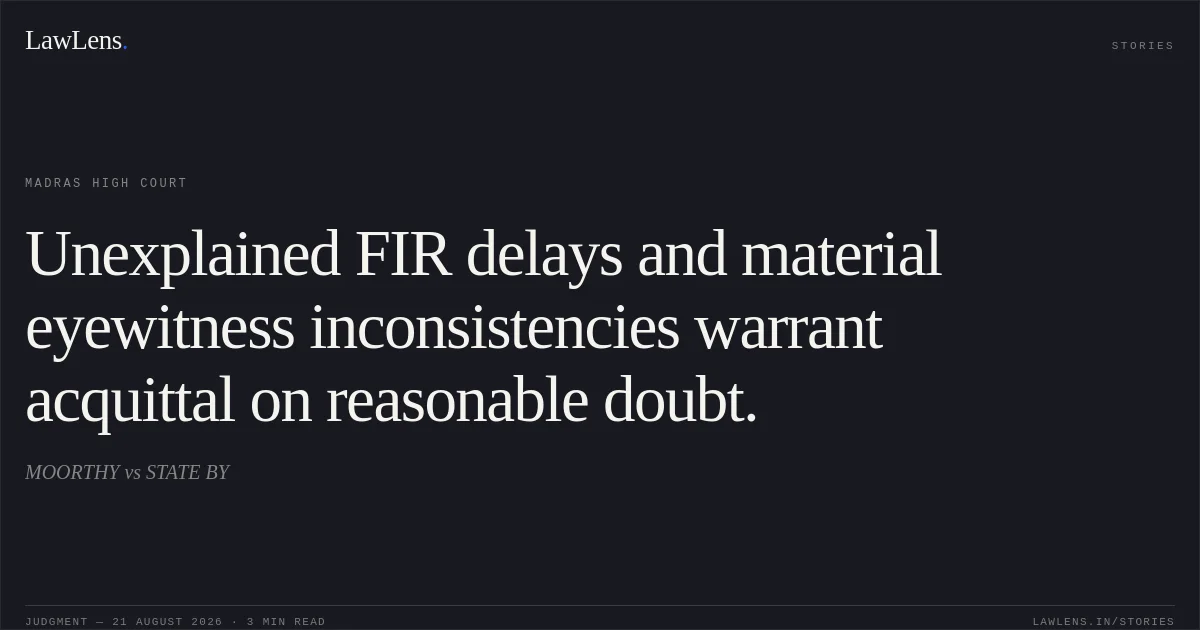
The Court answered the issues in favour of the accused and held that the prosecution failed to establish the charges under Sections 147, 148, 149, 341, 302 and 307 IPC beyond reasonable doubt.
The criminal appeal was allowed, the trial Court’s judgment dated 11.11.2019 in S.C.No.251 of 2016 was set aside, and all seven accused were acquitted.
Source reference: para. 19Any fine paid was directed to be refunded, and the bail bonds were ordered to stand discharged.
Source reference: para. 19Acts & Sections Cited
12 provisions across 2 statutes referred to in this judgment. Each provision opens on LawLens.
Code of Criminal Procedure, 19734
Indian Penal Code, 18608
Original Court PDF
MOORTHYvsSTATE BY
Click to open original judgment
Original judgment, available to read, download and summarize on LawLens.in