Facts
On 29 November 2004, the police claimed to have received information that two persons were carrying charas near Bandariya Tiraha, Jabalpur. A police party apprehended Abdul Rajik and Govind, who were each carrying a bag. The bags allegedly contained substances suspected to be charas, weighing 1 kilogram and 800 grams respectively. Samples were drawn and forwarded to the Forensic Science Laboratory (“FSL”), which reported that the samples were charas.
Source reference: para. 4–7The panch witnesses did not support the prosecution and were declared hostile. The trial court nevertheless convicted Abdul Rajik under Section 8 read with Section 20(b)(ii)(C) of the NDPS Act and Govind under Section 8 read with Section 20(b)(ii)(B), sentencing them to ten years’ and eight years’ rigorous imprisonment respectively. The High Court affirmed the convictions.
Source reference: para. 8–10Before the Supreme Court, the appellants challenged the search and seizure, alleged non-compliance with Sections 42, 50 and 52-A of the NDPS Act, and disputed the integrity of the samples and chain of custody. They alternatively sought reduction of sentence.
Source reference: para. 11–13Issues
Whether Sections 42 and 50 of the NDPS Act applied to the search and seizure of the bags carried by the appellants in an open public place?
Source reference: para. 16Whether the prosecution established an unimpeachable chain of custody and the identity and integrity of the samples forwarded to the FSL?
Source reference: para. 18–30Whether non-compliance with the sampling procedure under Section 52-A of the NDPS Act materially affected the prosecution case?
Source reference: para. 30–34Whether, in the absence of reliable scientific or other admissible evidence, the prosecution proved that the recovered substance was “charas” within Section 2(iii)(a) of the NDPS Act?
Source reference: para. 35–37Law Applied
The Court held that Sections 42 and 50 of the NDPS Act are not attracted where recovery is made from bags carried by accused persons apprehended in an open public place.
Source reference: para. 16Section 52-A provides a statutory safeguard for preparation of inventories, certification and drawing of representative samples before a Magistrate; although every procedural lapse does not automatically vitiate a trial, total non-compliance is relevant when assessing the integrity of the samples and the chain of custody.
Source reference: para. 30–33The prosecution must establish, through credible oral and documentary link evidence, that the samples drawn from the seized contraband were properly sealed, safely stored, duly dispatched and received at the FSL in an untampered condition.
Source reference: para. 30The Court relied on Narcotics Control Bureau v. Kashif, Bharat Aambale v. State of Chhattisgarh, Nadeem Ahamed v. State of West Bengal, and State of Rajasthan v. Tara Singh concerning Section 52-A compliance, sample integrity and unexplained gaps in custody.
Source reference: para. 31–34Unless the substance is proved to be charas within Section 2(iii)(a), the penal provisions of Section 20 cannot be attracted.
Source reference: para. 35Reasoning
The Court found that the seizure officer did not establish that the sample packets bore identifiable signatures, thumb impressions or other marks connecting them to the seized contraband or to either appellant. The samples were also not separately produced or exhibited before the trial court, and the sample panchnamas did not adequately identify or secure the packets.
Source reference: para. 18–22Although the maalkhana register recorded deposit of the samples, it contained no corresponding entry showing their removal for transmission to the FSL. The prosecution also failed to prove that the samples remained sealed and secure while in custody.
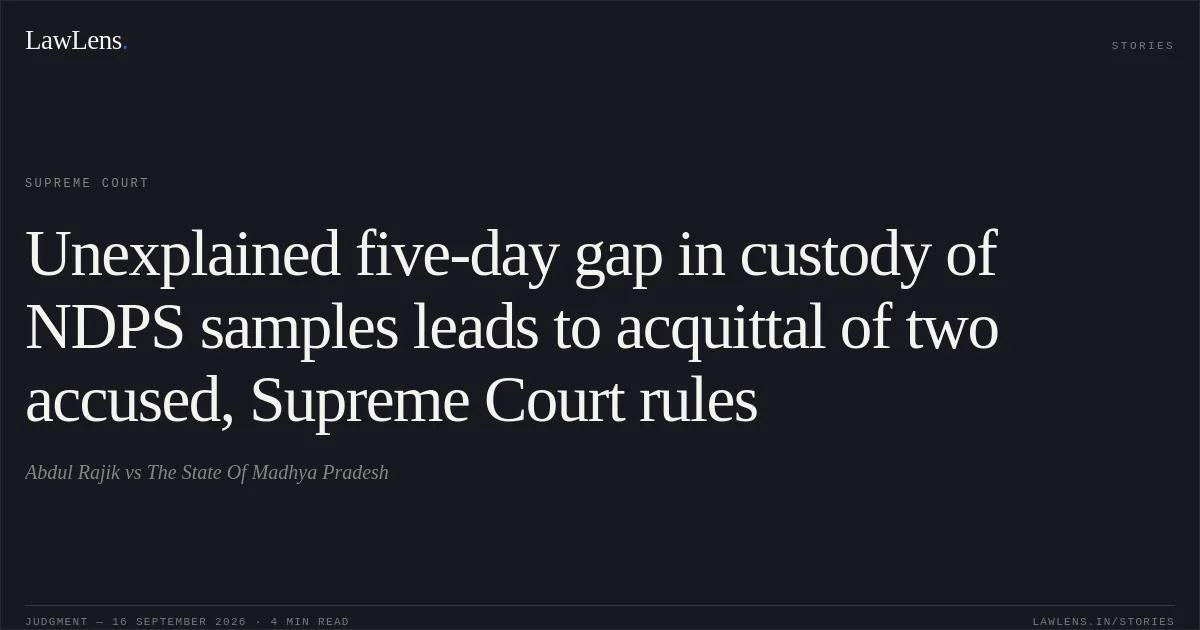
Source reference: para. 23–28Further, the forwarding letter was dated 1 December 2004, whereas the FSL report stated that the samples were received on 6 December 2004. The prosecution neither explained this five-day gap nor examined the carrier constable. This broke the evidentiary link between the alleged seizure and the samples examined by the FSL.
Source reference: para. 28–30The Court also noted total non-compliance with the Section 52-A procedure, including the failure to draw representative samples in the presence of a Magistrate.
Source reference: para. 31–34Once the FSL report was excluded for want of reliable chain-of-custody evidence, no legally admissible evidence remained to prove that the recovered material was charas. The seizure officer’s assertion that the substance was identified by burning a portion of it was unsupported by scientific evidence and could not independently establish its identity.
Source reference: para. 35–36Holding
The Supreme Court held that although Sections 42 and 50 of the NDPS Act did not apply, the prosecution failed to prove the integrity of the samples, the complete chain of custody and the identity of the substance as charas. The FSL report was therefore unsafe to rely upon, and the essential ingredient of the offences under Section 20 of the NDPS Act was not established beyond reasonable doubt.
The convictions and sentences imposed by the trial court and affirmed by the High Court were set aside. Abdul Rajik and Govind were acquitted of all charges, and their bail bonds were discharged; they were not required to surrender.
Source reference: para. 38–40Acts & Sections Cited
7 provisions across 1 statute referred to in this judgment. Each provision opens on LawLens.
Narcotic Drugs and Psychotropic Substances Act, 19857
Original Court PDF
Abdul RajikvsThe State Of Madhya Pradesh
Click to open original judgment
Original judgment, available to read, download and summarize on LawLens.in