Facts
The plaintiffs, including Lovekesh Talwar and Amita Talwar, instituted a suit for declaration and permanent injunction, asserting that various properties had been acquired from joint Hindu family funds and subsequently allotted to individual family members under an oral family settlement dated 01.02.2008, reduced into writing on 05.07.2008.
Source reference: p.2–5Defendants No.1 and 2 substantially admitted the family relationship, joint nature of the properties and the settlement, whereas defendants No.3 and 4 disputed the plaintiffs’ case and alleged that certain monetary obligations arose from the settlement.
Source reference: p.5–6The Trial Court framed several issues and dismissed the suit on 19.03.2013, principally because the plaintiffs failed to lead evidence. Although PW1 tendered his examination-in-chief, he did not appear for cross-examination, and the plaintiffs produced no further evidence despite repeated opportunities.
Source reference: p.7The plaintiffs filed an appeal on 30.04.2018, accompanied by an application under Section 5 of the Limitation Act for condonation of approximately five years’ delay.
Source reference: p.7The First Appellate Court dismissed the appeal on 02.05.2026, holding that no sufficient explanation had been furnished for the delay.
Source reference: p.7–13Issues
Whether the First Appellate Court rightly refused to condone the substantial delay in filing the first appeal under Section 5 of the Limitation Act?
Source reference: p.7–13, 16Whether the appellants had demonstrated sufficient cause warranting interference by the High Court in regular second appeal?
Source reference: p.13–14, 16–17Law Applied
The Court applied Section 5 of the Limitation Act, under which delay may be condoned only upon the applicant establishing “sufficient cause.”
Source reference: no citationIt relied on H. Guruswamy v. A. Krishnaiah, 2025 SCC OnLine SC 54, holding that limitation is not a mere technicality; the length of delay and bona fides of the explanation must be examined, and courts should not begin with the merits of the underlying case.
Source reference: p.8–10The Court also relied on Thirunagalingam v. Lingeswaran, 2025 SCC OnLine SC 1093, which reiterates that delay cannot be condoned as an act of generosity and that sufficient cause must first be established.
Source reference: p.10–11Further, Shivamma (Dead) by LRs v. Karnataka Housing Board, MANU/SC/1262/2025, was cited for the principle that limitation provisions promote finality and prevent lethargic or apathetic litigation.
Source reference: p.11–12Reasoning
The appellants’ explanation was that they delayed filing the appeal because the parties were attempting to implement or settle matters arising from the family settlement, and that defendant No.3 had subsequently resiled from it.
Source reference: p.11–13The Court found this explanation insufficient.
Source reference: p.11–13The plaintiffs had themselves instituted the original suit on the basis of the family settlement, yet failed to pursue it effectively: they did not complete their evidence, their witness did not submit to cross-examination, and the suit was dismissed in 2013.
Source reference: p.6–7They then remained inactive for approximately five years before filing the appeal.
Source reference: p.11–13, 16The alleged meetings or efforts at compromise did not explain the delay on a day-to-day or otherwise reasonable basis and did not establish bona fides or sufficient cause.
Source reference: p.11–13, 16Applying the Supreme Court’s limitation principles, the High Court held that substantial justice could not be invoked to disregard unexplained and prolonged inaction.
Source reference: no citationHolding
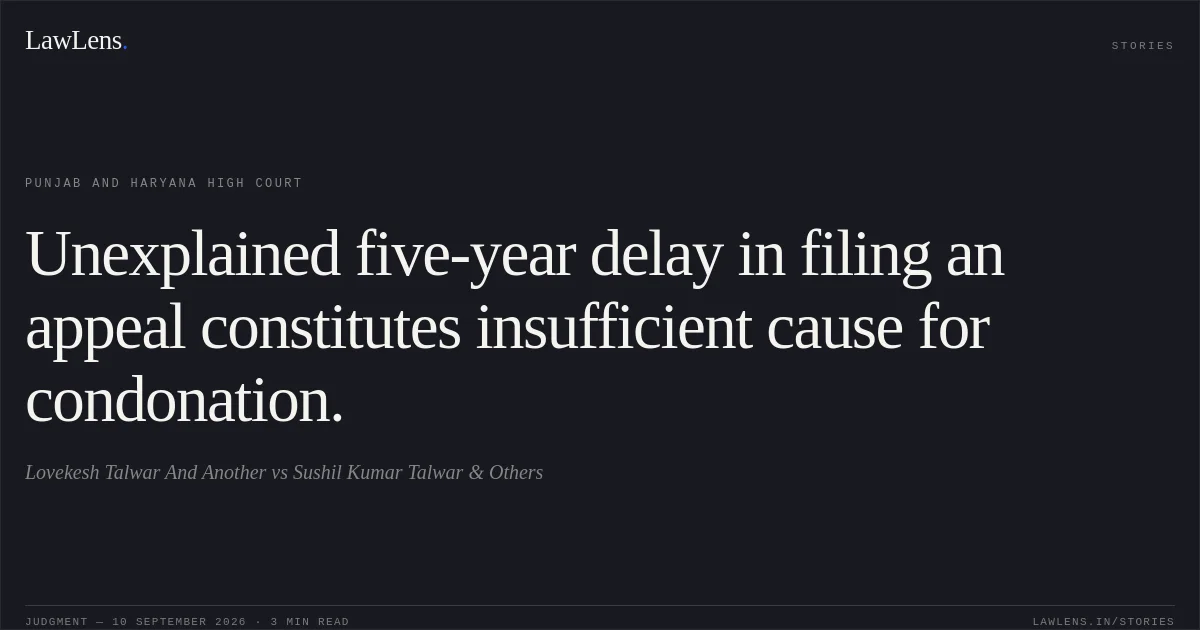
The High Court held that the appellants failed to establish sufficient cause for the delay in filing the first appeal.
The First Appellate Court therefore rightly dismissed the appeal as not maintainable on limitation grounds, and no error warranting interference in regular second appeal was made out.
Source reference: p.16The regular second appeal was dismissed, and all pending applications were ordered to stand closed.
Source reference: p.17Acts & Sections Cited
1 provisions across 1 statute referred to in this judgment. Each provision opens on LawLens.
Limitation Act, 19631
Original Court PDF
Lovekesh Talwar And AnothervsSushil Kumar Talwar & Others
Click to open original judgment
Original judgment, available to read, download and summarize on LawLens.in