Facts
The prosecution alleged that, following a dispute over a proposed marriage, the appellants and others assaulted Dinesh Thakur and persons who came to his aid; Dinesh later died while being taken to hospital.
Source reference: paras. 3–5, pp. 2–3The trial court convicted the appellants under Sections 304/34 and 323/34 IPC, while acquitting them of the other charged offences.
Source reference: para. 2, p. 1On appeal, the appellants challenged the reliability of the prosecution evidence, including its inconsistencies about the occurrence and the unexplained injuries sustained by the accused side in a counter-case.
Source reference: paras. 7–9, pp. 4–6Issues
Whether the prosecution proved beyond reasonable doubt that the appellants participated in the assault causing Dinesh Thakur’s death, with the common intention required for liability under Section 304/34 IPC.
Source reference: paras. 43–44, 49–50, pp. 24–28Whether the evidence established the appellants’ guilt under Section 323/34 IPC despite the evidentiary deficiencies identified on appeal.
Source reference: paras. 22, 25, 49–50, pp. 12–14, 27–28Law Applied
Sections 304/34 and 323/34 IPC were at issue; Section 34 imposes joint liability only where participation and a shared common intention are proved, and cannot substitute for proof of identity or participation.
Source reference: para. 43, p. 24The prosecution bears the burden of proving guilt beyond reasonable doubt, while the accused need only raise a reasonable doubt; weaknesses in the defence cannot repair deficiencies in the prosecution case (*Anand Ramchandra Chougule v. Sidarai Laxman Chougala*, paras. 10–12).
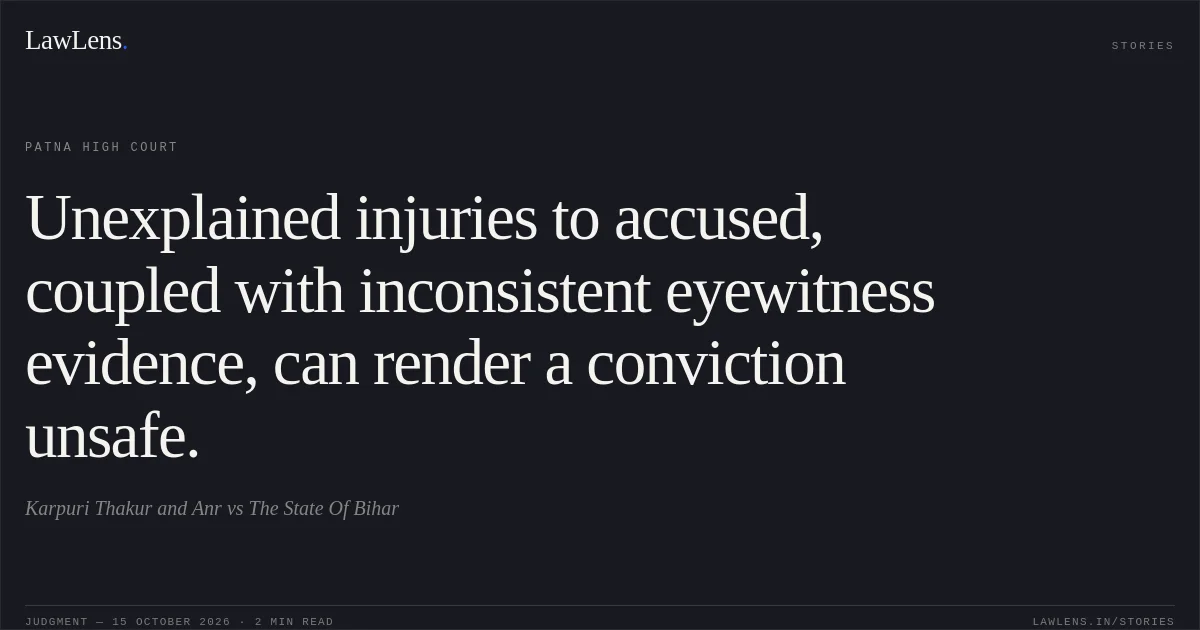
Source reference: paras. 26–27, pp. 14–15Non-explanation of injuries sustained by an accused in the same occurrence may, depending on the circumstances and quality of the evidence, indicate suppression of the occurrence’s genesis and weaken the prosecution case (*Lakshmi Singh v. State of Bihar*; *Parshuram v. State of M.P.*).
Source reference: paras. 28–30, pp. 15–18A hostile witness’s evidence is not wholly erased, and the court must assess the testimony actually on record; the intrinsic reliability of the witnesses, rather than their number, is controlling.
Source reference: paras. 14–15, 33–34, pp. 8–9, 19–20The judgment also relied on the principles that an uncertain place of occurrence, doubtful identification in darkness, and material contradictions may undermine the prosecution case.
Source reference: paras. 31–36, pp. 18–21Reasoning
The Court found that the medical evidence established Dinesh’s death but did not identify his assailants.
Source reference: para. 21, p. 11The informant gave inconsistent accounts of the time and place, stated that it was dark, and said he had not seen the deceased at the place of occurrence; other witnesses were hostile or did not corroborate the prosecution version.
Source reference: paras. 16–19, 31, 35, pp. 9–10, 18–21The counter-case and the Investigating Officer’s evidence that the appellants were injured were not satisfactorily answered, while injury reports for the alleged injured persons were absent.
Source reference: paras. 23–25, pp. 12–14Taken cumulatively, these deficiencies left the occurrence, identification, participation, and common intention uncertain; the Court therefore held that neither conviction could safely stand.
Source reference: paras. 49–58, pp. 27–31Holding
The Court held that the prosecution had not proved the appellants’ guilt beyond reasonable doubt under Sections 304/34 or 323/34 IPC and allowed the appeal.
It set aside the convictions and sentences for those offences and acquitted both appellants by extending the benefit of doubt; their trial-court acquittals on the remaining charges were left undisturbed, and their bail bonds and sureties were discharged.
Source reference: paras. 62–65, pp. 32–33Acts & Sections Cited
7 provisions across 2 statutes referred to in this judgment. Each provision opens on LawLens.
Indian Penal Code, 18606
Code of Criminal Procedure, 19731
Original Court PDF
Karpuri Thakur and AnrvsThe State Of Bihar
Click to open original judgment
Original judgment, available to read, download and summarize on LawLens.in