Facts
The petitioner sought directions to the authorities, particularly respondent no. 3, to determine and disburse compensation for her land.
Source reference: para. 2She pleaded that the land had been requisitioned on 21 December 1948 under Section 3(1) of Act II of 1948, but that she had no knowledge of any subsequent acquisition under Section 4 of that Act.
Source reference: para. 2The State admitted that no acquisition proceeding had ultimately taken place, although a revised estimate of ₹30,86,915 had been prepared and no final award was declared because the requiring body had not provided funds.
Source reference: para. 7The petitioner contended that, after the expiry of Act II of 1948 on 31 March 1997, the State’s occupation became wrongful from 1 April 1997 and that compensation or damages were consequently payable.
Source reference: paras. 3, 6Issues
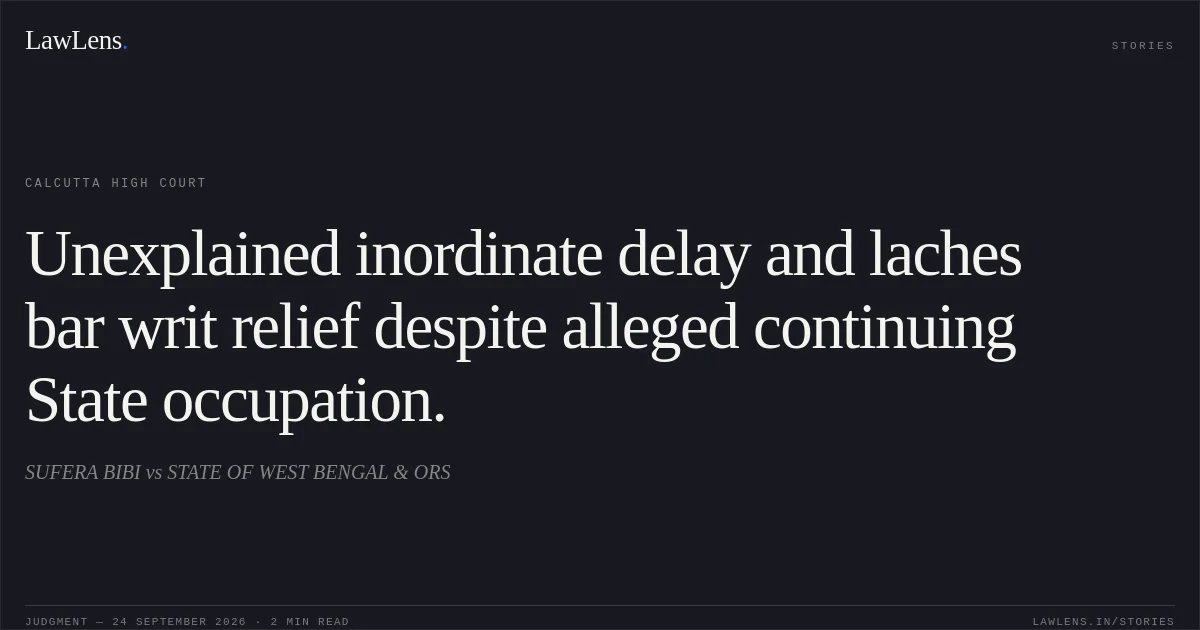
Whether the writ petition was liable to be rejected on the ground of unexplained delay and laches, despite the petitioner’s contention that the State’s occupation constituted a continuing breach or continuing tort.
Source reference: paras. 12, 17–20Whether the petitioner was entitled to directions for initiation or completion of acquisition proceedings and payment of compensation or damages for the alleged occupation of the land after 1 April 1997.
Source reference: paras. 1, 3–6, 21Law Applied
Although no statutory limitation period ordinarily governs the filing of a writ petition, unexplained and inordinate delay may justify refusal to exercise discretionary writ jurisdiction.
Source reference: para. 19Section 22 of the Limitation Act, 1963, which concerns continuing breaches of contract and continuing torts, did not apply to the present matter.
Source reference: para. 18Relying on University of Delhi v. Union of India, (2020) 13 SCC 745, the Court held that a party seeking indulgence despite substantial delay must show sufficient cause; routine or absent explanations are inadequate, and the adverse consequences of reviving stale claims must also be considered.
Source reference: para. 15It also followed Amar Kumar Das v. State of West Bengal, WPA 7392 of 2025, where unexplained delay in a decades-old requisition/acquisition matter led to dismissal of the writ petition.
Source reference: paras. 13–16Reasoning
The Court found that the petitioner’s own case was that the State’s alleged unauthorised occupation commenced on 1 April 1997, yet the writ petition was filed only in 2015.
Source reference: para. 17The pleadings contained no explanation for the petitioner’s inaction between 1 April 1997 and 31 December 2013, or for the delay thereafter.
Source reference: paras. 17–20The Court rejected the argument that the coming into force of the 2013 Act on 1 January 2014 supplied a sufficient explanation for the delay, observing that the petitioner had still failed to account for the preceding period.
Source reference: para. 18Section 22 of the Limitation Act was held inapplicable because the dispute was neither a continuing breach of contract nor a continuing tort.
Source reference: para. 18In view of the absence of any pleaded sufficient cause and the resulting delay and laches, the Court declined to examine the merits of the petitioner’s claims concerning acquisition, compensation, or damages.
Source reference: para. 21Holding
The Court held that the writ petition could not be entertained because of unexplained and inordinate delay and laches.
It therefore dismissed WPA 7400 of 2015 without adjudicating the merits of the petitioner’s entitlement to compensation or damages.
Source reference: paras. 21–22No order was made as to costs.
Source reference: para. 23Acts & Sections Cited
2 provisions across 2 statutes referred to in this judgment. Each provision opens on LawLens.
Right to Fair Compensation and Transparency in Land Acquisition, Rehabilitation and Resettlement Act, 20131
Limitation Act, 19631
Original Court PDF
SUFERA BIBIvsSTATE OF WEST BENGAL & ORS
Click to open original judgment
Original judgment, available to read, download and summarize on LawLens.in