Facts
The respondent was convicted by the Sessions Court under Section 302 IPC for the strangulation deaths of her stepmother and minor stepbrother, whose bodies were found in the stepmother’s locked house on 7 September 2011.
Source reference: para. 2–12, 28The prosecution relied on last-seen evidence, taxi and hotel witnesses, recovery of keys and the deceased’s mobile phone, a thumb injury, DNA evidence linking the respondent’s blood to a stain in the house, and alleged motive concerning property.
Source reference: para. 2–12, 28The High Court set aside the conviction and acquitted the respondent, finding the evidence insufficient; the State appealed.
Source reference: para. 13–18Issues
Whether the High Court’s acquittal involved a legally unsustainable or perverse assessment of the evidence warranting interference in an appeal against acquittal.
Source reference: para. 21–25Whether the prosecution proved beyond reasonable doubt a complete chain of circumstantial evidence establishing that the respondent committed the murders.
Source reference: para. 26–29Law Applied
An appellate court may review the evidence in an appeal against acquittal, but ordinarily should not interfere where the acquittal represents a reasonably possible view; interference is justified where material evidence has been rejected on unsustainable grounds or the judgment is perverse.
Source reference: para. 22–25; State of Rajasthan v. Shera Ram Alias Vishnu Dutta, (2012) 1 SCC 602; State of M.P. v. Bacchudas, (2007) 9 SCC 135; Rajesh Prasad v. State of Bihar, (2022) 3 SCC 471In a case resting on circumstantial evidence, each circumstance must be fully established, consistent only with guilt, and collectively form a complete chain excluding every reasonable hypothesis of innocence.
Source reference: para. 27; Hanumant v. State of Madhya Pradesh, (1952) 2 SCC 71; Sharad Birdhichand Sarda v. State of Maharashtra, (1984) 4 SCC 116The charge and trial conviction were under Section 302 IPC; the respondent’s account of incriminating circumstances was considered in her statement under Section 313 CrPC.
Source reference: para. 10, 12Reasoning
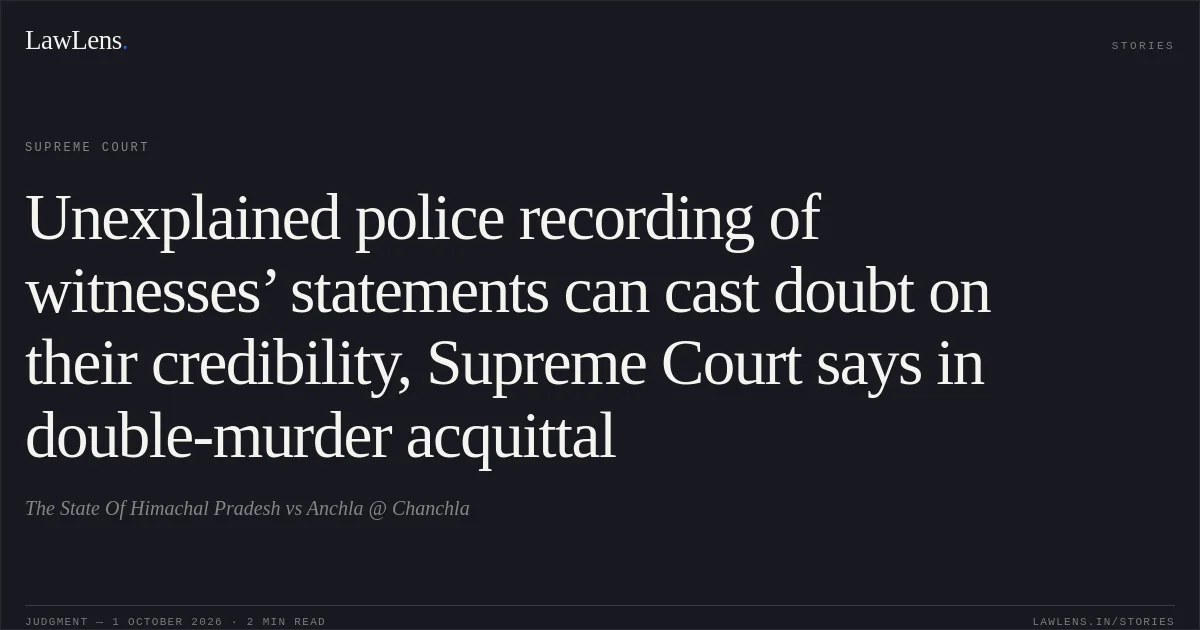
The Court found that the last-seen account was not safely established: PW-1’s evidence contained an improvement, while the taxi driver and hotel worker were not trustworthy, including because the investigation did not explain why or when their statements were recorded and hotel records were absent.
Source reference: para. 32–50, 55–57The uncertain time of death and failure to obtain mobile tower locations further weakened the prosecution’s account.
Source reference: para. 31, 51–56The prosecution did not reliably connect the lock produced in court to the lock on the house door, making the alleged key recovery inconsequential; the recovery of the deceased’s mobile was also doubtful, with its CDR and location evidence missing.
Source reference: para. 58–68The DNA match established, at most, that the respondent’s blood was present in the house at some point, not that she was there at the time of the murders, particularly as she had previously visited the house.
Source reference: para. 69–79The thumb injury did not establish guilt, and the alleged property motive was unsupported by proof of a bequest.
Source reference: para. 80–82Taken together, the circumstances did not exclude reasonable hypotheses consistent with innocence.
Source reference: para. 83Holding
The Court held that the prosecution had not proved the charge beyond reasonable doubt or established a complete circumstantial chain identifying the respondent as the perpetrator.
It found no basis to interfere with the High Court’s acquittal and dismissed the State’s appeal; pending applications were disposed of.
Source reference: para. 83–85Acts & Sections Cited
3 provisions across 2 statutes referred to in this judgment. Each provision opens on LawLens.
Indian Penal Code, 18601
Code of Criminal Procedure, 19732
Original Court PDF
The State Of Himachal PradeshvsAnchla @ Chanchla
Click to open original judgment
Original judgment, available to read, download and summarize on LawLens.in