Facts
The State of Haryana acquired approximately 68.69 acres of land situated in several villages in District Yamuna Nagar for construction of a ditch drain.
Source reference: para. 1; paras. 4–5Notifications under Sections 4 and 6 of the Land Acquisition Act, 1894 were issued on 15 May 2007 and 26 June 2007, respectively.
Source reference: para. 1; paras. 4–5The Land Acquisition Collector assessed the market value at ₹8,00,000 per acre by award dated 10 October 2007.
Source reference: para. 1; paras. 4–5On references under Section 18, the Reference Court enhanced the market value to ₹16,46,000 per acre, relying principally on sale deed Ex. P-7 dated 28 April 2006 and applying a 25% deduction for the superior location of the exemplar land near the National Highway.
Source reference: paras. 7, 14–15The landowners appealed seeking further enhancement, while the State filed appeals seeking restoration of the Collector’s valuation.
Source reference: paras. 2–3Issues
Whether the market value of the acquired land should be enhanced beyond ₹16,46,000 per acre determined by the Reference Court, considering the relevant sale exemplars, location, potentiality, and escalation in land prices?
Source reference: paras. 8–12, 14–23Whether a uniform market value should be fixed for land situated in all the acquired villages, notwithstanding the State’s contention that the villages had differing locational advantages?
Source reference: paras. 18, 21–24Whether the landowners were entitled to the statutory benefits under the Land Acquisition Act, 1894 on the enhanced market value?
Source reference: paras. 1, 24Law Applied
The Court applied Sections 4, 6, 18 and 54 of the Land Acquisition Act, 1894, governing acquisition, references to the civil court, and appeals against the Reference Court’s award.
Source reference: paras. 1, 4–5Market value is to be determined on the basis of relevant and comparable sale exemplars, while taking into account the acquired land’s location, potentiality, development prospects, and appropriate deductions for advantageous features of the exemplar land.
Source reference: no citationThe Court recognised the doctrine of potentiality and the use of reasonable judicial estimation or “guesstimation” where direct evidence does not provide a complete valuation, relying on New Okhla Industrial Development Authority v. Harnand Singh (Deceased) through LRs, 2024 SCC OnLine SC 1691.
Source reference: para. 20It also applied the principle that escalation in land prices may be granted where there is a time gap between the exemplar sale and the notification under Section 4.
Source reference: para. 23On uniform valuation, the Court relied on HSIIDC v. Pran Sukh, 2010 (11) SCC 175, and Ali Mohammad Beigh v. State of J&K, 2017 (4) SCC 717, which recognise that similarly situated lands acquired under a common notification for a common purpose may receive a uniform rate unless compelling reasons justify differentiation.
Source reference: para. 22The Court also considered the principle in Lal Chand v. Union of India, (2009) 15 SCC 769, regarding consideration of sale deeds produced by the State, and distinguished the objection based on Manoj Kumar v. State of Haryana, 2018 (13) SCC 96, concerning reliance on previous awards.
Source reference: para. 11Reasoning
The Court found that the acquired land possessed substantial development potential: it was situated near a canal and metalled road, was classified as good-quality Chahi land, and lay in an area containing numerous manufacturing units and a major sugar mill.
Source reference: paras. 18–19Sale deed Ex. P-1 dated 7 November 2006 concerning land in Village Chhota Bans reflected a rate of ₹39,10,112 per acre, despite the applicable Collector rate being only ₹5,00,000 per acre; the Court held that this genuine and proximate transaction could not be ignored.
Source reference: paras. 17–19It further observed that the Reference Court had failed to account for 12% annual escalation between the April 2006 sale deed and the May 2007 notification, which would raise the value reflected in Ex. P-7 to approximately ₹18,43,520 per acre.
Source reference: para. 23Although the State relied on lower-valued sale deeds and argued that different villages had different locational advantages, the Court noted that the acquisition was linear, concerned contiguous villages, was made through one notification for the same public purpose, and involved broadly similar land characteristics.
Source reference: paras. 14, 18, 21–23Balancing the high-value exemplar, the lower-value transactions, location-based deductions, escalation, and the need to avoid unjustified discrimination among landowners, the Court considered ₹20,00,000 per acre to be a fair and reasonable uniform valuation.
Source reference: paras. 20, 22–24Holding
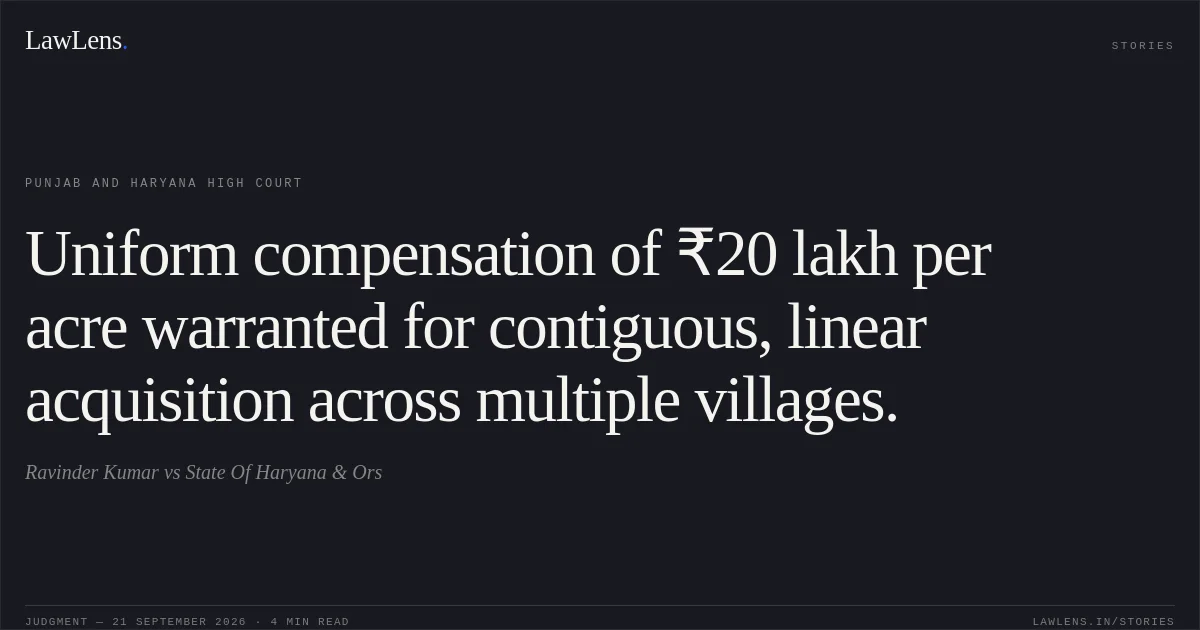
The High Court enhanced the market value of the acquired land in all the concerned villages to a uniform rate of ₹20,00,000 per acre, irrespective of the particular village or location within the acquired area.
The landowners’ appeals and cross-objections were allowed to that extent, while the State’s appeals and cross-objections were dismissed.
Source reference: paras. 24–25The landowners were also held entitled to the statutory benefits available under the Land Acquisition Act, 1894.
Source reference: paras. 24–25Any delay in filing the appeals was condoned, but the landowners were denied interest for the period attributable to the delay.
Source reference: para. 13Acts & Sections Cited
4 provisions across 1 statute referred to in this judgment. Linked provisions open on LawLens.
Land Acquisition Act, 18944
Original Court PDF
Ravinder KumarvsState Of Haryana & Ors
Click to open original judgment
Original judgment, available to read, download and summarize on LawLens.in