Facts
This batch of petitions involves teaching and non-teaching staff of Dayanand Adarsh Vidyalaya, a recognized private school.
Source reference: p.3, para 1The Petitioners sought arrears for the 7th Central Pay Commission and other service/retiral dues.
Source reference: p.4, para 2The school management stopped paying salaries and ceased all educational activities on 1st April, 2020, citing financial unviability and falling student strength.
Source reference: p.4, para 3Although the school had requested closure from the Directorate of Education (DoE) on 17th July, 2019, no formal approval was granted.
Source reference: p.4, para 3The school argued that since it was no longer functional and lacked assets, liability could not be extended to the parent society or management.
Source reference: p.4-5, para 3-5Conversely, the Petitioners contended that the school remained legally existent and that liability should vest in the controlling bodies, namely Arya Samaj (Tilak Nagar) and Delhi Arya Pratinidhi Sabha.
Source reference: p.7, para 9Issues
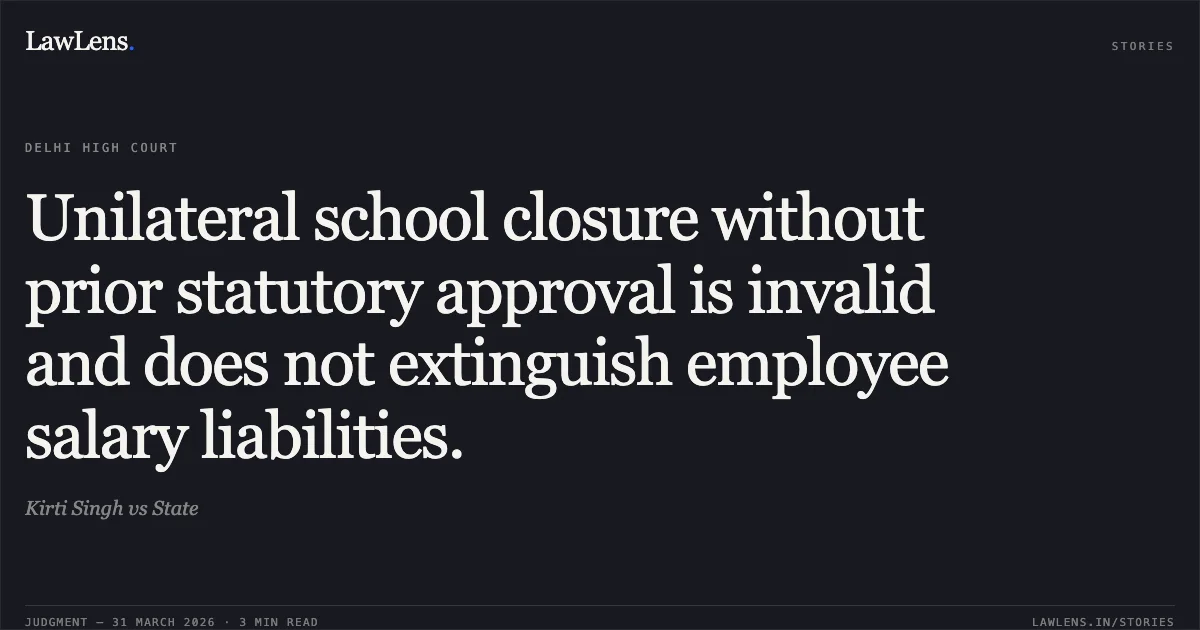
1. Whether a recognized school can be treated as closed in law merely by a unilateral stoppage of functioning by the management without prior approval from the Directorate of Education.
Source reference: p.5, para 4; p.10, para 152. Whether the Petitioners are entitled to be treated as continuing in service after 1st April, 2020, with a corresponding right to salary and service dues.
Source reference: p.10, para 153. Whether liability for the school’s dues can be extended to the parent society, managing committee, or affiliating body.
Source reference: p.10, para 15Law Applied
The Court applied Section 3 of the Delhi School Education Act (DSEA), which mandates that the closing of classes is subject to statutory rules.
Source reference: p.12, para 19Rule 46 of the DSEA Rules was central, establishing that no managing committee can close a recognized school without "full justification" and "prior approval" of the Director.
Source reference: p.12, para 20The Court relied on Manju Tomar & Ors. v. NCT [2009 SCC OnLine Del 4036] and the Supreme Court’s affirmation in NDMC & Anr. v. Manju Tomar & Ors. [2024 SCC OnLine SC 2272], which held that closure without prior permission is illegal and management cannot shift salary burdens due to their own wrongful conduct.
Source reference: p.13, para 22Furthermore, Section 10 of the DSEA ensures parity of pay scales, and Section 20 allows for the takeover of management regardless of building ownership.
Source reference: p.14, para 26; p.15, para 27Reasoning
The Court reasoned that "closure in fact" (physical shutdown) does not equate to "closure in law".
Source reference: p.15, para 25Under Rule 46, the insistence on prior approval is mandatory to protect the interests of students and staff; thus, a management cannot present a fait accompli to escape statutory obligations.
Source reference: p.12, para 20The Court rejected the school's reliance on Rule 55 (lapse of recognition), noting that an unlawful act triggering a lapse does not legitimize the cessation of employment rights.
Source reference: p.12, para 21Regarding liability, the Court found that while a school might maintain separate accounts, it is not an insulated shell; the DSEA requires a shared enterprise under a society or trust.
Source reference: p.16-17, para 30-31Applying the "real and effective control" test, the Court determined that liability anchors to the entity that actually managed the funds and took the illegal decision to stop the school.
Source reference: p.19, para 35However, due to an inconclusive record regarding which specific body (Arya Samaj or Delhi Arya Pratinidhi Sabha) held effective control, the Court delegated this factual determination to the DoE.
Source reference: p.19-20, para 37-40Holding
The Court held that the school was not lawfully closed and remained liable for all salary and service dues post-April 2020.
the DoE must determine within 8 weeks which entity (Respondent Nos. 2, 6, or 7) exercised effective control and is thus jointly and severally liable.
Source reference: p.21, para 43a nominated officer shall compute Petitioner-specific dues including 7th CPC arrears, gratuity, and leave encashment.
Source reference: p.22-23, para 45.5-45.7arrears shall carry 6% simple interest, increasing to 9% upon default.
Source reference: p.23-24, para 45.7/45.11the DoE must decide on the formal closure application within 10 weeks, ensuring all employee dues are secured before granting approval.
Source reference: p.25, para 45.13The contempt petition was disposed of as the relief was subsumed by the writ directions.
Source reference: p.21, para 44Acts & Sections Cited
5 provisions across 1 statute referred to in this judgment. Each provision opens on LawLens.
Delhi School Education Act, 19735
Original Court PDF
Kirti SinghvsState
Click to open original judgment
Original judgment, available to read, download and summarize on LawLens.in